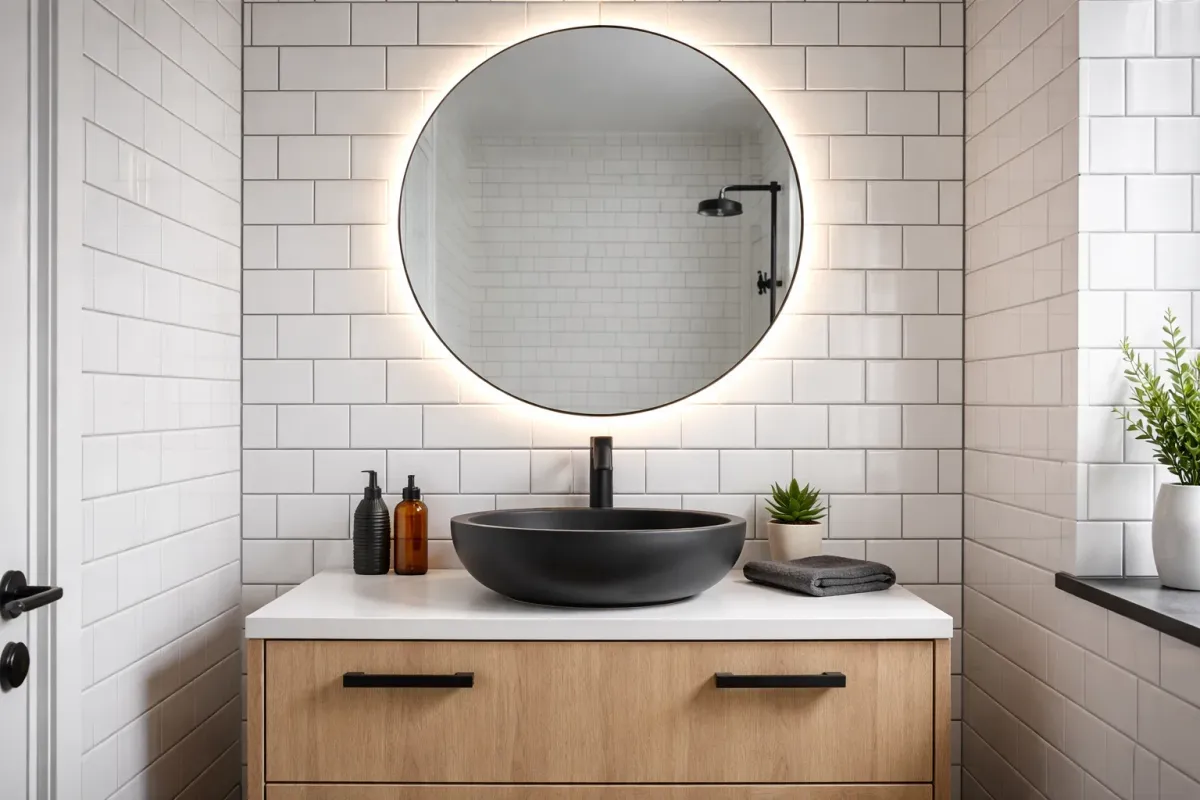

Tile, Grout & Adhesive Calculator UK | How Many Tiles Do I Need?
Work out how many bathroom tiles you need, how much grout to buy, and how much adhesive to order before placing your order. Enter your room dimensions, choose your tile size and laying pattern, and this free tiles, grout and adhesive calculator returns the total number of tiles, boxes to order, grout weight, and adhesive bags — including an offcut allowance for your pattern and room shape. The tiling calculator works for walls, floors, or both, covering everything from a compact shower room to a large family bathroom.
Every bathroom is different. If you have an unusual room shape, pipework that needs boxing in, or you are using larger format tiles and want to achieve symmetry across the walls, you will likely need more offcuts than a standard calculation allows. In those cases, Builders Squad Ltd can confirm the exact tile quantity during a free site survey — getting it right before ordering saves time, money, and the risk of running short mid-project.
Calculate Your Tiles
How to Calculate Tiles Needed for Your Bathroom

The calculator runs a straightforward area-based formula to work out how many tiles you need, adjusted for the tiling pattern you select and the shape of your room.
Wall area — to measure a wall for tiling, multiply the wall length by the tiling height you choose: full height (floor to ceiling), half height (1.2 m dado rail level), three-quarter height (1.8 m), or a custom measurement. For rectangular rooms, entering the room length and width automatically works out all four walls. For L-shaped or irregular bathrooms, you enter each wall individually.
Floor area — to calculate how many floor tiles you need, the calculator uses the same room dimensions for rectangular layouts (length × width). For L-shaped rooms, the floor area is computed automatically from the six wall lengths you enter. For irregular rooms, enter your total floor area manually. Standard deductions apply for windows (approximately 0.8 m² each) and doors (approximately 1.6 m² each). The calculator then adds an offcut percentage based on your chosen pattern — straight grid cuts waste the least, while herringbone and chevron generate noticeably more offcuts from the angled cuts involved.
The result gives you the net tiling area, the wastage allowance, the total tiles needed, and the number of boxes to order based on your packaging quantity. The built-in tiles and grout calculator then works out how much grout you need in kilograms and the number of bags to buy — based on your tile size, grout gap width, and joint depth. The tile adhesive calculator automatically estimates the adhesive needed based on surface type (wall or floor) and tile format, with higher coverage rates for large-format tiles that require back-buttering.
Offcut Allowances by Pattern
Every tiling pattern produces a different amount of waste because of how the cuts fall at walls, corners, and edges. The table below shows the base allowance this calculator uses for each pattern, plus the shape adjustment for non-rectangular rooms:
| Pattern | Base Offcut % | L-Shape Rooms | Irregular Rooms |
|---|---|---|---|
| Straight lay (grid) | 13% | 16% | 18% |
| Brick bond (offset) | 13% | 16% | 18% |
| Herringbone | 23% | 26% | 28% |
| Diagonal (45°) | 18% | 21% | 23% |
| Chevron | 23% | 26% | 28% |
Straight lay is the most economical pattern for material usage. Brick bond and herringbone are popular in UK bathrooms but generate more cuts at every wall edge. Chevron — where each tile is cut at an angle rather than laid as a full rectangle — produces the highest waste and takes the longest to install.
If your room has alcoves, boxed-in pipework, or many corners, consider adding an extra 2–3% on top of the calculator’s figure. Professional bathroom tilers will confirm the exact quantity during a site survey, but this tool gets you close enough for ordering purposes.
Common UK Tile Sizes and Coverage
Tiles sold in the UK come in a handful of standard dimensions. The table below shows how many tiles cover one square metre at each size — useful for cross-checking the calculator’s output or estimating material costs:
| Tile Size | Tiles per m² | Typical Box Qty | Common Use |
|---|---|---|---|
| 100 × 100 mm | 100 | 100 | Mosaic feature walls, splashbacks |
| 100 × 200 mm (metro) | 50 | 50 | Shower walls, kitchen splashbacks |
| 150 × 150 mm | 44 | 44 | Traditional bathroom walls |
| 200 × 200 mm | 25 | 25 | Smaller bathroom walls and floors |
| 300 × 300 mm | 11 | 11 | Standard bathroom floors |
| 300 × 600 mm | 6 | 6 | Modern bathroom walls and floors |
| 450 × 450 mm | 5 | 5 | Larger bathroom floors |
| 600 × 600 mm | 3 | 3–4 | Large-format wall and floor tiles |
| 600 × 1200 mm | 2 | 2 | Feature walls, premium wet rooms |
Box quantities vary by manufacturer and range, so always check the packaging before ordering. The calculator’s “tiles per box” field is editable for exactly this reason. Larger format tiles (600 × 600 mm and above) cover more area per piece but require a solid, level substrate — cement board backing is strongly recommended for anything above 450 mm on bathroom walls.
Metro tiles (100 × 200 mm) remain the single most popular wall tile in UK bathrooms. They work well in both brick bond and herringbone patterns, though herringbone cuts waste roughly double the material compared to a brick bond layout. Our guide on bathroom tile types covers the full range of materials, finishes, and where each performs best.
Tile Types: Which Material for Which Surface?
Not every tile material behaves the same way around water, and picking the wrong type for a wet area is one of the costliest mistakes in bathroom tiling. The four main categories sold by UK tile retailers each have distinct characteristics that determine where they can — and cannot — be installed safely.
Ceramic (glazed) tiles are made from fired clay with a protective glaze layer on the face. Water absorption sits between 3% and 6%, which is fine for walls and dry floors but not always suitable for direct wet areas such as shower enclosures. Ceramic is the most affordable option, typically £15–£40 per square metre, and the easiest to cut with a standard manual tile cutter. Most of the budget-range wall tiles at Topps Tiles and B&Q are glazed ceramic.
Porcelain is fired at a higher temperature and pressure, producing a far denser body with water absorption below 0.5%. That low absorption makes porcelain the go-to choice for showers, wet rooms, bath surrounds, and heated bathroom floors. It is harder to cut — a diamond wet cutter is usually necessary for clean edges — and costs more at £25–£70 per square metre, but the durability and moisture resistance justify the premium in any wet area.
Natural stone (marble, slate, travertine, limestone) brings character that manufactured tiles cannot replicate, but the porosity varies enormously — from around 1% for dense slate up to 20% for soft limestone. Every natural stone tile must be sealed with an impregnating sealer before grouting and again after grouting. Skip this step and grout pigment will stain the surface permanently. Expect to pay £40–£150+ per square metre, plus periodic resealing every one to three years depending on the stone. Natural stone performs well in bathrooms provided the sealing regime is followed.
Glass and mosaic tiles are virtually impervious to water (absorption near 0%), making them ideal for shower floors, splashbacks, and feature niches. The small format of mosaic sheets means more grout lines, which actually improves slip resistance on shower floors. Labour costs are higher because precise alignment takes time, and pricing ranges from £40–£100 per square metre for quality glass mosaic.
| Type | Water Absorption | Wet-Area Safe? | Sealer Needed? | Cost (per m²) |
|---|---|---|---|---|
| Ceramic (glazed) | 3–6% | Walls only (unless rated) | No (glaze protects) | £15–£40 |
| Porcelain | <0.5% | Yes — floors, walls, showers | No | £25–£70 |
| Natural stone | 1–20% (varies) | With sealer only | Yes — before and after grouting | £40–£150+ |
| Glass / mosaic | ~0% | Yes | No | £40–£100 |
Wet-area warning. Not all tiles are suitable for shower enclosures, wet rooms, and bath surrounds. Unglazed ceramic, porous natural stone, and low-PEI-rated wall tiles can absorb moisture, harbour mould, and deteriorate under constant water exposure. Always check the manufacturer’s technical specification for the water absorption rating, slip resistance (R10 minimum for wet floors), and whether an additional tile sealer or impregnator is required before installation. Our full guide on bathroom tile types covers each material in detail.
Wall Tiling Heights: Full, Half, or Three-Quarter?
Three standard tiling heights cover the vast majority of UK bathroom projects:
Full height (floor to ceiling) — the standard choice for wet rooms, shower enclosures, and modern family bathrooms. Every wall gets tiled from skirting to ceiling, which means the entire room is waterproofed and easy to clean. Full-height tiling uses the most material but eliminates the need for painting above a tile line.
Half height (1.2 m) — a dado rail level common in period properties and cloakrooms. The lower portion of the wall is tiled; the upper section is painted or plastered. This height covers the splash zone around basins and low-level cisterns without the material cost of tiling to the ceiling. Half-height tiling typically reduces your wall tile quantity by 40–50% compared to full height on a standard 2.4 m ceiling.
Three-quarter height (1.8 m) — sits just above head height and covers the wet zone around baths and showers without going all the way up. A practical middle ground that protects the walls where moisture hits most while keeping costs below a full-height finish.
The calculator lets you select any of these or enter a custom height. Whichever option you choose, always tile at least 150 mm above the highest point water can reach — that includes shower heads, bath rim splashes, and any wall-mounted taps.
Tiling Patterns and Their Impact on Offcuts
The pattern you choose affects more than appearance — it directly determines how many tiles end up in the waste pile.
Straight lay lines every tile edge-to-edge on a grid. Cuts happen only at wall edges and around obstacles. A typical rectangular bathroom loses about 13% to offcuts when you account for breakages and imperfect cuts. Straight lay is the fastest to install, cheapest on material, and the go-to choice when budget matters.
Brick bond (also called running bond or offset) staggers each row by half a tile width, like brickwork. The stagger means every other row starts with a half-cut, but the offcuts from one end are often reusable at the other — keeping wastage around 13%, similar to straight lay. It remains one of the most popular layouts in UK bathrooms because the offset hides minor wall irregularities and adds visual texture without dramatic cost increase. The evolution of tile trends in British homes tracks the rise of brick bond as a modern classic.
Herringbone arranges rectangular tiles at 45-degree angles to form a zigzag pattern. The diagonal cuts at every wall boundary generate roughly 23% waste — nearly double what straight lay produces — because the angled edges create triangular offcuts that are largely unusable. Laying speed drops noticeably too, since each tile position needs precise angular alignment. The result is striking — herringbone transforms a simple metro tile wall into a visual feature — but budget for significantly more tiles and labour time.
Diagonal (45°) rotates the entire grid 45 degrees. Waste runs around 18% because every wall edge meets the tiles at an angle rather than parallel, though it is lower than herringbone because the tiles all sit on the same axis — making more offcuts reusable. Diagonal layouts can make small bathrooms feel larger by drawing the eye along the longer diagonal axis.
Chevron uses tiles cut to a parallelogram shape (or purpose-made chevron tiles) to create a V-pattern. Wastage sits at roughly 23% — on par with herringbone — because the angled cuts rarely produce reusable offcuts. Chevron is a premium choice typically seen in high-end bathroom renovations and feature walls.
Grout Brands and Colour-Matched Silicone
Choosing the right grout matters as much as choosing the right tile. A poor-quality grout cracks, discolours, and lets moisture behind the tiles within a few years. The five brands below dominate the UK professional tiling market, and any of them will deliver a long-lasting result when mixed and applied correctly.
Mapei is the brand most frequently specified by professional tilers in the UK. The Ultracolor Plus FF range is a rapid-setting, polymer-modified grout with excellent colour stability — it resists fading and efflorescence (that white haze that appears on cheap grout). Mapei stock over 40 colours and the product is available at most tile merchants and building suppliers nationwide.
BAL (Building Adhesives Ltd) is a British manufacturer widely stocked at Topps Tiles and independent trade outlets. The Micromax range offers a strong colour selection at a competitive price point and is the grout most DIYers encounter first. BAL grout handles standard bathroom environments well and sets within 24 hours.
Kerakoll is an Italian brand gaining ground in the UK for its eco-friendly formulations and an extensive palette of 50+ colours — the widest of any mainstream grout manufacturer. The Fugabella Eco Porcelana range is particularly popular on high-end residential projects where an exact colour match to the tile is critical.
Weber, part of the Saint-Gobain group, produces the weber.joint flex and weber.joint fine ranges. The flexible formulation makes Weber grout a solid choice for substrates prone to slight movement, including underfloor heating installations and timber subfloors with cement board overlay. Weber is well represented in UK trade merchants.
Ardex is a German manufacturer known for precision-engineered products. The Ardex FG8 range has very low shrinkage and strong stain resistance, making it a favourite on commercial projects and high-spec residential bathrooms. Premium pricing reflects the performance — Ardex grout is noticeably more forgiving of imperfect mixing ratios than cheaper alternatives.
Colour-matched silicone sealant. Several of these manufacturers — Mapei, BAL, and Kerakoll in particular — produce colour-coded silicone sealants designed to match their grout colours exactly. Using a matched sealant at internal corners, around sanitaryware, and along the bath or shower tray rim gives a seamless finish where the silicone line blends with the grout rather than standing out in white or clear. A standard UK bathroom typically requires three to six tubes of silicone depending on the number of joints, corners, and fixtures. Always apply silicone (never grout) to any joint where two surfaces meet at an angle — these movement joints will crack rigid grout within months.
Tile Adhesive: Coverage Rates and UK Brands
The calculator auto-estimates adhesive based on the surface you are tiling and the tile format you selected. Wall tiles at standard sizes (below 600 mm in either dimension) need roughly 2 kg of cementitious adhesive per square metre when applied with a 6 mm notched trowel. Larger format wall tiles — anything 600 mm or above on one side — require back-buttering as well as trowelling the substrate, pushing consumption to around 3 kg/m². Floor tiles sit higher still because the notched trowel bed is thicker (10 mm): 3.5 kg/m² for standard formats, 4.5 kg/m² for large format. A 40% real-world allowance is added automatically to cover mixing losses, uneven substrates, trowel waste, and the extra adhesive that inevitably ends up on tools and in buckets — professional bathroom fitters consistently find that textbook coverage rates underestimate actual consumption by 20–30%.
| Surface | Tile Size | Coverage Rate | 20 kg Bag Covers |
|---|---|---|---|
| Walls | Standard (<600 mm) | 2.0 kg/m² | ~10 m² |
| Walls | Large format (≥600 mm) | 3.0 kg/m² | ~6.5 m² |
| Floors | Standard (<600 mm) | 3.5 kg/m² | ~5.5 m² |
| Floors | Large format (≥600 mm) | 4.5 kg/m² | ~4.5 m² |
Ready-mix vs powder adhesive. Ready-mix adhesive (sold in tubs) is convenient for small jobs — open the tub and apply straight away. The drawback is weight, cost, and limited shelf life once opened. Powder adhesive (sold in bags) is the professional standard for good reason: lighter to transport, cheaper per square metre, and a sealed bag stays usable for months. For most bathroom projects, powder adhesive is the better choice on every measure except convenience.
Flexible adhesive for underfloor heating and timber subfloors. Any substrate that moves — underfloor heating, timber floors, plywood overlays — requires a flexible adhesive rated S1 or S2 under BS EN 12004. Standard rigid adhesive will crack as the substrate expands and contracts through heating cycles. Weber, Mapei, and BAL all produce S1/S2 flexible ranges. The calculator’s coverage rates apply equally to flexible adhesive; the kg/m² consumption is the same regardless of whether you choose rigid or flexible.
UK adhesive brands. The professional tiling market in the UK is dominated by the same five manufacturers that produce the leading grouts. Mapei Kerabond and Keraquick are the most widely specified — Keraquick is a rapid-set formula that allows grouting after three to four hours. BAL Max Flex Fibre is a fibre-reinforced flexible adhesive popular with bathroom fitters for its grab strength on vertical surfaces. Weber Set Rapid offers a reliable rapid-set option at a competitive price point and is well stocked at Jewson, Travis Perkins, and most independent builders’ merchants. Ardex X7G Plus is a premium flexible adhesive favoured on commercial projects and high-spec residential work — it tolerates substrate imperfections that would trouble cheaper products. Kerakoll H40 Eco rounds out the five with an eco-friendly formulation that carries the EMICODE EC1 Plus rating for very low VOC emissions, making it a strong choice for enclosed bathrooms with limited ventilation.
Tile Spacers: Which Size for Which Tile?
Tile spacers maintain consistent grout gaps across every joint, ensuring the finished grid looks uniform and the grout lines cure evenly. Spacer size should match your chosen grout gap — the calculator assumes this already — but selecting the right spacer width for your tile format matters for both aesthetics and practicality.
| Tile Size | Recommended Spacer | Notes |
|---|---|---|
| Up to 150 × 150 mm | 1–2 mm | Small tiles, tight joints |
| 200 × 200 to 300 × 300 mm | 2–3 mm | Standard bathroom tiles |
| 300 × 600 mm | 2–3 mm | Popular wall/floor format |
| 450 × 450 mm and above | 3–5 mm | Large format, helps absorb size variation |
A practical quantity estimate is four spacers per tile (one at each corner). A 200-tile job therefore needs approximately 800 spacers. Bags of 250 are the standard packaging at most UK tile merchants, so four bags covers that job with spares for breakages. Always buy one extra bag — spacers snap under pressure, especially on textured tile edges, and running out mid-row is disruptive.
For large-format tiles (450 mm and above), consider using a tile levelling system (clips and wedges) instead of traditional cross spacers. Levelling systems hold adjacent tiles flush while the adhesive cures, preventing lippage — that slight height difference between tile edges that catches toes and collects dirt. The clips double as spacers, so you maintain a consistent grout gap at the same time. Cross spacers remain the standard for tiles up to 300 × 600 mm; wedge spacers offer a middle ground for moderate formats where levelling clips feel excessive.
Tips for Ordering the Right Amount
Getting the tile order right saves time, money, and the frustration of running short mid-project. A few practical guidelines that professional bathroom fitters follow:
Always round up to full boxes. Tile suppliers sell by the box, and partial boxes are rarely available. Ordering one extra box beyond the calculator’s result gives you a safety margin for breakages during cutting and any tiles damaged in transit.
Check the batch number. Tiles from different production batches can vary slightly in shade. Order all your tiles in one go and confirm they share the same batch code. If you need to reorder later, matching the original batch may not be possible.
Keep 2–3 spare tiles after installation. Store them somewhere dry. If a tile cracks or chips years later, you have an exact colour and batch match ready. Replacement tiles from a new production run almost never match perfectly.
Account for niche shelves and window reveals. Recessed shower shelves, window sills, and boxed-in pipework all need tiles cut to size. These small areas add up — typically another 0.5–1.0 m² on top of the main wall and floor areas. The calculator’s offcut allowance covers most of this, but heavily featured bathrooms may need an extra box.
Measure twice. The most common cause of over- or under-ordering is inaccurate room measurements. Measure each wall at floor level and again at tiling height — older UK properties often have walls that bow inward or outward by 10–20 mm. Use the longer measurement for each wall.
For a breakdown of everything involved in a complete bathroom tiling project — adhesive, grout, trims, spacers, and labour rates — see our guide on how much a new bathroom costs. If you are comparing wall finishes, our article on bathroom panels vs tiles covers the pros, cons, and long-term cost of each option.
Our Clients' Reviews

5/5

5/5

5/5

5/5
Based on 453+ verified reviews across all platforms
Past Projects


Frequently Asked Questions
How many tiles do I need for a standard UK bathroom?
What percentage should I add for tile wastage?
How much grout do I need?
Should I use the same tiles on walls and floors?
How do I measure an L-shaped bathroom?
What tile size is best for a small bathroom?
How many boxes of tiles should I order?
Can Builders Squad Ltd supply and fit my bathroom tiles?
Is herringbone tiling more expensive than straight lay?
How do I calculate how many tiles I need?
Which grout brand is best for UK bathrooms?
What types of tiles can I use in a bathroom?
Do I need a tile sealer for my bathroom tiles?
How much tile adhesive do I need?
What size tile spacers should I use?
Can I tile over underfloor heating?
How accurate is this tile calculator?
Get a Free Quote
Book a free, no-obligation site survey. Call us on +44 7428 653 653 or request a callback.
Book Free SurveyWhether you need help choosing tiles, calculating tile, grout, and adhesive quantities for a complex layout, or a complete bathroom renovation, Builders Squad Ltd covers Greater Manchester and Northern Cheshire. Use the tile, grout and adhesive calculator above to set your order, or book a free site survey for a fixed-price quote on professional bathroom tiling and fitting.