
Bathroom Backer Boards: Cement Board vs Plasterboard Behind Tiles
Why cement and foam backer boards replaced plasterboard in UK bathrooms. HardieBacker, Wedi, Marmox and Jackoboard compared with prices and specs.
The Board Behind Your Tiles Matters More Than the Tiles Themselves

A beautifully tiled bathroom can fail within two years if the substrate behind those tiles is wrong. Cracked grout lines, hollow-sounding tiles, black mould creeping through joints and entire tile sheets lifting away from the wall are problems that almost always trace back to one decision made before any tiling began. That decision is which board sits behind the tiles.
The 2018 amendment to BS 5385-1, the British Standard governing wall and floor tiling, made this explicit. Standard plasterboard is no longer considered an acceptable tile substrate in wet areas. The industry caught up with what experienced bathroom fitters had known for years. Gypsum-based boards absorb moisture, swell, lose structural integrity and eventually dump your tiles onto the bathroom floor.
This guide covers the five main backer board types available in the UK, explains why each performs differently, compares real costs and specifications, and sets out the installation details that determine whether your bathroom tiling lasts five years or twenty-five. Once you have chosen your substrate, use our tile and grout calculator to work out tile quantities for your room.
Why Plasterboard Fails in Wet Bathrooms
Standard plasterboard is a gypsum core sandwiched between paper liners. Both materials are vulnerable to moisture. The paper facing absorbs water through grout joints, tile edges and any gap in the silicone seal. Once wet, the paper becomes a food source for black mould. The gypsum core softens, loses its compressive strength and can no longer support the weight of tiles and adhesive.
Moisture-resistant plasterboard (the green or blue-faced boards sold as “bathroom grade”) improves the paper facing with a wax treatment and adds water-repellent additives to the gypsum core. It handles moisture considerably better than standard board, but it is still gypsum at heart. On its own, without any waterproof membrane, MR plasterboard will degrade over time in areas of regular water contact. The wax treatment slows water ingress rather than preventing it. This is why green board used in wet zones must always be combined with a proper tanking system.
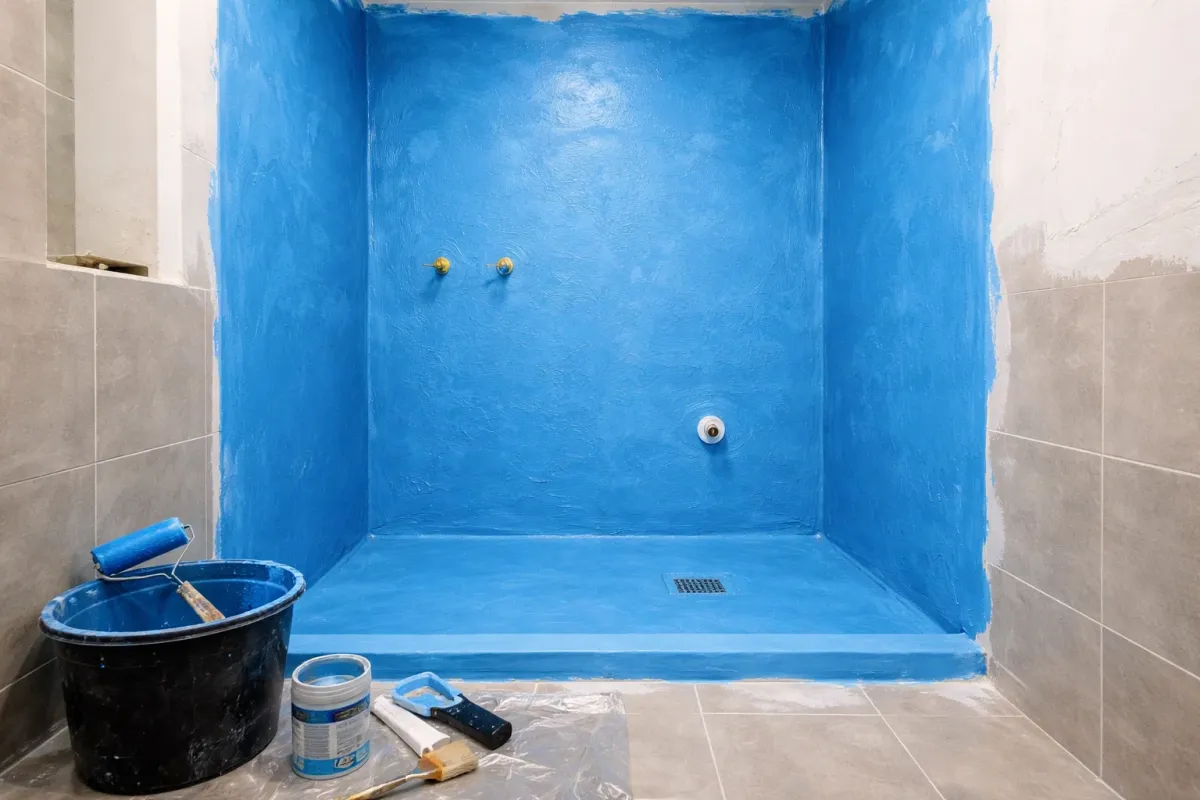
BS 5385-1:2018 tightened the rules on substrates for wet areas, specifying cement-based boards, XPS foam boards with cementitious coatings, or fibre cement boards as the preferred substrates. In practice, however, moisture-resistant plasterboard combined with a full liquid tanking membrane (BAL Waterproof 1C, Mapei AquaDefense or similar) remains a widely used and accepted solution in UK bathrooms. Major tanking product manufacturers specifically approve their systems for application over MR plasterboard, and countless professional installations use this combination successfully. The tanking membrane does the waterproofing. The MR board provides enough moisture resistance to cope with any residual humidity that might reach the substrate over decades of use. Where MR plasterboard falls down is when it is used without tanking, or when the tanking is applied poorly and water finds a path through to the gypsum.
Six Substrate Options Compared
The UK market offers several tile substrate options for bathrooms. Each has distinct properties that suit different situations. Understanding the differences prevents you from overspending where a simpler board would suffice and from under-specifying where moisture exposure demands maximum protection.
Moisture-Resistant Plasterboard + Tanking (Budget Option)
Green moisture-resistant plasterboard is the most affordable substrate for bathroom tiling and, when combined with a proper tanking membrane, it performs reliably in wet zones including shower enclosures and above baths. At roughly £5.50 per square metre for the board, it costs a fraction of dedicated backer boards. The board itself is not waterproof, which is why the tanking membrane is non-negotiable in any area that sees regular water.
The installation process is familiar to every plasterer and bathroom fitter. MR plasterboard fixes to timber studs or bonds to masonry exactly like standard board. Once fixed, two coats of liquid tanking membrane (BAL Waterproof 1C, Mapei AquaDefense, Weber Hydrostop) are applied to all wet zones, with reinforcing tape bedded into corners and joints. The membrane cures to form a continuous waterproof barrier between the water and the gypsum core. Provided the tanking is applied correctly with full coverage and no missed spots, this combination delivers a long-lasting tiled finish.
The risk with MR plasterboard sits entirely in the tanking application. A cement fibre or foam-core board tolerates imperfect waterproofing because the board itself resists moisture. MR plasterboard does not. If the tanking is patchy, if a joint is missed, or if the membrane is damaged during tiling, water reaches gypsum and the problems begin. For this reason, dedicated backer boards provide an extra margin of safety in high-risk areas like walk-in showers and wet rooms, while MR plasterboard with tanking is a perfectly sound choice for shower enclosures over baths, splashback areas and half-tiled bathrooms where the waterproofing can be verified before tiling begins.
HardieBacker 500 (Cement Fibre Board)
HardieBacker 500 is the most widely used cement backer board in UK bathrooms. It holds BBA Certificate 04/4100, confirming its suitability as a tile substrate in wet areas. The board is 12mm thick, weighs 14.4 kg per square metre and supports tile loads up to 100 kg per square metre, which comfortably covers natural stone and large format porcelain.
The composition is Portland cement reinforced with glass fibre mesh on both faces. It does not contain any organic material that mould can feed on, and it will not soften, swell or delaminate when exposed to water. HardieBacker is not waterproof in itself. Water passes through the board, which is why tanking (a liquid or sheet waterproof membrane) is still required in shower areas and wet rooms. Its role is structural. It provides a dimensionally stable, moisture-tolerant substrate that holds tile adhesive securely for the life of the installation.
At approximately £13.74 per square metre, HardieBacker is the most affordable dedicated backer board. The trade-off is weight. A standard 1200x800mm sheet weighs roughly 14 kg, making it harder to handle than foam-core alternatives. Cutting produces silica dust, requiring an FFP3 mask and ideally outdoor cutting or local exhaust ventilation. Score-and-snap reduces dust compared to power cutting. Always use cement board screws (typically 32mm or 38mm with a corrosion-resistant coating), never standard drywall screws. The alkaline cement reacts with uncoated steel, causing corrosion that weakens the fixing and stains the board.
Wedi Building Board (XPS Foam Core)
Wedi boards take a fundamentally different approach. The core is rigid extruded polystyrene foam (XPS) coated on both sides with a reinforced cement polymer layer. This makes the board inherently waterproof through its full thickness, not just on the surface. Wedi holds BBA Certificate 00/3675 and is approved as both a tile substrate and a waterproofing layer. In many installations, a Wedi board wall does not require separate tanking, provided the joints are sealed with Wedi sealant and joint tape.
The standard 20mm board weighs just 3 to 6 kg per square metre, roughly a quarter of the weight of HardieBacker. This makes overhead work and single-person installation considerably easier. Wedi boards can be bonded directly to sound plasterwork, studwork or blockwork using Wedi adhesive, eliminating mechanical fixings in some configurations.
The premium is significant. Wedi boards cost approximately £31.81 per square metre, more than double the price of cement fibre board. For a standard bathroom with 12 to 15 square metres of tiled wall area, the material cost difference is £200 to £270. Whether that premium is justified depends on the project. In shower enclosures, wet rooms and areas where maximum waterproofing assurance matters, Wedi’s integrated waterproofing saves time and eliminates a potential failure point. In a half-tiled bathroom where only the lower walls see occasional splashes, HardieBacker with standard tanking delivers the same result at lower cost.
Marmox Multiboard (XPS Foam Core)
Marmox Multiboard shares the same basic construction as Wedi: an XPS foam core with a reinforced cementitious coating. It is 100 per cent waterproof, resistant to mould and suitable as a direct tile substrate. The compressive strength of 400 kPa makes it strong enough for floor applications under tile, not just walls.
At approximately £18.40 per square metre, Marmox sits between HardieBacker and Wedi on price while offering similar waterproofing to Wedi. The boards are available in thicknesses from 6mm to 60mm, providing insulation value alongside their substrate function. A 20mm Marmox board adds measurable thermal resistance to external walls, which can reduce condensation risk in poorly insulated bathrooms. The lighter weight (similar to Wedi) makes handling straightforward.
Jackoboard Plano (XPS Foam Core)
Jackoboard Plano is another XPS foam-core board with a cementitious coating. It performs similarly to Marmox and Wedi in terms of waterproofing and tile substrate properties. At approximately £16.65 per square metre, it is the most affordable foam-core option, making it an attractive middle ground between the heavyweight cement fibre boards and the premium Wedi system.
Jackoboard is widely available through UK merchants including Toolstation, Screwfix and specialist tile suppliers. The range includes pre-formed shower elements (curved boards, niches, shelving units) that integrate with the flat boards for a fully bonded wet area system.
Knauf Aquapanel Indoor (Cement Board, No Paper)
Aquapanel Indoor is a 12.5mm cement board reinforced with glass fibre mesh on both faces, similar in concept to HardieBacker but with a different cement formulation. It weighs approximately 11 kg per square metre (slightly lighter than HardieBacker) and contains no paper or organic material. The board is rated for wet area use and can be curved to a minimum radius of 1 metre for feature walls and curved shower enclosures.
At £22 to £27 per square metre, Aquapanel sits at the higher end of the cement board category. Its main advantage over HardieBacker is the ability to curve and the slightly lower weight. Like all cement-based boards, it requires separate tanking in wet areas.
Cost Comparison
| Board | Type | Thickness | Weight (kg/m²) | Price (£/m²) | Waterproof | Tanking Needed |
|---|---|---|---|---|---|---|
| HardieBacker 500 | Cement fibre | 12mm | 14.4 | ~£13.74 | No | Yes (wet areas) |
| Jackoboard Plano | XPS foam core | 20mm | 3-5 | ~£16.65 | Yes | Joints only |
| Marmox Multiboard | XPS foam core | 20mm | 3-6 | ~£18.40 | Yes | Joints only |
| Knauf Aquapanel | Cement, no paper | 12.5mm | 11 | £22-27 | No | Yes (wet areas) |
| Wedi Building Board | XPS foam core | 20mm | 3-6 | ~£31.81 | Yes | Joints only |
| MR plasterboard | Gypsum/wax paper | 12.5mm | 8.5 | ~£5.50 | No | Yes (full tanking) |
| Standard plasterboard | Gypsum/paper | 12.5mm | 8.5 | ~£3.50 | No | NOT SUITABLE |
Standard plasterboard must never be used as a tile substrate in wet areas. MR (green) plasterboard is suitable for wet zones when combined with a full liquid tanking membrane, though dedicated backer boards provide a greater safety margin in high-risk installations such as walk-in wet rooms.
Which Board for Which Situation
Not every bathroom wall needs the most expensive board. Matching the board to the moisture exposure level keeps costs proportionate to risk.
Shower enclosures, wet rooms and directly above baths: Foam-core boards (Wedi, Marmox or Jackoboard) provide the highest level of protection. Their integrated waterproofing means that even if grout joints fail or silicone degrades, water cannot penetrate the substrate. For wet room installations where the entire room is a wet area, foam-core boards simplify the tanking process significantly.
Shower enclosures over baths and half-tiled wet zones: Moisture-resistant plasterboard with a full liquid tanking membrane is the most budget-friendly option that still delivers reliable long-term performance. The tanking does the waterproofing; the MR board provides sufficient moisture resistance as a backup. This is the approach used in the majority of standard UK bathroom renovations. For extra reassurance, HardieBacker 500 with tanking provides a more robust substrate at modest additional cost.
Half-tiled bathroom walls (splashbacks, basin areas): MR plasterboard with tanking on the wet zones, or HardieBacker 500 with tanking, both work well. In areas that only see occasional splashes rather than direct water, MR plasterboard alone (without tanking) can be sufficient, though applying tanking adds minimal cost and significant reassurance against future problems.
Bathroom ceilings: Aquapanel Indoor or HardieBacker are suitable for tiled ceilings. The lighter weight of Aquapanel (11 kg/m² versus 14.4 kg/m²) makes overhead installation less demanding. Foam-core boards also work for ceilings but may require more closely spaced fixings to prevent deflection.
Floors: Marmox Multiboard’s 400 kPa compressive strength makes it suitable as an overlay on solid or timber floors before tiling. HardieBacker 500 is also widely used for floor applications. For timber floor preparation in bathrooms, see our guide to avoiding costly renovation mistakes.
Installation: Getting It Right
The best backer board in the world fails if it is fixed badly. These are the installation details that separate a lasting bathroom from one that develops problems.
Fixing to Timber Stud Walls
Cement fibre boards (HardieBacker, Aquapanel) fix to timber studs at maximum 300mm centres using 32mm or 38mm cement board screws. Position screws 12mm from board edges and 150mm apart along edges, 200mm apart in the field (the middle of the board). Pre-drill near edges to prevent splitting. Leave a 3mm gap between boards and fill with flexible tile adhesive or the manufacturer’s jointing compound.
Foam-core boards can be fixed mechanically with washered screws at similar centres, or bonded with the manufacturer’s adhesive. Wedi specifies their own 610 adhesive for bonded installations. Marmox and Jackoboard have equivalent bonding systems. Mechanical fixing is more forgiving of substrate imperfections but creates more penetrations that need sealing.
Fixing to Masonry and Blockwork
On solid walls, cement boards fix through to the masonry with appropriate fixings (frame fixings or concrete screws). Foam-core boards are typically bonded using dot-and-dab technique with cementitious adhesive, ensuring at least 70 per cent contact between the board and the wall. Gaps behind the board can trap moisture, so full-bed adhesive application is preferable in wet areas.
Waterproofing the Board
Cement fibre boards and MR plasterboard both require a separate waterproof membrane in any wet area. Apply liquid tanking (two coats, allowing full cure between coats) to the board surface, lapping at least 50mm onto adjacent surfaces. Reinforce internal corners and board joints with tanking tape bedded into the first coat of membrane. BAL Waterproof 1C cures in two hours per coat. Mapei AquaDefense needs four hours. Schluter KERDI sheet membrane can be tiled immediately once bonded. With MR plasterboard, full and even coverage is particularly important because the board cannot tolerate water if the membrane has any gaps.
Foam-core boards (Wedi, Marmox, Jackoboard) require joint sealing only. Apply the manufacturer’s sealant to board-to-board joints and bed reinforcing tape into the sealant. The board surface itself is the waterproof layer.
Tile Adhesive Selection
Use a flexible (S1 or S2 deformation class) tile adhesive on all backer boards. The flexibility accommodates the slight differential movement between the board and the tile. A C2 TE S1 adhesive (Weber Set SPF, BAL Rapid Flex One, Mapei Keraquick) suits most bathroom applications. For natural stone and large format tiles exceeding 600x600mm, use a white S2 adhesive to prevent moisture-related staining.
PPE and Cutting
Cutting cement fibre boards (HardieBacker, Aquapanel) generates respirable crystalline silica dust. The HSE classifies silica dust as a workplace carcinogen. Wear an FFP3-rated mask when cutting, even for a few cuts. Score-and-snap minimises dust compared to power tools. If using a circular saw or jigsaw, cut outdoors or use a dust extraction attachment. Foam-core boards cut cleanly with a utility knife and produce no harmful dust.
Eight Mistakes That Ruin Bathroom Tiling
These are the errors that professional bathroom remodelling teams see when called to fix failed DIY and poor trade installations.
Using standard drywall screws on cement board. The alkaline cement corrodes uncoated steel. Within twelve months, the screw heads rust, weaken and lose clamping force. The board works loose, tiles crack along grout lines. Always use screws specifically rated for cement board (stainless steel or polymer-coated).
Skipping tanking on cement fibre board. HardieBacker and Aquapanel tolerate moisture but are not waterproof. Without tanking in wet areas, water passes through the board to the stud or wall behind, causing timber rot and mould growth that remains invisible until the damage is severe.
Tiling onto plasterboard in a shower without tanking. Standard plasterboard in a wet zone will always fail. MR plasterboard without tanking will eventually fail too, just more slowly. The gypsum core absorbs moisture through every grout line, swells behind the tiles and eventually lets go. If you are using MR plasterboard in a shower area, the tanking membrane is not optional. Two full coats with taped joints and corners, fully cured before any tile adhesive goes on. Skip the tanking and you will be stripping the entire area within a few years.
Leaving gaps between boards unsealed. Water finds the path of least resistance. A 3mm gap between backer boards, left unjointed and untaped, channels water directly to the structure behind. Joint tape bedded in flexible adhesive or the manufacturer’s sealant closes this route.
Over-tightening screws on foam-core boards. XPS foam crushes under excessive screw pressure. The screw head punches through the cement coating into the foam, losing all holding power. Use washered screws and stop driving when the washer sits flush with the board surface.
Insufficient fixing centres. Spacing screws at 400mm or 600mm (drywall centres) instead of the specified 300mm maximum leaves the board unsupported between fixings. Under the weight of large format porcelain tiles, the board deflects, adhesive bonds fail and tiles debond.
Not allowing for movement joints. Backer boards, like all building materials, expand and contract with temperature and humidity changes. Rigid grout across board-to-board joints cracks as the boards move. Use flexible silicone at perimeter joints, internal corners and at board-to-board junctions behind the tile. The grout itself should be flexible (or silicone) at these points.
Cutting cement board indoors without dust control. A single cut through HardieBacker releases enough silica dust to exceed workplace exposure limits in a small bathroom. The dust settles on surfaces and remains airborne for hours. Score-and-snap outdoors is the minimum precaution. Professional installations use wet-cutting or extraction equipment.
When to Call a Professional
Fitting backer boards is within the capability of a competent DIYer for half-tiled walls in dry areas. Shower enclosures, wet rooms and full bathroom renovations are different. The waterproofing, the board-to-board detailing, the integration with plumbing penetrations and the precise fixing requirements leave little margin for error. A failed waterproof membrane behind tiles is invisible until damp appears on the other side of the wall, sometimes months after the tiles were grouted.
Professional bathroom fitting includes the substrate preparation, tanking, tiling and all the detailing that connects these layers into a single waterproof system. The substrate choice and installation method should be specified at the quotation stage, not decided by whoever happens to be on site that day. If your quote does not mention backer board type, tanking method and fixing specification, ask. These details determine whether your bathroom lasts.
For more on the tiling process itself, see our guide to bathroom tiling techniques. For screw specifications and fixing hardware, our bathroom fitting screws guide covers the full range of fasteners used in wet area construction.
Frequently Asked Questions
Can I tile onto plasterboard in a bathroom?
What is the cheapest backer board for a bathroom?
Do foam-core backer boards like Wedi need tanking?
Is HardieBacker waterproof?
Can I use normal screws to fix cement board?
How much does it cost to backer-board a full bathroom?
Do I need an FFP3 mask when cutting cement board?
Past Projects


Get a Free Quote
Book a free, no-obligation site survey. Call us on 07428 653 653 or request a callback.
Book Free SurveyOur Clients' Reviews

5/5

5/5

5/5

5/5

5/5
Based on 453+ verified reviews across all platforms
Related Articles

How Much Does a New Bathroom Cost in 2026? UK Pricing Guide
What a New Bathroom Really Costs in 2026 The question every homeowner asks before a bathroom renovation is the same. How much? The answer depends on what you want, what you have already, and how much of the existing layout you intend to keep. But the data from thousands of UK projects gives us a clear picture.
view this article Read more
Bathroom Renovation Guide: Every Stage From Start to Finish
What a Bathroom Renovation Actually Involves A complete bathroom renovation is one of the most rewarding home improvement projects you can undertake, but it is also one of the most misunderstood. Homeowners frequently picture the finished result without appreciating the sequence of skilled trades and carefully timed stages that make it happen. Every professional bathroom renovation follows a logical order, and understanding that order is the single most important thing you can do before your project begins.
view this article Read more
Bathroom Tiling Styles for Timeless Elegance
Why Layout Matters More Than the Tile Itself
view this article Read more
Quartz, Granite or Porcelain Worktops: Which Suits Your Kitchen?
The Three-Way Decision Most Kitchen Renovations Come Down To
view this article Read more
Ceramic Disc Technology in Bathroom Taps: How It Works
The Technology Inside Almost Every Modern Tap If your bathroom taps turn with a smooth quarter-turn rather than two and a half rotations, they contain ceramic disc cartridges. This technology has become so dominant that it is now difficult to buy a new tap in the UK that does not use it. Yet most homeowners have no idea how it works, why it fails, or what to do when a ceramic disc tap starts dripping.
view this article Read more

How to Choose an Electrical Bathroom Mirror
What an Electrical Bathroom Mirror Actually Does
view this article Read more
Best Bathroom and Toilet Brands in the UK
What Makes a Good Bathroom Brand The brand name on your toilet, basin or shower valve determines far more than the price tag. It affects how long the product lasts, how easy it is to get replacement parts in five or ten years, whether the finish holds up to daily cleaning, and how well the engineering behind the product actually performs in a real bathroom rather than a showroom.
view this article Read more
Bathroom Underfloor Heating: Types, Installation and What to Expect
Why Underfloor Heating Works So Well in Bathrooms Stepping onto a warm bathroom floor on a cold January morning is one of those small luxuries that, once experienced, becomes very difficult to give up. Underfloor heating has grown from a niche luxury into a genuinely practical heating solution for UK bathrooms, and the reasons go well beyond comfort.
view this article Read more
Tools Required for Bathroom Fitting: The Professional Trade Toolkit
The Professional Bathroom Fitter’s Complete Toolkit Every professional bathroom fitter knows that quality tools are an investment, not an expense. The difference between a flawless installation and a problematic one often comes down to having the right equipment for the job. Over years of bathroom fitting projects across Greater Manchester, we have refined our toolkit to include everything a trade professional needs on site.
view this article Read more
What You Need to Know Before Your Kitchen Renovation
The Gap Between Expectation and Reality A kitchen renovation is not a weekend project. The 2025 Houzz UK Kitchen Trends Study found that 71 percent of homeowners change their kitchen layout during a renovation, and the median spend rose 34 percent year on year to £17,500. Those numbers tell you two things. First, most people end up doing more work than they originally planned. Second, the costs are significant enough that poor preparation leads to genuinely painful surprises.
view this article Read more
Accessible Bathroom Design: UK Regulations, Grants and Guide
Why Accessible Bathroom Design Matters Around 16.8 million people in the United Kingdom have a disability. That is one in four of the population, according to the DWP Family Resources Survey 2023/24, and the figure has risen by 4.9 million over the past decade. Among adults over State Pension age, 45 percent are disabled. The most common impairment types for working-age adults are mental health conditions (48 percent) and mobility impairments (42 percent).
view this article Read more