

Tools Required for Bathroom Fitting: The Professional Trade Toolkit
Professional bathroom fitter's complete tool guide. From SDS drills and laser levels to pipe benders and soldering kits, every trade tool explained.
The Professional Bathroom Fitter’s Complete Toolkit

Every professional bathroom fitter knows that quality tools are an investment, not an expense. The difference between a flawless installation and a problematic one often comes down to having the right equipment for the job. Over years of bathroom fitting projects across Greater Manchester, we have refined our toolkit to include everything a trade professional needs on site.
This guide covers the specialist tools that professional bathroom fitters rely on daily. If you are a homeowner looking for a simpler introduction to basic bathroom tools, see our essential tools guide for DIY bathroom projects.
Measuring, Marking and Layout Tools
Precision is the foundation of every professional bathroom installation. Millimetres matter when fitting bespoke shower enclosures, aligning wall-hung sanitaryware, or tiling around awkward features.
- Laser level - Far superior to a spirit level for establishing datum lines across entire rooms. A cross-line laser is essential for tiling layout, setting heights for wall-hung toilets, and checking floor levels before installing shower trays. Self-levelling models from Bosch or DeWalt save considerable time.
- Digital angle finder - Critical for measuring mitres on complex trim work and determining exact angles in rooms that are rarely perfectly square.
- Tape measure (8m minimum) - Stanley FatMax or similar wide-blade models that hold rigid over longer distances. Professionals typically carry two.
- Spirit levels (multiple sizes) - A 1200mm level for checking walls and large surfaces, a 600mm for vanity units and cabinets, and a torpedo level for tight spaces around pipework.
- Chalk line - For snapping long reference lines on walls and floors before tiling.
- Contour gauge - Invaluable for transferring complex profiles when cutting tiles or panels around pipework and fittings.
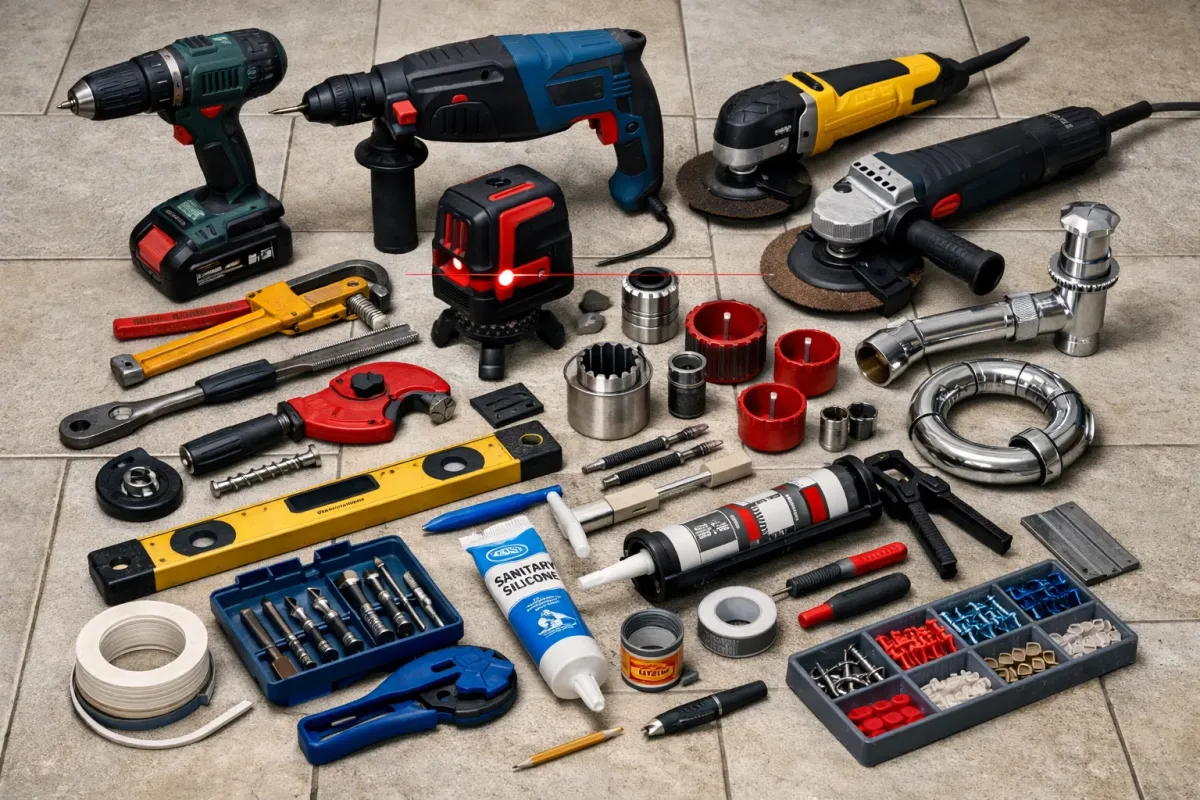
Power Tools
Professional-grade power tools withstand the demands of daily site use and deliver the precision that trade work requires.
- SDS rotary hammer drill - The workhorse of bathroom fitting. Essential for drilling into masonry, concrete and blockwork for fixing frames, brackets and supports. A Makita HR2630 or Bosch GBH 2-26 are industry favourites.
- Cordless combi drill and impact driver - A matched pair on the same battery platform. The combi drill handles pilot holes and smaller masonry fixings; the impact driver makes light work of screws and coach bolts. 18V minimum, with brushless motors for longevity.
- Oscillating multi-tool - Perhaps the most versatile tool in a fitter’s bag. Cuts flush against walls, trims door linings, removes old sealant, and sands in tight corners. Essential for retrofit bathroom work where access is restricted.
- Reciprocating saw - Speeds up demolition work. Cuts through old pipework, timber, screws, and even cast iron waste pipes with the right blade.
- Circular saw or track saw - For cutting sheet materials, worktops and large panels with clean, straight edges.
- Jigsaw - Handles curved cuts in worktops, panels and laminate flooring. Variable speed control is essential for different materials.
Plumbing Tools
Bathroom plumbing demands specialist tools that general tradespeople rarely carry. See our bathroom plumbing service page for details on the plumbing work involved in a full installation.
- Pipe bender (15mm and 22mm) - Essential for forming clean bends in copper pipe without kinking. Spring benders work for minor adjustments, but a proper stand-off bender handles the tight bends needed behind pedestals and in boxing.
- Pipe cutter and pipe slice - Professional-grade rotary cutters produce clean, square cuts. A pipe slice fits into the tightest spaces behind walls and under floors.
- Blow torch and soldering kit - For making watertight soldered joints on copper pipework. MAP gas torches offer higher temperatures and faster work than butane.
- Flux, solder wire and cleaning mat - The consumables that make soldered joints reliable. Lead-free solder is now mandatory under UK regulations.
- Basin wrench - A long-reach spanner specifically designed for tightening tap connectors in the confined space beneath basins. No substitute exists for this tool.
- Adjustable spanners and plumbing grips - Multiple sizes for compression fittings, tap connectors and waste traps.
- Pipe freeze kit - Allows work on live pipework without draining the entire system. Essential when modifying existing plumbing runs.
- Compression and push-fit fittings kit - A well-stocked selection of elbows, tees, reducers and connectors in 15mm and 22mm.
- Waste pipe cutters - For clean cuts on 32mm and 40mm plastic waste pipe.
- PTFE tape and jointing compound - For sealing threaded connections on radiator valves, tap tails and shower fittings.
- Silicone gun and sealant - Professional-grade skeleton guns deliver more control than budget ratchet types. Dow Corning 785 or similar sanitary-grade silicone is the trade standard.

Tiling Tools
Professional tiling in a bathroom requires specialist equipment that goes well beyond a basic tile cutter. For more on our tiling work, visit our bathroom tiling services page.
- Electric wet tile cutter - A bench-mounted diamond wet cutter handles porcelain, ceramic and natural stone with precision. Rubi, Vitrex and Brevetti Montolit are trusted trade brands.
- Angle grinder with diamond blade - For cutting notches, L-shapes and holes in tiles that a wet cutter cannot manage.
- Diamond hole saw set - For drilling clean holes through tiles for pipework, shower valve bodies and electrical points.
- Notched trowels (multiple sizes) - Different tile sizes require different trowel notch sizes. 6mm, 10mm and 12mm notched trowels cover most applications.
- Tile levelling system - Wedges and clips that ensure a perfectly flat tile surface with consistent lippage. Saves enormous time on large-format tiles.
- Grout float and sponges - For applying and finishing grout cleanly.
- Tile spacers (various sizes) - From 1mm to 5mm depending on tile type and desired joint width.
- Mixing paddle and bucket - A proper mixing paddle attached to a drill ensures adhesive and grout are mixed to the correct consistency without lumps.

Carpentry and Fitting Tools
Bathroom carpentry covers everything from building stud walls and boxing pipework to fitting vanity units and bespoke storage. Our joinery and carpentry services page explains the scope of this work.
- Mitre saw - For precise angle cuts on trims, skirting and architraves. A sliding compound mitre saw handles wider boards.
- Chisels (set of 4) - Sharp bevel-edge chisels for morticing hinges, trimming door linings and refining joints.
- Hand plane - For trimming doors after new flooring is laid.
- Hole saw kit - For cutting openings in worktops and panels for taps, wastes and pop-up mechanisms.
- Router - For profiling edges on bespoke wooden worktops and trimming laminate.
- Clamps - Quick-grip clamps hold materials in place during cutting, gluing and assembly.
Electrical Tools
Bathroom zones have specific wiring regulations under BS 7671. While Part P qualified electricians handle the main electrical work, fitters need basic electrical tools for preparation and testing.
- Voltage tester - A non-contact voltage detector is essential before cutting into walls or lifting floors. Safety first, always.
- Cable detector - Scans walls for hidden cables and pipes before drilling. Professional models detect both AC cables and metal pipes.
Safety and Protection Equipment
Professional fitters take safety seriously. Construction dust, sharp edges, power tools and working at height all present hazards.
- FFP3 dust mask or powered respirator - Cutting tiles, plaster and cement board generates fine silica dust. FFP2 is the minimum; FFP3 is recommended for regular cutting work.
- Safety goggles and glasses - Impact-rated eye protection for cutting, drilling and demolition.
- Cut-resistant gloves - For handling sharp tile edges, broken ceramics and sheet metal.
- Knee pads - Professional-grade gel knee pads are essential when spending hours tiling floors or fitting low-level pipework.
- Ear defenders - SDS drills, angle grinders and tile cutters all exceed safe noise levels.
- Steel-capped boots - Mandatory on any building site and sensible in domestic settings when handling heavy sanitaryware.
- Dust sheets and floor protection - Protecting the customer’s home is as important as protecting yourself.

Site Management and Consumables
Beyond the core tools, professional fitters keep their work organised and efficient.
- Fixings kit - A well-organised case of wall plugs, screws, coach bolts, toggle fixings and expanding anchors in various sizes. Different wall types demand different fixings: dot-and-dab plasterboard, solid block, stud walls and concrete all behave differently.
- Caulking and sealing kit - Multiple colours of silicone, mastic guns, smoothing tools and masking tape for achieving crisp, professional seal lines.
- Dust extraction - A professional vacuum with a HEPA filter keeps the workspace clean and reduces airborne dust during cutting.
- Site lighting - LED work lights and head torches for working in rooms with no natural light or where the power supply is temporarily disconnected.
- Tool bags and cases - Organisation matters. Professional fitters invest in quality bags and stackable cases that keep tools accessible and protected.
Frequently Asked Questions
How much should a professional bathroom fitter spend on tools?
What is the single most important power tool for bathroom fitting?
Do professional bathroom fitters need a laser level?
What plumbing tools are unique to bathroom fitting?
Should bathroom fitters invest in cordless or corded power tools?
What safety equipment is legally required for bathroom fitting work?
Where can I find a professional bathroom fitter in Manchester?
Past Projects


Get a Free Quote
Book a free, no-obligation site survey. Call us on 07428 653 653 or request a callback.
Book Free SurveyOur Clients' Reviews

5/5

5/5

5/5

5/5

5/5
Based on 453+ verified reviews across all platforms
Related Articles

Essential Tools Required for Bathroom Fitting: A DIY Homeowner's Guide
Getting Started with DIY Bathroom Tools
view this article Read more
How Much Does a New Bathroom Cost in 2026? UK Pricing Guide
What a New Bathroom Really Costs in 2026 The question every homeowner asks before a bathroom renovation is the same. How much? The answer depends on what you want, what you have already, and how much of the existing layout you intend to keep. But the data from thousands of UK projects gives us a clear picture.
view this article Read more
Bathroom Renovation Guide: Every Stage From Start to Finish
What a Bathroom Renovation Actually Involves A complete bathroom renovation is one of the most rewarding home improvement projects you can undertake, but it is also one of the most misunderstood. Homeowners frequently picture the finished result without appreciating the sequence of skilled trades and carefully timed stages that make it happen. Every professional bathroom renovation follows a logical order, and understanding that order is the single most important thing you can do before your project begins.
view this article Read more
Bathroom Tiling Styles for Timeless Elegance
Why Layout Matters More Than the Tile Itself
view this article Read more
Quartz, Granite or Porcelain Worktops: Which Suits Your Kitchen?
The Three-Way Decision Most Kitchen Renovations Come Down To
view this article Read more
Ceramic Disc Technology in Bathroom Taps: How It Works
The Technology Inside Almost Every Modern Tap If your bathroom taps turn with a smooth quarter-turn rather than two and a half rotations, they contain ceramic disc cartridges. This technology has become so dominant that it is now difficult to buy a new tap in the UK that does not use it. Yet most homeowners have no idea how it works, why it fails, or what to do when a ceramic disc tap starts dripping.
view this article Read more

How to Choose an Electrical Bathroom Mirror
What an Electrical Bathroom Mirror Actually Does
view this article Read more
Best Bathroom and Toilet Brands in the UK
What Makes a Good Bathroom Brand The brand name on your toilet, basin or shower valve determines far more than the price tag. It affects how long the product lasts, how easy it is to get replacement parts in five or ten years, whether the finish holds up to daily cleaning, and how well the engineering behind the product actually performs in a real bathroom rather than a showroom.
view this article Read more
Bathroom Underfloor Heating: Types, Installation and What to Expect
Why Underfloor Heating Works So Well in Bathrooms Stepping onto a warm bathroom floor on a cold January morning is one of those small luxuries that, once experienced, becomes very difficult to give up. Underfloor heating has grown from a niche luxury into a genuinely practical heating solution for UK bathrooms, and the reasons go well beyond comfort.
view this article Read more
What You Need to Know Before Your Kitchen Renovation
The Gap Between Expectation and Reality A kitchen renovation is not a weekend project. The 2025 Houzz UK Kitchen Trends Study found that 71 percent of homeowners change their kitchen layout during a renovation, and the median spend rose 34 percent year on year to £17,500. Those numbers tell you two things. First, most people end up doing more work than they originally planned. Second, the costs are significant enough that poor preparation leads to genuinely painful surprises.
view this article Read more
Accessible Bathroom Design: UK Regulations, Grants and Guide
Why Accessible Bathroom Design Matters Around 16.8 million people in the United Kingdom have a disability. That is one in four of the population, according to the DWP Family Resources Survey 2023/24, and the figure has risen by 4.9 million over the past decade. Among adults over State Pension age, 45 percent are disabled. The most common impairment types for working-age adults are mental health conditions (48 percent) and mobility impairments (42 percent).
view this article Read more