
Damp Proofing Old UK Houses: Causes, Treatments and What Works
Why old UK houses get damp and what treatments work. Rising damp, penetrating damp, lime plaster, chemical DPC and treatment costs.
Why Old Houses and Damp Are a Different Problem Entirely

The English Housing Survey puts the number of dwellings in England with a damp problem at 1.4 million, roughly 5 per cent of the housing stock. But that figure disguises a striking imbalance. Pre-1919 homes account for 10 per cent of damp cases compared to just 1 to 4 per cent for later construction periods. There are approximately 4.8 million pre-1919 dwellings in England, the vast majority built with solid walls, lime mortar and no cavity. These buildings were designed to manage moisture in a fundamentally different way to modern construction, and the single most common reason they develop damp problems is that someone has applied modern materials to a building that was never designed for them.
Understanding how an old house was built to handle moisture is the essential first step in treating damp correctly. Get it wrong and you trap moisture inside the walls, accelerate decay, and spend thousands on treatments that make the problem worse. Get it right and a 150-year-old solid-wall terrace can be drier than a badly ventilated new build.
Manchester ranks among the worst areas in England for damp, with over 2,000 recorded damp-related complaints between 2020 and 2025 and approximately 14.5 per cent of homes falling into a high-risk category. As damp proofing specialists in Manchester, we work predominantly with Victorian and Edwardian solid-wall terraces where understanding the building’s original moisture management system is not optional. It is the difference between a treatment that lasts decades and one that fails within months.
How Old Houses Were Built to Manage Moisture
Pre-1919 houses were constructed as breathing structures. The walls, typically 9-inch solid brick or stone with lime mortar joints, absorbed moisture from rain, ground contact and internal living activities. That moisture then evaporated from both the internal and external surfaces through the porous lime mortar, lime plaster and limewash finishes. The system worked because every component was vapour-permeable. Moisture moved freely through the building fabric and escaped through evaporation, maintaining an equilibrium that kept the structure sound.
Ventilation was integral to the design. Open fireplaces drew air through the building constantly, pulling moisture-laden air up and out through the chimney. Draughty sash windows, gaps in timber floorboards and uninsulated loft spaces all contributed to continuous air movement. A Victorian terrace with its fireplaces lit and windows slightly open was a remarkably effective moisture management system, even in Manchester’s wet climate.
The problems started when twentieth-century improvements began sealing these buildings up. Double glazing replaced draughty sashes. Fireplaces were blocked and chimney breasts removed. Cement render replaced breathable lime render on external walls. Gypsum plaster replaced lime plaster internally. Vinyl wallpaper and modern masonry paint sealed the remaining surfaces. Each of these changes individually seems sensible. Together, they systematically dismantled the moisture management system the building was designed around.
Why Cement and Gypsum Cause Damp in Old Houses
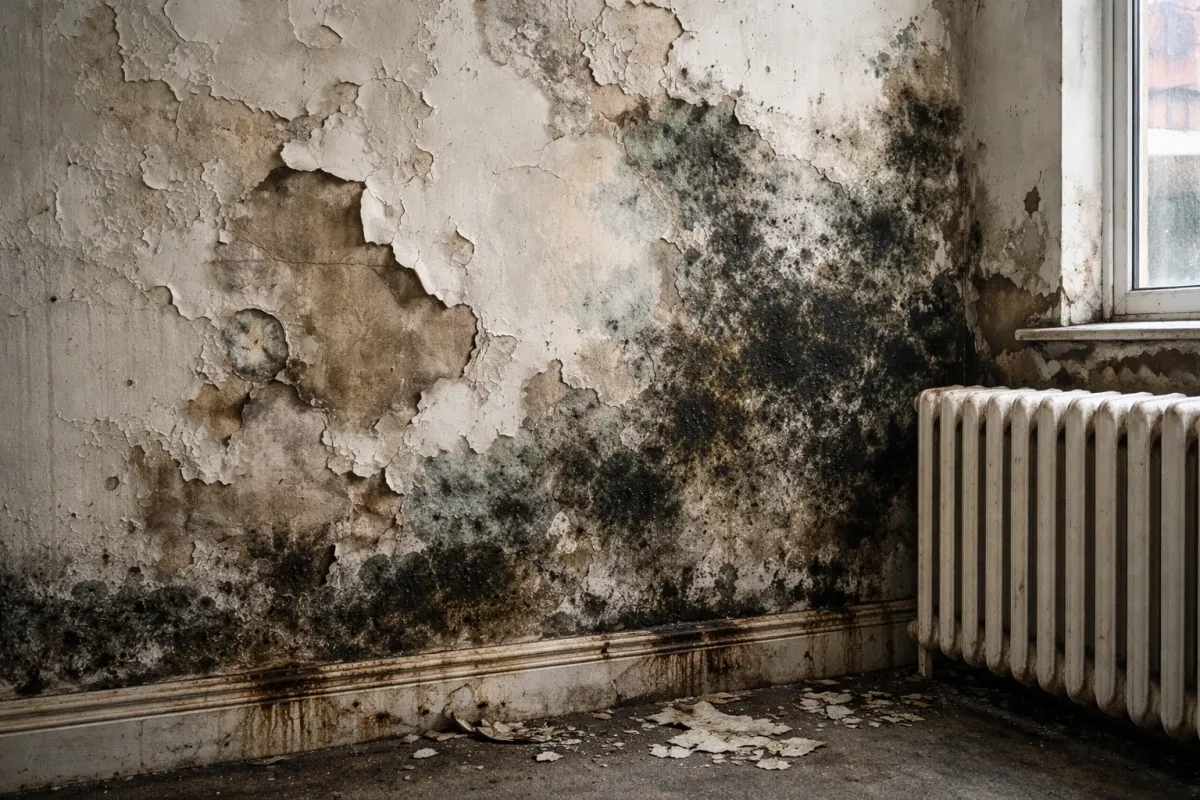
Portland cement render is hard, rigid and relatively impermeable. When applied to the outside of a solid wall, it creates a shell that prevents moisture from evaporating outward. When the render inevitably cracks (and cement always cracks because it cannot accommodate the natural movement of old masonry), rainwater enters through the cracks but cannot evaporate back out through the intact render. The wall becomes saturated from within.
Gypsum plaster internally has the same effect in reverse. It traps moisture migrating inward, preventing it from evaporating into the room. The moisture has nowhere to go, leading to damp patches, salt crystallisation and mould growth. Waterproof paints and vinyl wallpaper compound the problem by sealing the last remaining evaporation routes.
The Lime Solution
Lime mortar, lime render and lime plaster are the traditional breathable alternatives that conservation bodies including Historic England, SPAB and the IHBC strongly recommend for all pre-1919 solid-wall buildings. Natural Hydraulic Lime (available in NHL 2, NHL 3.5 and NHL 5 grades of increasing strength) sets in damp conditions, making it well suited to the UK climate. Lime render is softer and more flexible than cement, accommodating the natural movement of old buildings rather than cracking against it.
Replacing cement render with lime render is often the single most effective damp treatment for an old solid-wall house. It addresses the root cause rather than the symptoms, and a properly applied lime render lasts 50 to 100 years with periodic limewash renewal.
Three Types of Damp and How They Affect Old Houses
Every damp problem in a UK house falls into one of three categories, and each requires a completely different treatment approach. Misdiagnosis is the single most expensive mistake in damp proofing because treating the wrong type wastes money and leaves the real problem to worsen.
Rising Damp
Groundwater drawn upward through porous masonry by capillary action. It affects walls where the original damp proof course has failed, been bridged by raised external ground levels, or was never installed. Georgian and early Victorian properties commonly had no DPC at all. Later Victorian and Edwardian houses may have original DPCs of slate, bitumen or engineering brick that have deteriorated over 100-plus years.
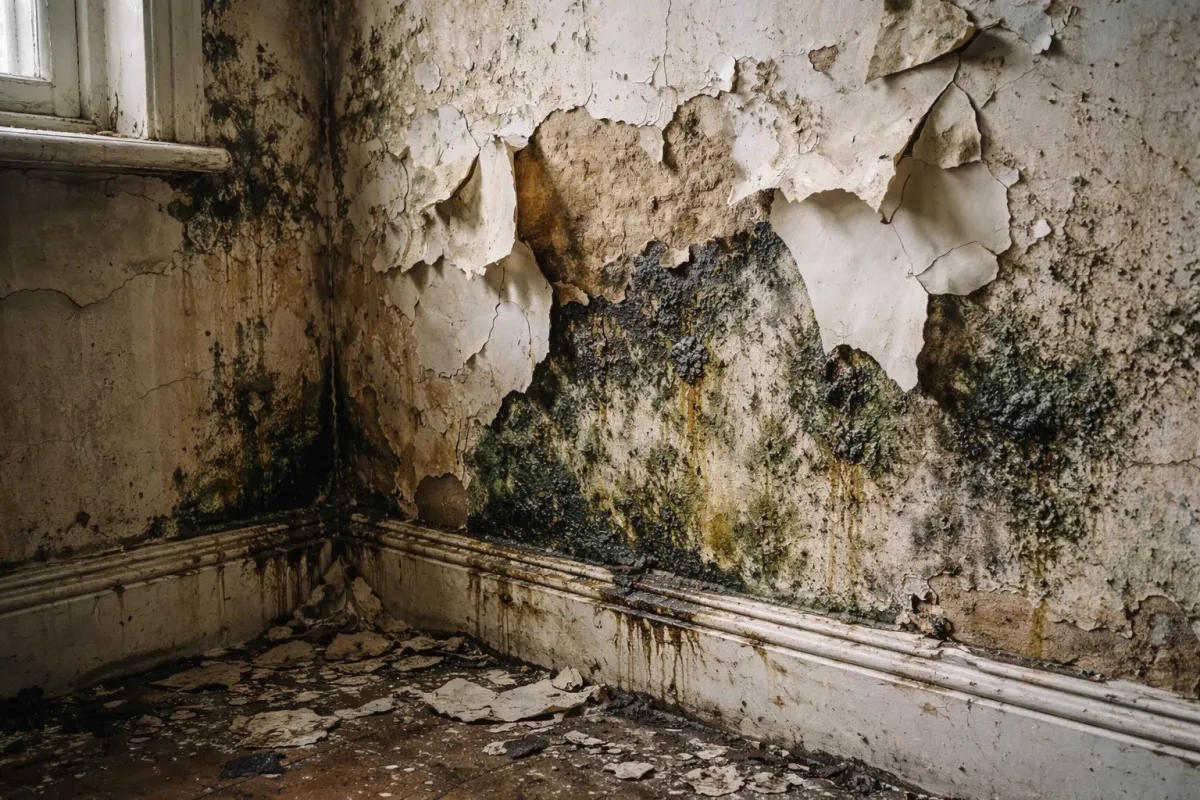
The diagnostic signs are specific. A visible horizontal tide mark on internal walls, typically reaching no higher than 1.0 to 1.2 metres above floor level (as specified in BS 6576:2005), marks the point where gravity and evaporation overcome the capillary pull. White crystalline salt deposits (chlorides and nitrates from the groundwater) appear along the affected zone. These salts are hygroscopic, meaning they attract further moisture from the air and perpetuate the damp cycle even after the original water source is addressed. Plaster bubbles, crumbles and blows away from the masonry. Unlike condensation, rising damp rarely produces significant black mould because the salts inhibit fungal growth.
If damp appears above 1.2 metres, BS 6576 advises that something is wrong with the diagnosis. It is more likely penetrating damp, condensation, or a plumbing leak.
Penetrating Damp
Rainwater entering through the building fabric from outside. In solid-wall properties there is no cavity to interrupt moisture transfer, so water can track straight through to the internal face. The common causes in old UK houses are failed pointing (particularly on west-facing walls receiving the prevailing rain), cracked cement render, leaking gutters saturating the wall below, damaged chimney flashings, and defective window sills without proper drip edges. Manchester’s soft red Victorian brick is particularly porous, and sandblasting or aggressive cleaning worsens this considerably.
Penetrating damp appears as irregular patches that worsen during or immediately after rainfall. It does not leave hygroscopic salt deposits. The critical point is that it can appear at any height and on any wall. Fix the external fault first. A £50 gutter clearance or £350 repointing job addresses the cause. An internal membrane or replastering job without fixing the source is an expensive sticking plaster.
Condensation
The most common damp problem in UK homes according to the Building Research Establishment. It occurs when warm moisture-laden air meets a surface below its dew point temperature. At 20 degrees Celsius and 60 per cent relative humidity, the dew point is approximately 12 degrees. Uninsulated solid walls (U-value around 2.0 W/m2K versus 0.3 for modern insulated walls) create extensive cold surfaces where internal temperatures can drop to 8 to 10 degrees in winter, well below dew point.
A family of four generates approximately 14 litres of water vapour per day through breathing, cooking, bathing and drying clothes. In a Victorian house where the fireplaces have been blocked and the windows sealed, that moisture has nowhere to go. Black mould appears in corners, behind furniture and around window reveals, worst on north-facing walls and at thermal bridges where two external walls meet.
Part F of the Building Regulations requires minimum extraction rates of 15 litres per second for bathrooms and 13 litres per second for kitchens. Positive Input Ventilation systems from manufacturers like Nuaire (Drimaster-Eco) and EnviroVent (ATMOS) cost £400 to £1,200 installed, run on as little as 15 watts, and are one of the most cost-effective condensation treatments available at roughly £7 to £36 per year in running costs.
The Rising Damp Controversy
Rising damp is one of the most contentious topics in UK building surveying, and anyone considering damp proofing for an old house should understand both sides of the debate before committing to treatment.
The sceptical position, articulated most prominently by Jeff Howell in his 2008 book The Rising Damp Myth, argues that laboratory tests show water does not rise by capillary action through properly built brickwork to the heights commonly diagnosed. He estimates that approximately 5,000 UK homes per week are incorrectly diagnosed with rising damp. A former RICS Chief publicly stated that rising damp is a myth. Both BS 6576 and BRE Digest 245 acknowledge that handheld electrical resistance moisture meters (the Protimeter-type devices used by many surveyors) are unreliable for detecting rising damp because hygroscopic salts in old walls produce high conductivity readings that mimic moisture.
Historic England published a Joint Position Statement in September 2022, co-signed by RICS, the PCA, IHBC, SPAB, Cadw and Historic Environment Scotland. The statement is unequivocal: it is no longer acceptable to simply use a handheld meter, get a reading and declare there is a problem requiring treatment. Surveyors must take a whole-building approach, identify the actual source of moisture, and understand how traditional buildings manage moisture through breathable materials rather than reflexively recommending chemical DPC injection.
The Property Care Association, the trade body for the damp proofing industry, collaborated on that same statement. The PCA maintains that rising damp is a real phenomenon when properly diagnosed by qualified professionals, but acknowledges the need for better diagnostic standards. PCA-accredited surveyors with CSRT (Certificated Surveyor in Remedial Treatments) or CSSW (Certificated Surveyor in Structural Waterproofing) qualifications are required to demonstrate diagnostic rigour beyond handheld meter readings, including visual inspection, salt analysis and gravimetric moisture measurement.
The practical takeaway for homeowners is straightforward. If a surveyor diagnoses rising damp based solely on a handheld meter reading and recommends immediate chemical injection, get a second opinion. Proper diagnosis requires understanding the building type, checking external ground levels, inspecting gutters and pointing, testing for salts, and considering whether cement render or gypsum plaster might be trapping moisture that the building was designed to release through evaporation.
Treatment Options for Old Houses
Chemical DPC Injection
The most common treatment for diagnosed rising damp. Holes are drilled into the mortar bed joint at approximately 150mm above external ground level, spaced at 120mm centres. A silicone-based cream (typically a silane/siloxane blend) is injected which diffuses into the surrounding masonry and creates a hydrophobic barrier. Major UK brands include Safeguard Dryzone (BBA-certified, 63 per cent silane/siloxane by weight) and Wykamol Ultracure (BBA-approved).
Chemical DPC injection costs £50 to £70 per linear metre for the injection itself. Total project costs including salt-resistant replastering (mandatory under BS 6576, using renovation plaster rather than standard gypsum) typically run £250 to £1,020 for a terraced house, £475 to £2,350 for a semi-detached, and £690 to £5,200 for a detached property. PCA members offer 20-year guarantees with insurance-backed cover that transfers to subsequent owners.
A word of caution for listed buildings. Chemical DPC injection requires drilling through mortar joints. Some conservation officers permit this. Others have rejected applications on the grounds that it destroys historic fabric. Listed Building Consent should always be confirmed in writing before any injection work on a Grade I, II* or II listed property.
Cavity Drain Membranes

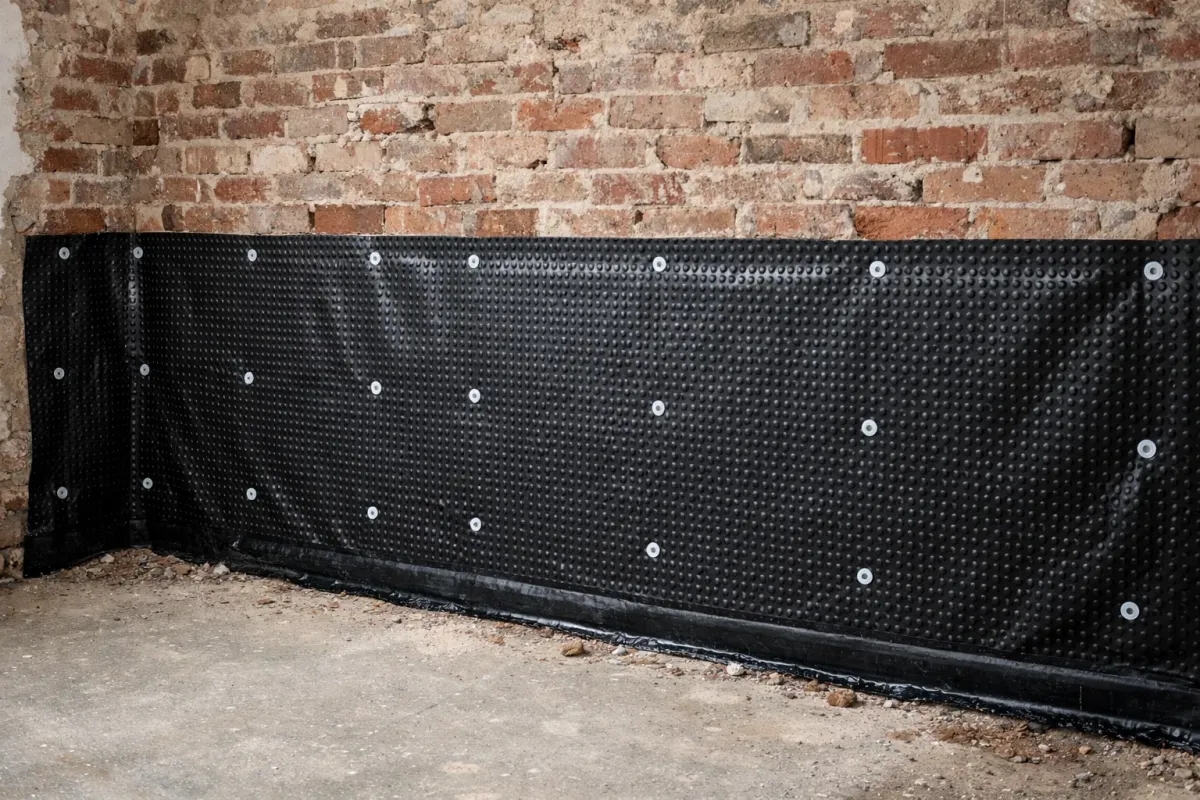
Studded polypropylene or HDPE membranes fixed to the masonry with studs facing the wall create a small air gap that intercepts moisture and allows it to drain downward or evaporate within the cavity. This is a Type C (drained protection) system under BS 8102:2022. For detailed guidance on membrane types, installation steps and plasterboard options, see our damp proofing with membrane guide.
Professional membrane installation costs approximately £45 per square metre (supply and fit), with a full treatment for an average semi-detached house running around £4,000. Newton CDM System 508 carries a 30-year guarantee against deterioration.
Addressing the Source Rather Than the Symptoms
For many old houses, the most effective treatment is not adding a new barrier but removing the wrong ones. Stripping cement render and replacing it with lime render restores the external evaporation path. Removing gypsum plaster and applying lime plaster internally restores the internal path. Lowering raised external ground levels below the DPC (or below where the DPC should be) eliminates the moisture bridge. Unblocking chimneys and installing ventilation restores the air movement that Victorian houses depend on.
These approaches align with Historic England’s guidance and are increasingly preferred by surveyors who specialise in pre-1919 buildings. They address root causes rather than managing symptoms, and they preserve the character and fabric of period properties.
What Does Not Work
Electro-osmotic DPC systems claim to repel moisture downward using an electrical charge. BRE research found that their effectiveness has not been demonstrated in the laboratory and field evidence is disappointing. Neither active nor passive electro-osmotic systems have been approved by a recognised testing laboratory. Heritage House describes them as an expensive fraud. They are not recommended by Historic England, SPAB or most independent surveyors.
Manchester’s Victorian Terraces: Specific Challenges
Manchester’s housing stock presents a concentrated version of every old-house damp issue. The city’s Victorian and Edwardian terraces are predominantly solid 9-inch brick construction using soft red brick that is highly porous. No cavity, no insulation, U-values around 2.0 W/m2K. Several features create particular vulnerability.
Bay windows are a consistent weak point. Cold bridging around the frames, failing pointing at junctions, and water ingress from deteriorating stonework above make them a common origin for both penetrating damp and condensation-driven mould. End-of-terrace gable walls take the full force of weather, and those rendered with cement in twentieth-century improvement schemes develop penetrating damp almost inevitably.
External ground levels around Manchester terraces have often risen over 150 years as paths, drives and raised garden beds have been added. Where the ground now sits above the original DPC (or above where the DPC would have been in pre-1875 properties), moisture bridges directly into the wall. Lowering the ground level by 150mm below the DPC line is one of the simplest and most effective treatments available.
The blocked chimney is perhaps the most overlooked factor. Victorian fireplaces provided constant stack-effect ventilation, pulling air through the building and carrying moisture with it. When fireplaces were sealed off, that ventilation disappeared. Installing an airbrick or ventilated chimney cap costs under £100 and can make a measurable difference to condensation in rooms that previously had a working fireplace.
Health Risks and Your Legal Obligations
Damp is not just a property maintenance issue. The UK government estimates that approximately 2 million people in England live in homes with significant damp or mould. Almost 31,000 babies and toddlers are admitted to hospital annually with lung conditions caused or exacerbated by cold, damp and mould, with nearly 80 per cent developing acute bronchiolitis. The NHS estimates it could save £38 million per year if damp problems were rectified.
The case that changed UK damp policy was that of Awaab Ishak, a two-year-old boy who died in Rochdale in December 2020 from a severe respiratory condition caused by prolonged mould exposure in his family’s housing association flat. His parents had made repeated complaints about mould over three years. No effective action was taken. The coroner called it a defining moment for the country.
Awaab’s Law, part of the Social Housing (Regulation) Act 2023, came into force in October 2025. Social landlords must now investigate significant damp and mould within 10 working days of notification and make properties safe within 5 working days after that. Emergency health hazards must be addressed within 24 hours. The Homes (Fitness for Human Habitation) Act 2018 extends obligations to private landlords, allowing tenants to take them to court directly. Under the Housing Health and Safety Rating System, severe damp constitutes a Category 1 hazard that triggers mandatory enforcement by local authorities.
For homeowners, the health argument for treating damp is as compelling as the financial one. Untreated surface damp reduces property value by approximately 5 per cent. Visible rising or penetrating damp drops valuations by 10 to 20 per cent. Extensive structural damage from prolonged untreated damp reduces property value by 25 to 53 per cent, with affected properties sitting on the market twice as long as comparable dry homes.
What Damp Proofing Costs in the UK
| Treatment | Typical UK Cost |
|---|---|
| Professional damp survey | £150 to £400 |
| Chemical DPC injection (terraced house) | £250 to £1,020 |
| Chemical DPC injection (semi-detached) | £475 to £2,350 |
| Chemical DPC injection (detached) | £690 to £5,200 |
| Cavity drain membrane (installed per m²) | ~£45 |
| Penetrating damp treatment (minor repair) | £150 to £250 |
| Full penetrating damp treatment with re-render | £2,000 to £5,000 |
| Replastering per room (salt-resistant plaster) | £300 to £800 |
| Gutter repair or unblocking | £150 to £350 |
| External repointing (single wall) | £350+ |
| PIV system (supply and install) | £400 to £1,200 |
PCA member companies offer 20-year guarantees with insurance-backed cover that transfers to new owners on sale. This transferable guarantee is often the gold standard that mortgage lenders require before releasing funds on a property with a history of damp problems. For a free assessment of your property, our team can survey, diagnose and recommend the right treatment for your specific building type.
Frequently Asked Questions
Is rising damp real or a myth?
Why do old houses get damp more than modern houses?
Should I use lime plaster instead of gypsum on old walls?
How much does damp proofing cost for a Victorian terrace?
Do I need Listed Building Consent for damp proofing?
What is Awaab's Law and how does it affect damp treatment?
What qualifications should a damp surveyor have?
Past Projects


Get a Free Quote
Book a free, no-obligation site survey. Call us on +44 7428 653 653 or request a callback.
Book Free SurveyOur Clients' Reviews

5/5

5/5

5/5

5/5
Based on 453+ verified reviews across all platforms
Related Articles
Damp Proofing with Membrane for Plasterboard: The Complete UK Guide
Why Plastering Over Damp Never Works Every damp proofing specialist in the UK has walked into a property where the previous owner or builder plastered directly over a damp wall and hoped for the best.
view this article Read more
How Much Does a New Bathroom Cost in 2026? UK Pricing Guide
What a New Bathroom Really Costs in 2026 The question every homeowner asks before a bathroom renovation is the same. How much?
view this article Read more
Bathroom Renovation Guide: Every Stage From Start to Finish
What a Bathroom Renovation Actually Involves A complete bathroom renovation is one of the most rewarding home improvement projects you can undertake, but it is also one of the most misunderstood.
view this article Read more
Bathroom Tiling Styles for Timeless Elegance
Why Layout Matters More Than the Tile Itself A bathroom tile is a raw ingredient. The layout pattern is the recipe.
view this article Read more
Quartz, Granite or Porcelain Worktops: Which Suits Your Kitchen?
The Three-Way Decision Most Kitchen Renovations Come Down To Once you have decided that laminate is not enough and solid wood is not right for your cooking habits, the conversation narrows quickly.
view this article Read more
Ceramic Disc Technology in Bathroom Taps: How It Works
The Technology Inside Almost Every Modern Tap If your bathroom taps turn with a smooth quarter-turn rather than two and a half rotations, they contain ceramic disc cartridges.
view this article Read more
Fitting Kitchen Worktops: The Complete Installation Guide
From Order to Fitted The worktop is one of the last things fitted in a kitchen renovation and one of the first things to go wrong if the process is rushed.
view this article Read more
How to Choose an Electrical Bathroom Mirror
What an Electrical Bathroom Mirror Actually Does An electrical bathroom mirror is a permanently wired fixture that combines a mirror with integrated LED lighting, and often a demister pad, Bluetooth speakers, a shaver socket, or adjustable colour temperature.
view this article Read more
Best Bathroom and Toilet Brands in the UK
What Makes a Good Bathroom Brand The brand name on your toilet, basin or shower valve determines far more than the price tag.
view this article Read more
Bathroom Underfloor Heating: Types, Installation and What to Expect
Why Underfloor Heating Works So Well in Bathrooms Stepping onto a warm bathroom floor on a cold January morning is one of those small luxuries that, once experienced, becomes very difficult to give up.
view this article Read more
Tools Required for Bathroom Fitting: The Professional Trade Toolkit
The Professional Bathroom Fitter’s Complete Toolkit Every professional bathroom fitter knows that quality tools are an investment, not an expense. The difference between a flawless installation and a problematic one often comes down to having the right equipment for the job.
view this article Read more
What You Need to Know Before Your Kitchen Renovation
The Gap Between Expectation and Reality A kitchen renovation is not a weekend project. The 2025 Houzz UK Kitchen Trends Study found that 71 percent of homeowners change their kitchen layout during a renovation, and the median spend rose 34 percent year on year to £17,500.
view this article Read more