
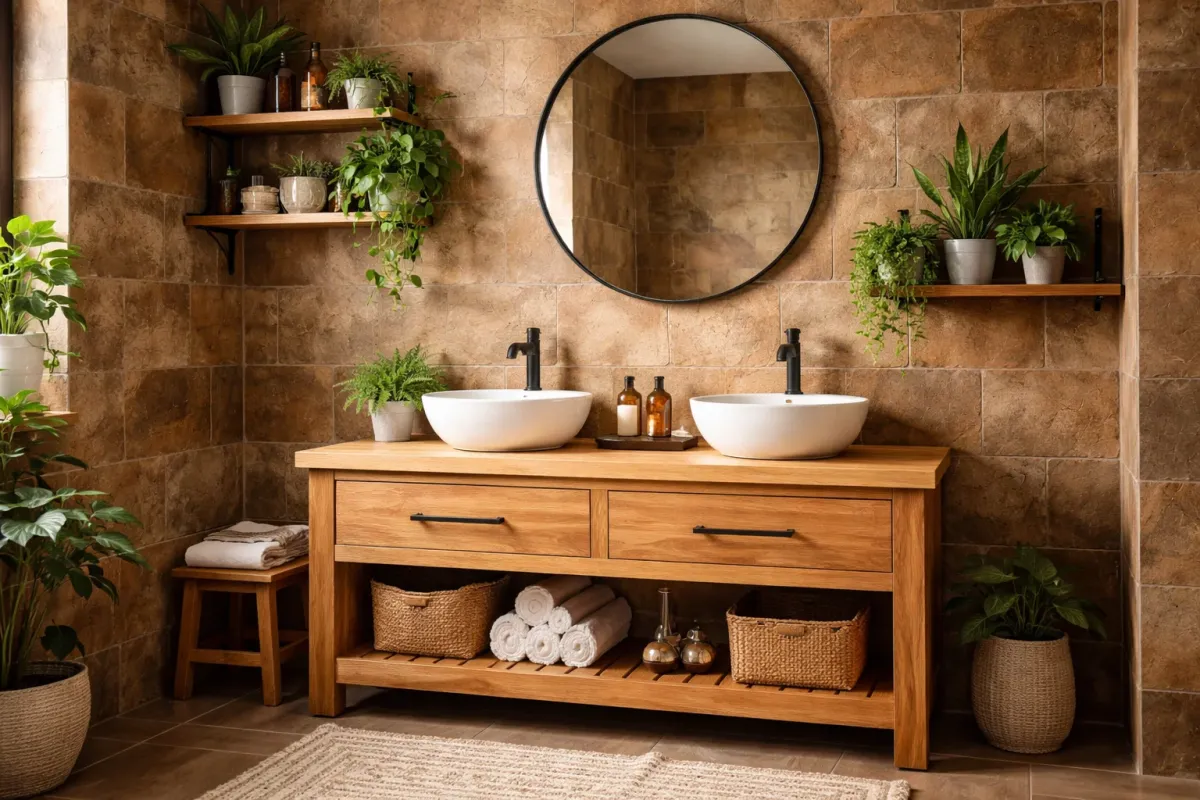
The Art of Bathroom Tiling: A Professional Installation Guide
Professional guide to bathroom tiling from surface preparation to grouting. BS 5385 compliance, UK adhesive brands, tanking systems and common mistakes.
How Professional Bathroom Tiling Actually Works

Beautiful bathroom tiles start long before the first tile touches the wall. The visible result — clean lines, flush surfaces, watertight joints — depends on a sequence of preparation steps that most homeowners never see. Skip any one of them and the tiling can fail within months, sometimes dramatically.
As bathroom fitters in Manchester, we tile hundreds of square metres every year across everything from compact en-suites to full wet room conversions. This guide explains how professional bathroom tiling is actually done, step by step, with the specific products, techniques and British Standards that separate lasting work from a job that cracks, lifts or lets water through to the structure behind.
If you are choosing tile materials, our guide to bathroom tile types covers that ground. For layout patterns and design styles, see our tiling styles guide. To work out how many tiles and how much grout to order, use our tile and grout calculator. This article focuses on the installation process itself.
Surface Preparation
The substrate behind the tiles determines whether the finished tiling lasts five years or twenty-five. No adhesive compensates for a poorly prepared surface, and this is the stage where most DIY tiling projects go wrong.
Assessing the Substrate
Different wall and floor materials have different load limits, moisture behaviour and priming requirements. Getting this wrong means tiles that debond, crack or trap moisture behind them.
Plasterboard supports up to 32 kg per square metre when bare, dropping to 20 kg per square metre with a skim coat. That weight limit matters more than people realise. Large format porcelain tiles at 12mm thick can weigh 28 kg per square metre before adhesive is added. In wet areas, standard plasterboard must be tanked before tiling regardless of whether it is labelled moisture-resistant. New plaster skim needs at least seven days to dry before any tiling begins; new backing plaster on solid walls needs four weeks.
Cement board (HardieBacker 12mm or similar) supports up to 200 kg per square metre and is inherently water-resistant. It is the professional choice for shower enclosures and wet rooms. Fix it to timber studs at 300mm centres using cement board screws, stagger the joints, and seal every joint with tanking tape.
Existing tiles can be tiled over if they are firmly bonded and structurally sound. Tap each tile and listen for hollow sounds, which indicate debonding. Roughen the glazed surface with an orbital sander to create a mechanical key, clean with a degreaser, and apply a bonding primer such as Mapei Eco Prim Grip Plus before tiling with an S1-class flexible adhesive.
Priming
Every porous substrate needs priming before cementitious adhesive is applied. The primer controls suction, prevents the substrate drawing moisture out of the adhesive too quickly, and improves the bond.
| Product | Application | Drying Time |
|---|---|---|
| BAL Prime APD | Undiluted on plasterboard and plaster before cementitious adhesive | 15 to 30 minutes |
| BAL Bond SBR | Diluted 1:4 with water for ready-mix adhesive, 1:2 for powder adhesive | 15 to 30 minutes per coat |
| Mapei Eco Prim Grip Plus | Ready-to-use on non-absorbent surfaces (existing tiles, terrazzo) | 15 to 60 minutes |
Skipping the primer is one of the most common reasons tiles fail on plasterboard. The adhesive dries out before it bonds, and the tiles come away in sheets.
Waterproofing Wet Areas
BS 5385-1:2018 now requires all substrates in wet areas to be waterproofed before tiling. This includes domestic bathrooms, not just commercial or public facilities. The standard was updated because decades of evidence showed that tiles and standard grout are not waterproof. Water migrates through grout joints over time, saturates the substrate behind, and causes mould growth, structural damage and tile debonding.
Understanding the Zones
Wet zone covers the area directly under the showerhead and within the shower enclosure. This requires a full tanking membrane system.
Splash zone extends roughly 600mm beyond the shower or bath edge where splashing occurs. Waterproofing is strongly recommended here.
Moisture zone covers the remainder of the bathroom. A suitable primer and moisture-resistant substrate are sufficient for walls, though floor-level damp-proof considerations apply in ground-floor rooms.
Tanking Systems
Professional tilers use either liquid-applied membranes or sheet membranes depending on the situation.
| System | Type | Tileable After | Best For |
|---|---|---|---|
| BAL Waterproof 1C | One-coat liquid | 2 hours | Speed — single coat, tile same day |
| Mapei AquaDefense | Two-coat liquid | 4 hours after second coat | Industry standard, wide substrate compatibility |
| Schluter KERDI | Polyethylene sheet | Immediately once bonded | Guaranteed consistent thickness, zero drying time |
| Schluter DITRA | Polyethylene uncoupling mat | Immediately once bonded | Combined waterproofing and uncoupling for floors |
| ARDEX 8+9 | Two-part liquid | 2 to 3 hours | Extremely tough cure |
Every tanking system requires reinforcing tape at internal corners, pipe penetrations and board joints. Mapei Mapeband, BAL WP1 tape and Schluter KERDI-BAND all serve this purpose. The tape gets embedded while the first coat is still wet, creating a continuous waterproof envelope with no weak points at the junctions.
For liquid membranes, apply two coats (except BAL 1C which is single-coat) with the second coat at right angles to the first once the first is fully dry. Sheet membranes bond directly to the substrate using unmodified thin-set mortar with 50mm overlaps at joints.
Adhesive Selection
Choosing the right adhesive is not about picking the cheapest bag on the shelf. The adhesive must match the tile type, the substrate and the environment. Getting this wrong is the second most common cause of tiling failures after poor surface preparation.
Flexible vs Rigid
Adhesives are classified under BS EN 12004. The key distinction for bathroom tiling is deformability.
S1 (deformable) adhesives flex 2.5 to 5mm before breaking. Required for porcelain tiles, large format tiles (300x600mm and above), underfloor heating, tile-on-tile applications, plasterboard and any substrate with potential movement. This is the minimum standard for bathroom tiling.
S2 (highly deformable) adhesives flex 5mm or more. Required for timber floors and substrates with significant movement.
Non-S rated (rigid) adhesives have no deformability classification. Only suitable for stable concrete or sand-cement screeds with standard ceramic tiles. Never use rigid adhesive in a bathroom where moisture, temperature changes and substrate movement are constant factors.
The cost difference between rigid and S1-flexible adhesive is a few pounds per bag. The cost of replacing failed tiling runs into hundreds or thousands. Always go flexible in a bathroom.
Popular UK Products
| Product | Classification | Open Time | Grout After | Key Use |
|---|---|---|---|---|
| BAL Max Flex Fibre | C2TE S1 | 40+ minutes | 16 hours | Standard-set workhorse for all bathroom tiles |
| BAL Rapid Flex One | C2FE S1 | 30 minutes | 3 hours | Fast-track jobs, grout same day |
| Mapei Keraquick | C2FT S1 | — | 3 hours approx | Rapid-set flexible for porcelain and stone |
| Ardex X77 | C2TE S1 | 60 minutes | 16 hours | Large format tiles, extended working time |
| Dunlop CF-03 | C2F S1 | 60 minutes | 3 hours | Fast-set flexible for all tile types |
Trowel Size and Back-Buttering
The notch trowel size determines how much adhesive sits beneath the tile. Too small a trowel means insufficient coverage; too large wastes adhesive and creates a bed that is too thick.
| Tile Size | Trowel Notch |
|---|---|
| Mosaics (up to 50x50mm) | 3mm round notch |
| Small wall tiles (up to 150x150mm) | 4 to 4.5mm |
| Standard wall tiles (up to 300x300mm) | 6mm square notch |
| Medium floor tiles (300x300 to 400x400mm) | 8 to 10mm square |
| Large format (400x400mm and above) | 10 to 12mm square |
| Very large slabs (600x600mm and above) | 12 to 20mm, solid-bed method |
Back-buttering means spreading a thin skim of adhesive across the back of the tile in addition to combing adhesive on the wall or floor. It is essential for all tiles 300x600mm and larger, and for all porcelain tiles regardless of size. Porcelain absorbs less than 0.5 per cent moisture, which means the adhesive cannot grip through suction alone. Back-buttering ensures full contact.
The target is 95 per cent adhesive coverage in wet areas. The old “dot and dab” method — blobs of adhesive at corners and centre — is never acceptable for tiling. It creates voids that trap moisture, grow mould and leave tiles vulnerable to cracking under load.
Setting Out and Layout
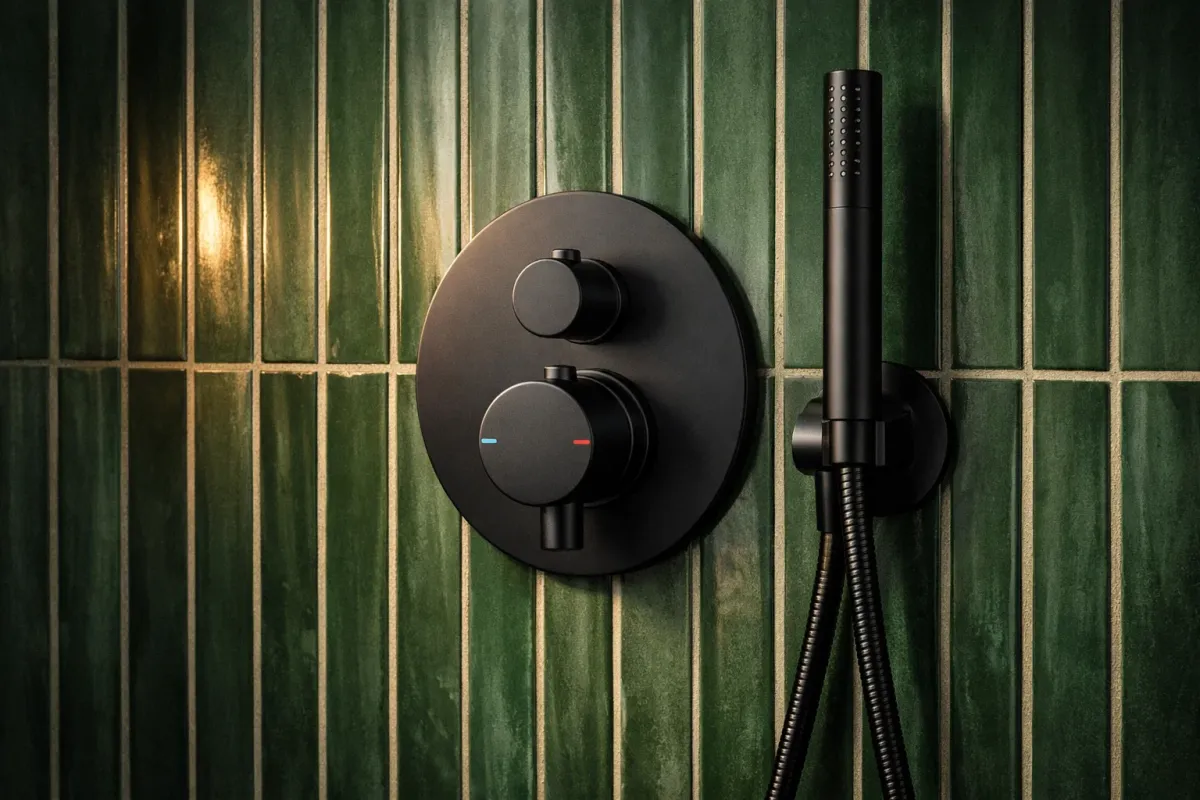
Professional tiling looks professional because of what happens before the adhesive goes on. Setting out is the process of planning exactly where every tile will sit so that the finished result looks balanced and intentional.
Finding the Starting Point
For floors, find the centre of the room by snapping chalk lines from the midpoints of opposite walls. Dry lay a row of tiles with spacers along each chalk line from the centre outward. If the cut tiles at the edges would be less than half a tile wide, shift the entire layout by half a tile. Narrow slivers look unprofessional and are difficult to cut cleanly.
For walls, work from the centre of each wall horizontally. Vertically, fix a level batten one tile height above the floor or bath edge and tile upward from there. The bottom row is cut to fit last, accommodating any unevenness in the floor line.
Never start from a corner unless the room is perfectly square, which in older Manchester properties it rarely is. Starting from the centre guarantees equal cuts on both sides.
Offsets for Large Format Tiles
BS 5385 and tile manufacturers recommend limiting the offset to 33 per cent (third-bond) for tiles longer than 300mm. A traditional 50 per cent brick bond offset on large rectified porcelain exaggerates any minor convexity in the tile, creating visible lippage where tile edges sit at slightly different heights. Third-bond is the current professional standard for 600x300mm, 600x600mm and larger formats.
Movement Joints
Tiles expand and contract with temperature changes, and different substrates move independently. Movement joints absorb this movement so that stress does not build up and crack tiles or grout.
BS 5385 Part 3 requires movement joints at all changes of plane (wall-to-wall corners, wall-to-floor junctions, wall-to-bath or shower tray), around fixed points such as pipes and columns, and at intervals of 3 to 5 metres across large tiled floor areas. Movement joints must be filled with flexible silicone sealant, never with grout. Grout is rigid and will crack when the joint moves.
Joint Widths
| Tile Size | Minimum Joint Width |
|---|---|
| Up to 300x300mm | 2mm |
| 300x600mm to 1000x1000mm | 3mm |
| Over 1000x1000mm or any edge over 1200mm | 5mm |
The practical UK convention is 2mm spacers for wall tiles up to 300x300mm, 3mm for standard floor tiles and larger wall tiles, and 5mm for natural stone and very large format installations.
Cutting Techniques
Even the most carefully planned layout requires cut tiles at edges, around pipes and at junctions. The cutting method depends on the tile material and the type of cut needed.
Manual tile cutters score and snap tiles along a straight line using a tungsten carbide wheel. They work well for ceramic tiles and smaller porcelain pieces but cannot handle curves, L-shapes or very hard materials. Rubi and Sigma are the brands most professionals trust.
Electric wet cutters use a diamond blade spinning through continuous water to cool the cut and suppress dust. Essential for porcelain (especially large format), natural stone and any cut that is not a simple straight line. Porcelain requires a slow, steady feed. Forcing the tile into the blade chips the glaze edge. Always cut with the glazed face upward to minimise chipping.
Diamond hole saws cut circular holes for pipe penetrations. Available in standard plumbing sizes from 20mm up to 110mm. Use with water cooling, either from a wet drill attachment or a sponge ring dam. Dry cutting overheats the tile and cracks it every time.
Angle grinders with diamond discs handle on-site notches, L-cuts and awkward adjustments where a wet cutter cannot reach. They create significant dust, particularly with porcelain, which contains silica. Dust extraction or outdoor cutting is essential for respiratory safety. Masking tape along the cut line reduces edge chipping.
Grouting and Finishing
Grouting fills the joints between tiles, creating a continuous surface that resists moisture and dirt. It is the final visible step, and poor grouting undermines even the best tiling work.
Cement Grout vs Epoxy
Cement-based grout is the standard choice for most bathroom tiling. Products such as BAL Micromax2 (rapid-set, antimicrobial Microban protection, efflorescence-free) and Mapei Ultracolor Plus (rapid-set, anti-efflorescence) offer good performance at reasonable cost. Cement grout is more porous than epoxy and will absorb some moisture over time, but for standard bathroom use it performs well.
Epoxy grout is a two-component resin system that cures to a waterproof, stain-proof finish. Mapei Kerapoxy and BAL Easypoxy AG are the most commonly used UK products. Epoxy costs roughly three to four times more per square metre than cement grout and has a shorter working time (30 to 45 minutes), making it harder to apply. However, for shower floors, wet rooms and areas where staining resistance matters, epoxy is the superior choice.
Grouting Technique
Allow the adhesive to fully cure before grouting. BAL Rapid Flex One allows grouting after three hours; BAL Max Flex Fibre after sixteen hours; standard-set adhesives after twenty-four hours. Rushing this step traps moisture beneath the tiles and weakens the adhesive bond.
Mix the grout to a thick, smooth paste and push it into the joints with a rubber grout float held at roughly 45 degrees. Work diagonally across the joints, not parallel. Parallel dragging pulls grout out of the joints rather than packing them. Scrape off excess with the float edge, wait ten to fifteen minutes for the surface to begin firming, then clean with a damp sponge wiped diagonally. Polish off the remaining haze with a dry cloth once it has dried.
Silicone at Change-of-Plane Joints
Every internal corner (wall-to-wall), every wall-to-floor junction, and every wall-to-bath or shower tray junction must be sealed with colour-matched sanitary silicone, not grout. BAL Micromax Sealant and Mapei Mapesil AC both offer wide colour ranges to match their grout lines.
Apply silicone after grouting. Mask both sides of the joint with painter’s tape for a clean line, apply the silicone, tool it with a wet finger or profiling tool, and remove the tape immediately before the silicone skins over.
Curing Before Water Exposure
No water should contact freshly grouted tiles for a minimum of twenty-four hours regardless of which product was used. BAL Micromax2 sets in two to three hours but needs twenty-four hours before shower use. Epoxy grouts need twenty-four hours for initial set and seven days for full chemical resistance. Rushing this step leads to grout washout, discolouration and early failure.
Common Mistakes That Cause Tiling Failures
Seven recurring problems cause the majority of bathroom tiling failures we see when called to inspect or repair work done by others.
Insufficient adhesive coverage is the single most common issue. Dot-and-dab application, the wrong trowel size or failure to back-butter large tiles all leave voids behind the tile. Voids collect water, encourage mould growth and leave tiles unsupported. A sharp tap on a hollow tile produces a distinctly different sound from one with full adhesive contact.
Missing movement joints at changes of plane cause grout cracking within the first year, particularly in shower enclosures where temperature cycling is constant. Every internal corner and every junction between different surfaces needs flexible silicone, not rigid grout.
Tiling over painted surfaces without proper preparation is alarmingly common. The adhesive bonds to the paint film, and the paint film eventually releases from the wall, bringing every tile with it. All paint must be removed, or the surface thoroughly abraded and primed with a bonding agent.
Wrong adhesive for the substrate appears regularly in DIY work. Rigid adhesive on plasterboard, non-flexible adhesive over underfloor heating, standard cement adhesive on porcelain tiles. Each combination invites failure.
Grouting too soon traps moisture between the tiles and the substrate, weakening the adhesive bond at exactly the point where it needs to be strongest. Always follow the adhesive manufacturer’s stated grout-after time.
No waterproofing behind shower tiles remains widespread despite BS 5385 requiring it since 2018. The assumption that tiles and grout are waterproof is wrong. Water penetrates standard cement grout steadily, and over months or years it saturates the substrate behind. By the time the damage becomes visible, the repair involves stripping everything back to the structure.
Incorrect offset for large format tiles using a 50 per cent brick bond on tiles longer than 300mm creates visible lippage that cannot be disguised. The maximum recommended offset is 33 per cent for large format tiles.
Professional vs DIY Bathroom Tiling
Professional tiling costs more upfront than doing it yourself, and for straightforward ceramic wall tiling in a dry area, a competent DIYer can achieve a good result. Bathroom tiling, however, involves waterproofing, wet-area compliance, and working with materials and substrates that do not forgive mistakes easily.
What Professional Tiling Includes
Correct substrate assessment and preparation (the stage most DIYers underestimate), tanking compliant with BS 5385, precise setting out that avoids awkward cuts, full adhesive coverage with the correct trowel technique, clean consistent grouting, and proper silicone at every movement joint. Professionals also complete the work significantly faster, typically finishing in 40 to 60 per cent of the time a DIYer would need.
UK Tiling Costs
| Cost Element | Typical Range |
|---|---|
| Labour: wall tiling per square metre | £20 to £40 |
| Labour: floor tiling per square metre | £30 to £50 |
| Labour: day rate | £150 to £250 |
| Complex work (natural stone, large format, mosaics) per square metre | £40 to £60 |
| Total cost including materials per square metre | £80 to £130 |
| Typical bathroom (walls and floor, approximately 10 square metres) | £800 to £1,300 |
Rates vary regionally. London and the south-east sit at the higher end; the north-west including Greater Manchester is generally mid-range. The total cost assumes mid-range tiles with professional-grade adhesive, grout and silicone.
Typical Timescales
| Bathroom Size | Professional | DIY |
|---|---|---|
| Small en-suite (4 to 6 square metres) | 2 to 3 days | 4 to 6 days |
| Standard bathroom (6 to 10 square metres) | 3 to 4 days | 5 to 7 days |
| Large bathroom or wet room (10 to 15 square metres) | 4 to 5 days | 7 to 10 days |
These timescales cover preparation, tanking, tiling and grouting. They do not include rip-out, re-boarding or plumbing work. Rapid-set adhesives (BAL Rapid Flex One, Dunlop CF-03) can compress the professional schedule by allowing grouting on the same day.
For tiling within a full bathroom renovation or shower room installation, our team handles the entire process from substrate preparation through to final silicone. The tiling integrates with plumbing, electrical and joinery work under a single project timeline.
Frequently Asked Questions
Do I need to waterproof (tank) my bathroom walls before tiling?
What adhesive should I use for porcelain bathroom tiles?
How long after tiling can I use the shower?
Why do my tile edges sit at different heights (lippage)?
Can I tile over existing bathroom tiles?
Should I use silicone or grout in the corners of my shower?
How much does it cost to have a bathroom professionally tiled in the UK?
Past Projects


Get a Free Quote
Book a free, no-obligation site survey. Call us on +44 7428 653 653 or request a callback.
Book Free SurveyOur Clients' Reviews

5/5

5/5

5/5

5/5
Based on 453+ verified reviews across all platforms
Related Articles

Tile Fitting in a Bathroom Renovation: What Homeowners Should Know
Why the Tiling Phase Matters More Than You Think Choosing beautiful tiles is the exciting part. Getting them onto the walls and floors so they stay there for twenty years without cracking, lifting or letting water through is the part that actually determines whether your bathroom renovation succeeds or fails.
view this article Read more
Choosing the Right Bathroom Tiles: A Type-by-Type Guide
Choosing Tiles That Work for Your Bathroom Every tile you lay in a bathroom has a job to do. It needs to repel water, survive years of foot traffic, resist staining from soap and cosmetics, and still look good after thousands of cleaning cycles.
view this article Read more
Full House Renovation UK: Costs, Trade Sequence and What to Expect
What a Full House Renovation Actually Involves A full house renovation is not a cosmetic refresh. It is the systematic strip-out and rebuild of every room, every system and every surface in a property.
view this article Read more
Tips for Effective Bathroom Cleaning
The Difference Between Cleaning Hard and Cleaning Smart A DBS Bathrooms survey of British adults found that the average UK household cleans the bathroom 2.
view this article Read more
Sustainable Materials in Bathroom Fittings
Building a Greener Bathroom Without Compromising on Style The Houzz UK Bathroom Trends Study found that 87% of homeowners added at least one sustainable feature during their bathroom renovation.
view this article Read more