
Kitchen Design Trends Shaping UK Homes
Kitchen design trends for UK homes covering colour palettes, cabinet styles, worktop materials, smart appliances and sustainable choices.
What Is Driving Kitchen Design in 2026
The 2025 Houzz UK Kitchen Trends Study found that the median kitchen renovation spend rose 34 percent year on year to £17,500, with 71 percent of homeowners changing their kitchen layout during the project. That level of investment means design decisions carry real weight. Homeowners are not just replacing tired units. They are rethinking how the kitchen functions, how it connects to the rest of the house, and how it reflects the way they actually live.

The trends shaping UK kitchens in 2026 share a common thread. Warmth is replacing the cool greys that dominated the last decade. Texture is returning through fluted surfaces and natural materials. Sustainability is moving from aspiration to specification. And the rigid fitted kitchen is loosening up, borrowing ideas from freestanding furniture and broken-plan living to create rooms with more personality and flexibility. This guide covers the trends that are genuinely influencing UK kitchen renovations right now, backed by industry data rather than speculation.
Colour Palettes That Define the Moment
Green has become the dominant cabinet colour for UK kitchens, accounting for 21 percent of lower and contrasting cabinet choices in the 2025 Houzz study. This is not a single shade but a spectrum, from the soft muted calm of Little Greene’s Sage Green to the smoky depth of Farrow and Ball’s Green Smoke, which has overtaken Hague Blue as one of their best-selling kitchen colours. Treron, a darker, more saturated green, suits kitchens with good natural light and pairs well with brass hardware and oak worktops.
Warm neutrals are replacing the cool greys that defined the 2010s. Tones like taupe, mushroom, stone and oat create a softer, more welcoming backdrop, particularly when paired with natural materials. Farrow and Ball’s Jitney, a relaxed sandy neutral, works well on island units to balance bolder perimeter cabinetry. Bone, a pale grey-beige, pairs naturally alongside it.
Bold blues remain a strong choice for statement kitchens. Dulux’s 2026 Colour of the Year family centres on three indigo-based shades, from vibrant royal blue to deep meditative navy. Farrow and Ball’s Hague Blue continues to perform on cabinetry, reading as rich and opulent against white marble or quartz worktops. For more on heritage colour choices, our Victorian kitchens guide covers the deeper end of the palette.
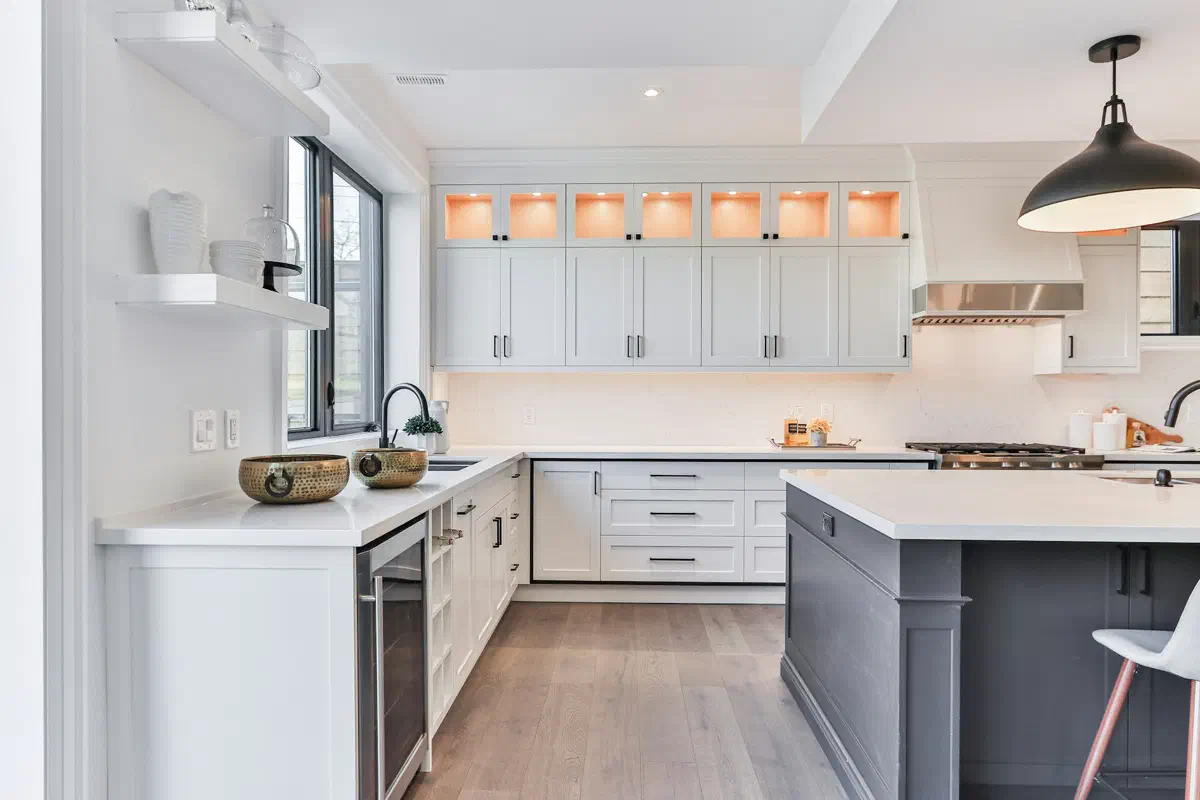
The two-tone kitchen is now the norm rather than the exception. The Houzz study found that 31 percent of homeowners chose differing colours for upper and lower cabinets. The most common approach pairs white or off-white uppers with green, blue or charcoal lowers, or uses a contrasting colour on the island to anchor the room.
Cabinet Styles and Door Profiles
Three door profiles are competing for dominance in UK kitchens, and the balance between them tells you a lot about where design is heading.
Handleless cabinetry with J-pull profiles or integrated rail handles remains the strongest choice for contemporary kitchens. The clean, unbroken lines suit open-plan spaces where the kitchen needs to recede visually when not in use. Howdens’ Clerkenwell and Greenwich Handleless ranges are among the most specified in the UK trade market.
The Slim Shaker, a modern reinterpretation with a narrower one-to-two-inch frame, bridges the gap between traditional and contemporary. It delivers the warmth and character of a panelled door without the ornate detail of a full heritage Shaker. Wren Kitchens’ Shaker Chelsea Ermine in Olive Green won commendation at the 2025 Ideal Home Awards. Howdens’ Witney range offers a similar balance at a more accessible price point.
Fluted and ribbed surfaces are the defining texture of the moment. Fluted doors, island panels and feature end panels add depth and tactile interest without overwhelming the room. The texture works particularly well on islands, where it catches light at different angles throughout the day, and pairs naturally with handleless systems. Curved, fluted kitchen islands are one of the strongest emerging details for 2026, softening the geometry of the room and improving traffic flow around tight corners.
Super-matte finishes with a soft-touch feel have displaced high-gloss as the dominant surface treatment. Reeded glass in upper cabinet doors offers a translucent alternative that softens visual clutter while still letting you see roughly what is inside.
Worktop Materials
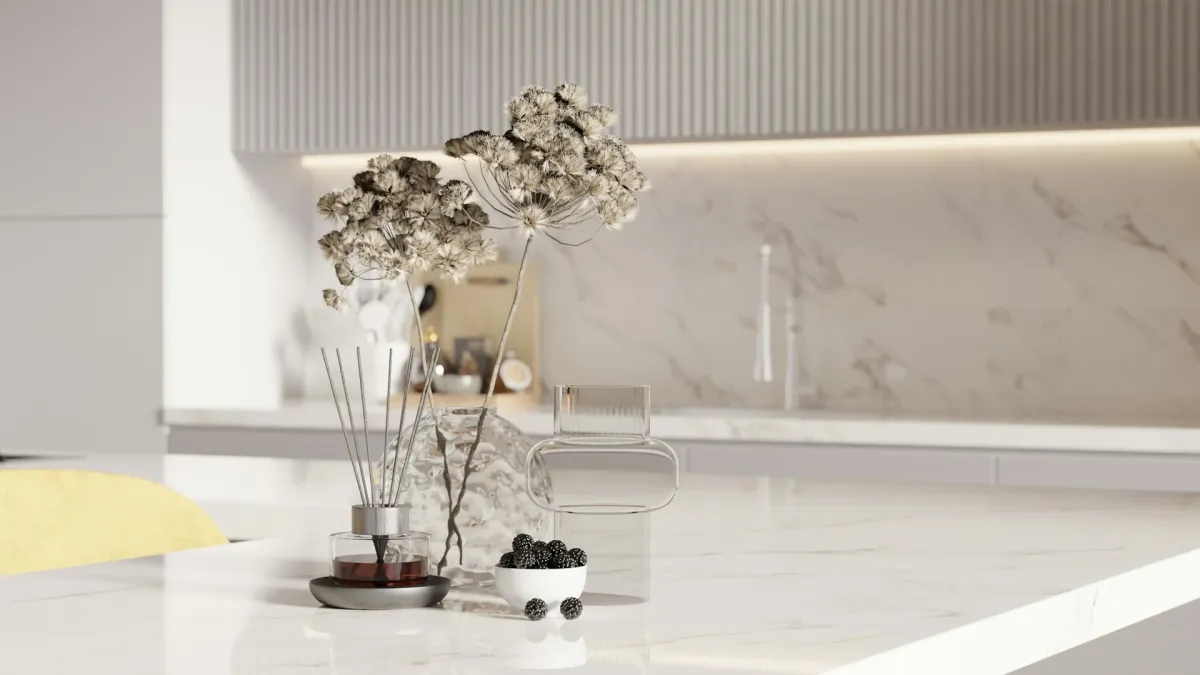
Engineered quartz holds 42 percent of the UK worktop market according to the Houzz study, and its dominance is unlikely to change soon. It offers the visual appeal of natural stone with superior consistency, stain resistance and low maintenance. White and off-white quartz accounts for over half of all worktop choices, though warmer tones like honey, taupe and Calacatta Oro (white with golden veining) are gaining ground. UK prices range from £165 per square metre for budget ranges to £600 or more for premium options.
Sintered stone, led by brands like Dekton and Neolith, is the fastest-growing material in the premium segment. It is virtually indestructible against scratches, heat, UV and staining, and it can be fabricated into large seamless slabs with waterfall edges that flow from the worktop down the sides of an island. Dekton runs from £300 to £600 per square metre installed, with premium finishes reaching £800 or more. For a detailed comparison of quartz, granite and porcelain, see our worktop guide.
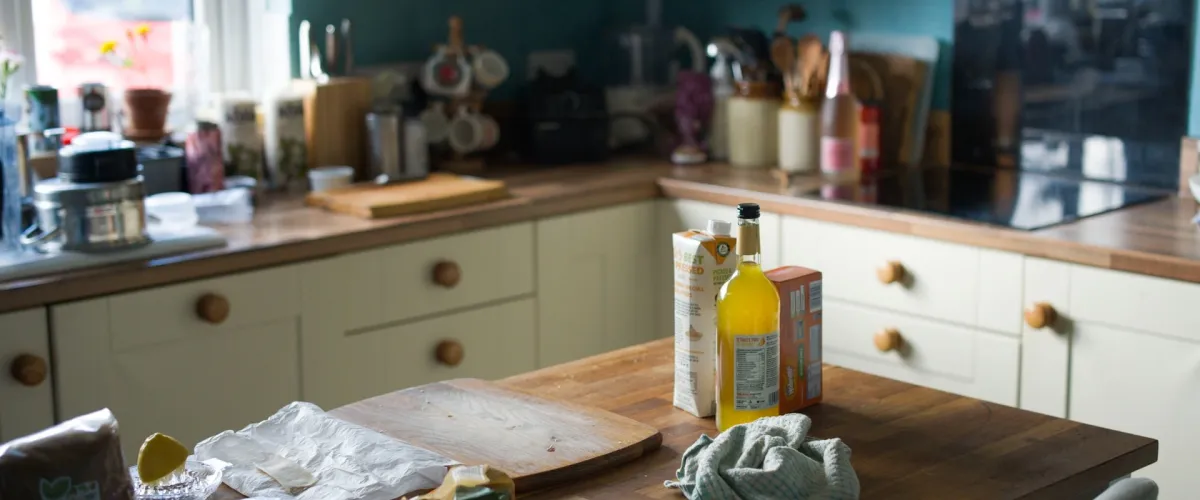
Solid wood remains the first choice for warmth and character, particularly in traditional and period kitchens. Oiled oak costs £120 to £250 per square metre and develops a patina over time that many homeowners prefer to the uniformity of engineered materials. It does require regular oiling and is more vulnerable to heat and water damage than stone alternatives. For worktop replacement options and costs, see our kitchen worktop replacement service page.
Smart Appliances and Boiling Water Taps
Induction hobs are overtaking gas as the default cooking surface in new UK kitchen installations. They heat at roughly 90 percent efficiency compared to 60 percent for gas, respond instantly to temperature changes, and keep the surrounding surface cool enough to touch. The switch has accelerated as energy costs have risen and as homeowners recognise that induction simply cooks better. Neff, Bosch and Siemens lead the UK market, with BORA’s integrated downdraft extraction models gaining a following for island installations where overhead extractors would obstruct sightlines.
Boiling water taps have moved from luxury to near-standard in UK kitchen renovations. The UK market is valued at £470 million and growing at over four percent annually. Quooker remains the market leader, with entry-level models from around £1,250, though the under-counter tank requires significant cupboard space. Franke’s Minerva Helix offers a four-in-one solution at around £1,060. For tighter budgets, Qettle provides similar functionality from £480 to £545. These taps eliminate the kettle from the worktop and reduce energy waste from repeatedly boiling more water than needed.
The Houzz study found that nearly 80 percent of renovating homeowners replace major appliances during a kitchen project, with 67 percent of oven upgrades now incorporating specialist features like steam cooking, sous-vide functions and app-based monitoring. Smart ovens from Neff, AEG and Miele offer remote temperature control, automated programmes and self-cleaning cycles that would have seemed excessive five years ago but are quickly becoming expected.
Layout: From Open-Plan to Broken-Plan
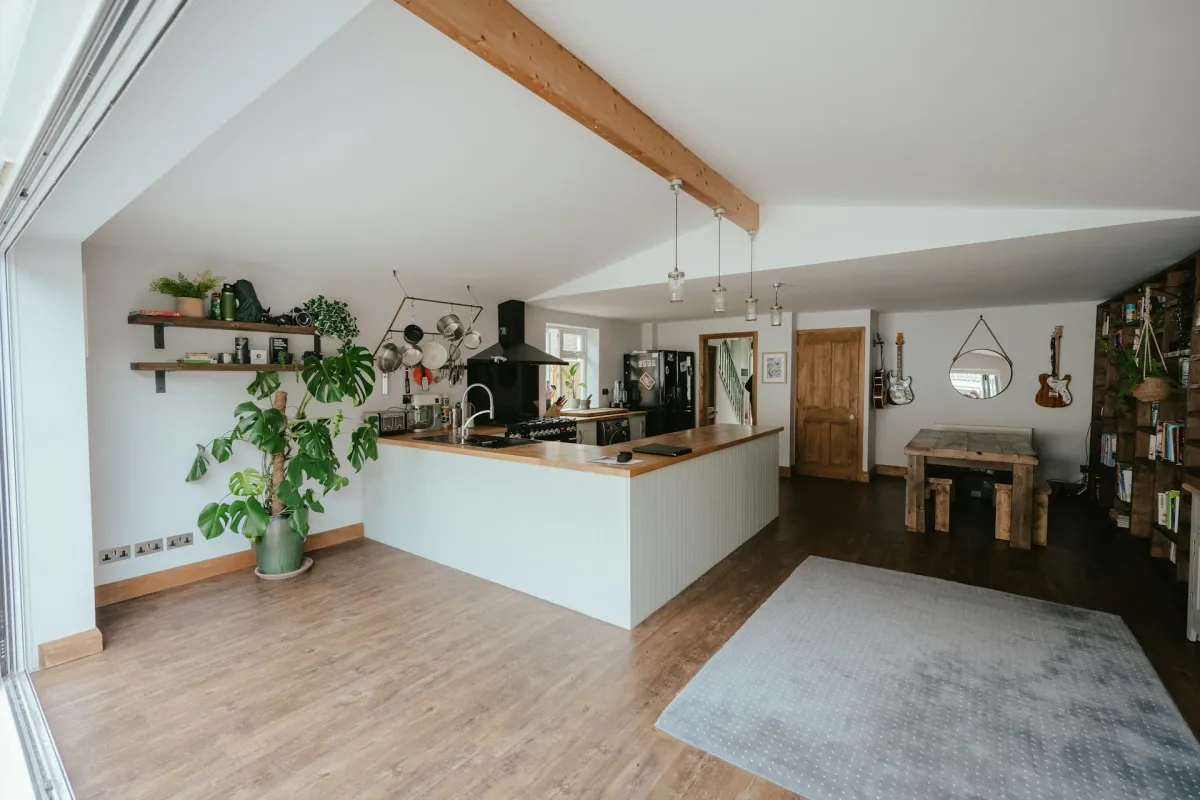
The fully open-plan kitchen-living-dining room that dominated UK renovations for two decades is evolving. Homeowners still want connection between spaces, but experience has taught many that a kitchen on full display while you are trying to relax in the living area is not always ideal. Broken-plan design uses half-height walls, changes in floor level, strategic furniture placement and flooring transitions to create visual separation between zones while retaining flow and sightlines.
Kitchen islands remain central to the layout, with 40 percent of Houzz survey respondents adding or upgrading one. The data on how they are used is telling: 80 percent include drawers, 79 percent have cabinets with doors, and 57 percent incorporate at least one appliance. The island has evolved from a simple prep surface into a genuine working hub. That said, a growing number of homeowners are finding that their island is too large for the space. In average-sized British kitchens, peninsulas and working walls are gaining ground as more space-efficient alternatives that deliver similar functionality.
The pantry revival is one of the most significant storage trends. Modern larder units and walk-in pantries consolidate food storage, small appliances and meal preparation into a dedicated zone that keeps the main kitchen visually clean. Full-height larder units with internal pull-out drawers and shelves are among the most requested features in current UK kitchen specifications. For advice on planning a kitchen remodelling project that includes layout changes, our team can survey your space and advise on what works.
Sustainability in Practice
An eco-conscious kitchen renovation can reduce kitchen energy use by 30 to 40 percent compared to a conventional fit-out. The premium is typically five to 15 percent higher on materials, offset by lower running costs and longer product lifespans.
The most impactful choice is the hob. Switching from gas to induction delivers immediate energy savings. Beyond that, A-rated integrated appliances, LED lighting throughout, and aerated taps that reduce water flow without losing perceived pressure all contribute. Placing the fridge at least 30 centimetres from heat sources improves its efficiency measurably.
Material choices matter too. FSC or PEFC-certified timber for cabinets confirms sustainable forestry sourcing. Recycled-content boards from manufacturers like Egger and Kronospan use post-consumer material without sacrificing structural performance. Low-VOC water-based paints and adhesives protect indoor air quality, which matters particularly in kitchens where heat activates off-gassing from conventional finishes. Bamboo and cork flooring offer renewable alternatives with good durability, while natural linoleum (made from linseed oil and wood flour) is staging a quiet comeback as an eco-friendly kitchen floor.

Flooring and Splashbacks
Luxury vinyl tile (LVT) is the most popular kitchen flooring material in the UK, chosen by 25 percent of renovating homeowners. Its combination of water resistance, warmth underfoot, easy maintenance and increasingly convincing wood and stone reproductions makes it practical for the demands of a kitchen. The key technical development is Embossed in Register (EIR) finishing, which matches surface texture precisely to the printed grain pattern, creating a tactile realism that earlier LVT could not achieve. Herringbone LVT is the single most popular format, adding parquet elegance with none of the moisture vulnerability.
Large-format porcelain tiles (600x600mm or larger) are the second choice, favoured for their durability and the minimal grout lines that make cleaning easier. Engineered wood in herringbone format holds a steady 14 percent share, valued for its authentic timber character and suitability for period properties. Across all materials, the colour trend is shifting from cool grey to warmer, earthier tones: honey oak, caramel, chestnut and natural pale oaks.
For splashbacks, the Houzz study found that 62 percent of homeowners now choose larger-format slab options over traditional tiles, with many extending coverage up to extractor height or beyond. Using the same material as the worktop creates a seamless, upscale connection between surfaces. Full-height tiling, sometimes referred to as tile drenching, is the premium approach for 2026, taking tiles from worktop to ceiling and around windows for a fully immersive effect.
Kitchen Trends at a Glance
| Trend | What Is Happening | Key Data |
|---|---|---|
| Colour | Green dominant, warm neutrals replacing grey | 21% choose green cabinetry (Houzz 2025) |
| Cabinets | Slim Shaker, handleless, fluted surfaces | 78% replace all cabinets during renovation |
| Worktops | Quartz dominant, sintered stone growing fast | 42% choose quartz (Houzz 2025) |
| Islands | Becoming working hubs with appliances | 57% add at least one appliance to island |
| Appliances | Induction hobs, boiling water taps, steam ovens | 80% replace major appliances |
| Layout | Broken-plan replacing fully open-plan | 71% change layout during renovation |
| Flooring | LVT leading, herringbone format dominant | 25% choose LVT (Houzz 2025) |
| Sustainability | Eco materials, induction, LED, low-VOC | 30-40% energy reduction possible |
Frequently Asked Questions
What is the most popular kitchen colour for 2026?
Are handleless kitchens still in style?
What kitchen worktop is most popular in the UK?
Is an open-plan kitchen still a good idea?
What is fluted kitchen cabinetry?
Are boiling water taps worth it?
How much does a kitchen renovation cost in the UK?
Past Projects


Get a Free Quote
Book a free, no-obligation site survey. Call us on 07428 653 653 or request a callback.
Book Free SurveyOur Clients' Reviews

5/5

5/5

5/5

5/5

5/5
Based on 453+ verified reviews across all platforms
Related Articles

How Much Does a New Bathroom Cost in 2026? UK Pricing Guide
What a New Bathroom Really Costs in 2026 The question every homeowner asks before a bathroom renovation is the same. How much? The answer depends on what you want, what you have already, and how much of the existing layout you intend to keep. But the data from thousands of UK projects gives us a clear picture.
view this article Read more
Bathroom Renovation Guide: Every Stage From Start to Finish
What a Bathroom Renovation Actually Involves A complete bathroom renovation is one of the most rewarding home improvement projects you can undertake, but it is also one of the most misunderstood. Homeowners frequently picture the finished result without appreciating the sequence of skilled trades and carefully timed stages that make it happen. Every professional bathroom renovation follows a logical order, and understanding that order is the single most important thing you can do before your project begins.
view this article Read more
Bathroom Tiling Styles for Timeless Elegance
Why Layout Matters More Than the Tile Itself
view this article Read more
Quartz, Granite or Porcelain Worktops: Which Suits Your Kitchen?
The Three-Way Decision Most Kitchen Renovations Come Down To
view this article Read more
Ceramic Disc Technology in Bathroom Taps: How It Works
The Technology Inside Almost Every Modern Tap If your bathroom taps turn with a smooth quarter-turn rather than two and a half rotations, they contain ceramic disc cartridges. This technology has become so dominant that it is now difficult to buy a new tap in the UK that does not use it. Yet most homeowners have no idea how it works, why it fails, or what to do when a ceramic disc tap starts dripping.
view this article Read more

How to Choose an Electrical Bathroom Mirror
What an Electrical Bathroom Mirror Actually Does
view this article Read more
Best Bathroom and Toilet Brands in the UK
What Makes a Good Bathroom Brand The brand name on your toilet, basin or shower valve determines far more than the price tag. It affects how long the product lasts, how easy it is to get replacement parts in five or ten years, whether the finish holds up to daily cleaning, and how well the engineering behind the product actually performs in a real bathroom rather than a showroom.
view this article Read more
Bathroom Underfloor Heating: Types, Installation and What to Expect
Why Underfloor Heating Works So Well in Bathrooms Stepping onto a warm bathroom floor on a cold January morning is one of those small luxuries that, once experienced, becomes very difficult to give up. Underfloor heating has grown from a niche luxury into a genuinely practical heating solution for UK bathrooms, and the reasons go well beyond comfort.
view this article Read more
Tools Required for Bathroom Fitting: The Professional Trade Toolkit
The Professional Bathroom Fitter’s Complete Toolkit Every professional bathroom fitter knows that quality tools are an investment, not an expense. The difference between a flawless installation and a problematic one often comes down to having the right equipment for the job. Over years of bathroom fitting projects across Greater Manchester, we have refined our toolkit to include everything a trade professional needs on site.
view this article Read more
What You Need to Know Before Your Kitchen Renovation
The Gap Between Expectation and Reality A kitchen renovation is not a weekend project. The 2025 Houzz UK Kitchen Trends Study found that 71 percent of homeowners change their kitchen layout during a renovation, and the median spend rose 34 percent year on year to £17,500. Those numbers tell you two things. First, most people end up doing more work than they originally planned. Second, the costs are significant enough that poor preparation leads to genuinely painful surprises.
view this article Read more
Accessible Bathroom Design: UK Regulations, Grants and Guide
Why Accessible Bathroom Design Matters Around 16.8 million people in the United Kingdom have a disability. That is one in four of the population, according to the DWP Family Resources Survey 2023/24, and the figure has risen by 4.9 million over the past decade. Among adults over State Pension age, 45 percent are disabled. The most common impairment types for working-age adults are mental health conditions (48 percent) and mobility impairments (42 percent).
view this article Read more