
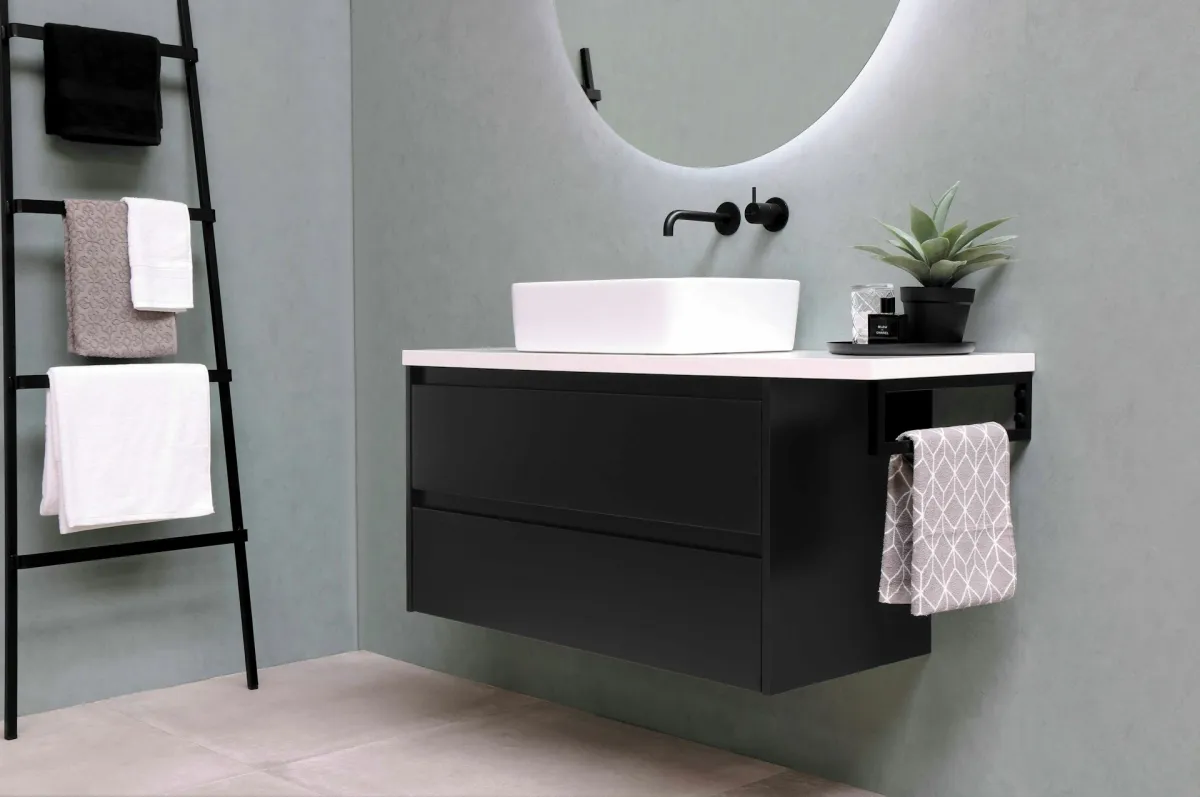
How to Choose an Electrical Bathroom Mirror
How to choose an electrical bathroom mirror: IP zones, LED types, demister pads, Bluetooth, sizing and UK wiring regulations. Brand picks and prices.
What an Electrical Bathroom Mirror Actually Does

An electrical bathroom mirror is a permanently wired fixture that combines a mirror with integrated LED lighting, and often a demister pad, Bluetooth speakers, a shaver socket, or adjustable colour temperature. It replaces the traditional combination of a plain mirror and separate wall lights with a single unit that provides even, shadow-free illumination directly where you need it.
The LED technology inside these mirrors typically lasts 35,000 to 50,000 hours. At three hours of daily use, that is 32 to 45 years before the LEDs begin to dim. Annual running costs sit between £3 and £8 at current electricity prices. The mirror itself draws 8 to 30 watts depending on size and features, roughly equivalent to a single traditional light bulb.
Choosing the right one involves more than picking a shape you like. The electrical zone where the mirror will hang determines the minimum IP rating. The type of LED illumination (backlit, front-lit, or combined) determines whether the mirror provides practical task lighting or purely ambient glow. And the installation must comply with Part P of the Building Regulations, which means a qualified electrician for every hardwired bathroom mirror in the UK.
Bathroom Electrical Zones and IP Ratings
Before choosing any electrical bathroom mirror, you need to know which zone it will occupy. BS 7671 (the 18th Edition Wiring Regulations) divides bathrooms into zones that determine the minimum protection required for any electrical equipment.
Zone 0 is the interior of the bath or shower tray itself. Only 12V SELV (Safety Extra-Low Voltage) equipment rated IPX7 (submersible) is permitted. Mirrors are never installed here.
Zone 1 extends vertically from the top of the bath or shower tray up to 2.25 metres from the finished floor, and horizontally up to 1.2 metres from the shower head fitting. Equipment must be rated at least IPX4 (splash-proof), though IP65 is recommended. Only 12V SELV or 240V equipment on a 30mA RCD-protected circuit is permitted.
Zone 2 extends 0.6 metres horizontally beyond the outer edge of Zone 1, up to 2.25 metres from the floor. Equipment must be rated at least IPX4. Shaver sockets complying with BS EN 61558-2-5 are permitted in this zone.
Outside all zones has no mandatory IP requirement, though IPX1 (drip-proof) is recommended in any bathroom environment. Standard UK electrical accessories are permitted.
IP Ratings Explained
The IP (Ingress Protection) code has two digits. The first rates solid particle protection (0-6), the second rates water protection (0-9).
| Rating | Meaning | Suitable Zones |
|---|---|---|
| IP44 | Protected against objects over 1mm and water splashes from any direction | Zone 2 and outside zones |
| IP65 | Dust-tight and protected against low-pressure water jets from any direction | Zones 1, 2, and outside |
| IP67 | Dust-tight and protected against temporary immersion | All zones including Zone 0 |
Most bathroom mirrors carry an IP44 rating, which is suitable for Zone 2 and beyond. If your mirror will hang directly above or within 1.2 metres of a shower, you need IP65 or higher. Check the IP rating on the product specification before purchasing, not just the marketing description.
Types of Illuminated Mirrors
Backlit Mirrors
Backlit mirrors have LED strips mounted behind the glass, casting light onto the wall to create a soft halo or floating glow around the mirror’s edges. The light is indirect, bouncing off the wall before reaching you. The effect is atmospheric and spa-like, making the bathroom feel calm and spacious. Backlit mirrors typically produce 300 to 800 lumens.
The limitation is practical. Indirect light is not bright enough for detailed grooming tasks. If your bathroom mirror is primarily for shaving, applying makeup, or skincare, a backlit-only mirror will leave you reaching for the overhead light.
Front-Lit Mirrors
Front-lit mirrors have LED strips integrated into the front edge or frame, projecting light directly outward onto your face. This provides bright, even illumination with minimal shadows, making front-lit the better choice for task lighting. Typical output ranges from 800 to 1,800 lumens.
The trade-off is aesthetic. Front-lit mirrors look more functional and less atmospheric than backlit models. The visible light source around the frame can produce slight glare if the LEDs are not well diffused behind a frosted strip.
Edge-Lit and Combination
Edge-lit mirrors embed LEDs within the glass edge itself, creating illuminated borders with a clean, minimalist look. They sit between backlit and front-lit in terms of practical illumination.
Combination mirrors (sometimes called dual-lit) offer both front and back LED strips, allowing you to switch between ambient backlighting and bright task lighting. These are increasingly common in mid-range models from brands like Crosswater and Roper Rhodes, and add approximately £50 to £100 over single-lit equivalents. For bathrooms that serve both relaxation and grooming, a combination mirror eliminates the compromise.
Mirror Cabinets
Mirror cabinets combine storage with illumination in a single wall-mounted unit. LED strips typically run along the top, bottom, or inside the cabinet, with some models offering all three. Standard depths range from 100mm (slim profile) to 170mm (generous storage). Widths run from 300mm for a small cloakroom to 1,500mm for a double vanity installation.
Recessed mirror cabinets sit within the wall cavity for a flush, built-in finish but require sufficient wall depth (typically stud walls with at least 100mm cavity). Surface-mounted cabinets project from the wall and need secure fixings, especially on plasterboard. A loaded cabinet with toiletries, medicines, and grooming products can weigh 15 to 20kg or more.
Features to look for in mirror cabinets include soft-close doors (prevents slamming and protects the mirror), internal shelf lighting (illuminates contents when the door opens), integrated shaver sockets (dual voltage 110V/240V, compliant with BS EN 61558-2-5), and USB charging ports.
Features That Matter
Demister Pads
A demister pad is a thin, self-adhesive heating element stuck to the back of the mirror glass. It warms the glass surface just enough to prevent condensation forming after a shower or bath. In a UK bathroom with limited ventilation and a humid climate, this feature is not a luxury. Without it, you will wipe the mirror with a towel after every shower, leaving streaks and water marks.
Demister pads clear existing condensation in approximately 15 seconds. They work best when activated before the shower starts, preventing steam from settling on the glass at all. Typical wattage ranges from 15W for a small pad to 50W for a standard 500x530mm size. Most built-in demisters activate automatically with the mirror’s light switch or the bathroom lighting circuit. Standalone demister pads (Heat Mat, ThermoSphere, Warmup) cost £15 to £40 and can be retrofitted to any mirror.
Colour Temperature and CRI
Colour temperature, measured in Kelvin, determines whether the light feels warm or cool. Warm white (2,700-3,000K) creates a cosy, relaxing atmosphere similar to incandescent bulbs. Neutral white (4,000K) is closest to natural daylight and the most versatile single choice. Daylight (5,000-6,500K) is bright and energising but can feel clinical in the evening.
Tuneable CCT (Correlated Colour Temperature) mirrors allow you to adjust between warm and cool, typically 3,000K to 6,000K, using a touch control. This flexibility matters if you use the bathroom for both relaxation and detailed grooming. Most mid-range mirrors from HIB, Roper Rhodes, and Crosswater now offer tuneable CCT with a memory function that remembers your last setting.
CRI (Colour Rendering Index) measures how accurately the light renders colours compared to natural sunlight, on a scale to 100. A CRI of 80 is the minimum acceptable for bathroom mirrors. CRI 90 or above is recommended for makeup application and skincare, because lower CRI distorts skin tones and makes colours look wrong. Many budget mirrors do not state their CRI at all, which usually means it is below 80. If grooming accuracy matters to you, check the CRI before buying.
Dimming Controls
Touch-sensor controls (capacitive pads on the mirror surface) are the most common. Tap to switch on and off, long press to dim. Infrared sensors offer contactless activation by waving a hand near the sensor, avoiding fingerprints on the glass. Some Roper Rhodes models feature physical slider controls on the frame edge for precise brightness adjustment. Dimming range is typically 10% to 100%.
Bluetooth Speakers and Shaver Sockets
Integrated Bluetooth speakers (typically 5W, paired via standard Bluetooth from approximately 10 metres) are adequate for background music and podcasts but are not audiophile quality. They add roughly £50 to £100 to the mirror price. Shaver sockets provide dual-voltage (110V/240V) two-pin output for electric shavers and toothbrush charging stands. Both features are convenient but neither is essential. Prioritise demister, colour temperature, and CRI over these secondary features.
Sizing Your Mirror
Width Relative to Vanity
The most reliable sizing rule is that the mirror should be 70-80% of the vanity or basin unit width. On a 600mm vanity, that means a mirror width of 420 to 480mm. On an 800mm vanity, 560 to 640mm. This leaves a comfortable visual margin on each side. In compact bathrooms, a full-width mirror matching the basin width creates an illusion of space, which can be more effective than strict proportional sizing.
For double basins, you have two options: one large mirror spanning both basins (typically 1,000-1,200mm wide), or two matching mirrors centred above each basin. The single mirror creates a more seamless, contemporary look. The two-mirror approach allows individual features (lighting, demister) for each user.
Standard UK Sizes
| Size | Best For |
|---|---|
| 400 x 600mm | Small cloakroom or WC |
| 500 x 700mm | Compact bathroom or ensuite |
| 600 x 800mm | Standard bathroom with 600mm vanity (most popular) |
| 800 x 600mm (landscape) | Wider basins, modern designs |
| D500mm, D600mm, D800mm (round) | Contemporary feature mirrors |
| 1000 x 700mm | Large bathroom or double vanity |
Height Placement
Centre the mirror at eye height, approximately 1,500 to 1,600mm from the finished floor for an average adult. The bottom edge should sit at least 100mm above the tallest tap or fixture to prevent splash damage and allow cleaning access. For accessible bathrooms, lower the centre point to accommodate seated users. Our accessible bathroom design guide covers the full range of inclusive design considerations.
Cabinet Depth
Surface-mounted mirror cabinets project 100 to 170mm from the wall. Before ordering, check that the cabinet depth does not interfere with basin taps or splashbacks. A minimum clearance of 50mm between the open cabinet door and the nearest tap is recommended. Recessed cabinets eliminate the projection issue but require sufficient wall cavity depth and are best specified during the bathroom renovation planning stage rather than retrofitted.
Installation Requirements
Every hardwired illuminated mirror in a UK bathroom is notifiable work under Part P of the Building Regulations. A Part P registered electrician (NICEIC, NAPIT, or ELECSA) must carry out the installation, or the work must be notified to Building Control. Non-compliance is technically illegal and will cause problems when selling the property.
The mirror connects via a hardwired fused spur (fused connection unit), typically rated at 3A for the low power draw of LED mirrors. The fused spur must be located outside Zones 0, 1, and 2, usually in an adjacent cupboard, the landing, or high on the wall outside the zones. Cable runs in conduit within the wall, with a junction box behind the mirror position connecting to the fused spur circuit.
Plan the electrical connection during first fix, before tiling. Specify a 25mm metal back box with conduit and draw wire at the mirror position. Retrofitting electrical connections after tiling is expensive and disruptive. The demister pad typically connects to the same circuit as the mirror lighting, activating automatically when the bathroom lights switch on.
For plasterboard walls, standard plastic wall plugs are not adequate for mirrors weighing more than a few kilograms. Toggle bolts or spring toggles (rated up to 45kg per fixing) are the minimum for most LED mirrors. Mirror cabinets, especially when loaded, should ideally be fixed into timber studs or noggins. If your bathroom is being renovated, ask the carpenter to fit timber noggins between studs at mirror height during the first-fix stage. This provides a solid fixing point for any mirror weight.
UK Brands and What to Expect to Pay
Budget (£60-£200)
HIB (British, established 1992) is the UK’s leading illuminated mirror brand. The Ambience range offers tuneable colour temperature, infrared sensor, and heated demister from around £290 for the 400mm width. The Outline range provides backlit cool white from £383. Entry-level models without demister start from approximately £100. Sensio (UK, part of GHD Group) offers the Aspect range from around £70 at Toolstation, with demister and infrared sensor options. Pebble Grey (UK-designed) offers rechargeable battery-operated mirrors from £130, avoiding hardwiring entirely.
Mid-Range (£200-£500)
Roper Rhodes (British, Bath-based) produces the Calibre range (round, pill, and rectangular from £232-£306), the Loop range with integrated magnifying vanity mirror (£450-£575), and the Frame range with infrared sensor and tuneable CCT. Crosswater (British) offers the Infinity round (colour-change LED, £250-£400) and Svelte rectangular (tuneable CCT 3,000-6,000K, around £311 discounted). Both brands offer brushed brass and matt black finishes alongside chrome.
Premium (£500-£2,000+)
Duravit (German) integrates mirrors with their furniture ranges from around £392 for a rectangular front-lit model. Keuco (German) produces the Edition 400 light mirror from £751 and the Plan adjustable light mirror from £900. Villeroy and Boch offers the My View recessed mirror cabinet range from £923 to £1,876 for the 1,300mm width.
Price by Category
| Category | Typical Price |
|---|---|
| Basic LED mirror (no demister) | £60-£150 |
| Mid-range with demister and touch control | £150-£300 |
| Premium with Bluetooth, dimming, tuneable CCT | £300-£600+ |
| Illuminated mirror cabinet (basic) | £150-£400 |
| Illuminated mirror cabinet (premium) | £400-£1,000+ |
| Designer/luxury (Keuco, Villeroy and Boch) | £750-£2,000+ |
Backlit vs Front-Lit: Which to Choose
| Factor | Backlit | Front-Lit |
|---|---|---|
| Light direction | Indirect (bounces off wall) | Direct (projects onto face) |
| Best for | Ambient mood, spa atmosphere | Shaving, makeup, skincare |
| Typical output | 300-800 lumens | 800-1,800 lumens |
| Shadow elimination | Minimal | Excellent |
| Glare risk | None | Possible if poorly diffused |
| Visual effect | Mirror appears to float | Bright frame/border |
| Ideal bathroom | Guest ensuite, relaxation space | Main family bathroom, vanity station |
If your bathroom serves primarily as a grooming space, choose front-lit or combination. If it is a guest ensuite or a room designed for relaxation, backlit creates the better atmosphere. A combination mirror that offers both modes is the most versatile option and increasingly available in the mid-range price bracket from brands like Crosswater, Roper Rhodes, and HIB.
For help with bathroom electrical work including mirror installation, lighting circuits, and Part P compliance, contact our team for a free, no-obligation quote. Our bathroom fitting service covers the full renovation from first fix to finished room.
Frequently Asked Questions
What IP rating does a bathroom mirror need?
Do I need an electrician to install a bathroom mirror?
What is a demister pad and do I need one?
What is the difference between backlit and front-lit mirrors?
What size mirror should I choose for my bathroom?
What colour temperature is best for a bathroom mirror?
How much does an illuminated bathroom mirror cost in the UK?
Past Projects


Get a Free Quote
Book a free, no-obligation site survey. Call us on 07428 653 653 or request a callback.
Book Free SurveyOur Clients' Reviews

5/5

5/5

5/5

5/5

5/5
Based on 453+ verified reviews across all platforms
Related Articles

How Much Does a New Bathroom Cost in 2026? UK Pricing Guide
What a New Bathroom Really Costs in 2026 The question every homeowner asks before a bathroom renovation is the same. How much? The answer depends on what you want, what you have already, and how much of the existing layout you intend to keep. But the data from thousands of UK projects gives us a clear picture.
view this article Read more
Bathroom Renovation Guide: Every Stage From Start to Finish
What a Bathroom Renovation Actually Involves A complete bathroom renovation is one of the most rewarding home improvement projects you can undertake, but it is also one of the most misunderstood. Homeowners frequently picture the finished result without appreciating the sequence of skilled trades and carefully timed stages that make it happen. Every professional bathroom renovation follows a logical order, and understanding that order is the single most important thing you can do before your project begins.
view this article Read more
Bathroom Tiling Styles for Timeless Elegance
Why Layout Matters More Than the Tile Itself
view this article Read more
Quartz, Granite or Porcelain Worktops: Which Suits Your Kitchen?
The Three-Way Decision Most Kitchen Renovations Come Down To
view this article Read more
Ceramic Disc Technology in Bathroom Taps: How It Works
The Technology Inside Almost Every Modern Tap If your bathroom taps turn with a smooth quarter-turn rather than two and a half rotations, they contain ceramic disc cartridges. This technology has become so dominant that it is now difficult to buy a new tap in the UK that does not use it. Yet most homeowners have no idea how it works, why it fails, or what to do when a ceramic disc tap starts dripping.
view this article Read more

Best Bathroom and Toilet Brands in the UK
What Makes a Good Bathroom Brand The brand name on your toilet, basin or shower valve determines far more than the price tag. It affects how long the product lasts, how easy it is to get replacement parts in five or ten years, whether the finish holds up to daily cleaning, and how well the engineering behind the product actually performs in a real bathroom rather than a showroom.
view this article Read more
Bathroom Underfloor Heating: Types, Installation and What to Expect
Why Underfloor Heating Works So Well in Bathrooms Stepping onto a warm bathroom floor on a cold January morning is one of those small luxuries that, once experienced, becomes very difficult to give up. Underfloor heating has grown from a niche luxury into a genuinely practical heating solution for UK bathrooms, and the reasons go well beyond comfort.
view this article Read more
Tools Required for Bathroom Fitting: The Professional Trade Toolkit
The Professional Bathroom Fitter’s Complete Toolkit Every professional bathroom fitter knows that quality tools are an investment, not an expense. The difference between a flawless installation and a problematic one often comes down to having the right equipment for the job. Over years of bathroom fitting projects across Greater Manchester, we have refined our toolkit to include everything a trade professional needs on site.
view this article Read more
What You Need to Know Before Your Kitchen Renovation
The Gap Between Expectation and Reality A kitchen renovation is not a weekend project. The 2025 Houzz UK Kitchen Trends Study found that 71 percent of homeowners change their kitchen layout during a renovation, and the median spend rose 34 percent year on year to £17,500. Those numbers tell you two things. First, most people end up doing more work than they originally planned. Second, the costs are significant enough that poor preparation leads to genuinely painful surprises.
view this article Read more
Accessible Bathroom Design: UK Regulations, Grants and Guide
Why Accessible Bathroom Design Matters Around 16.8 million people in the United Kingdom have a disability. That is one in four of the population, according to the DWP Family Resources Survey 2023/24, and the figure has risen by 4.9 million over the past decade. Among adults over State Pension age, 45 percent are disabled. The most common impairment types for working-age adults are mental health conditions (48 percent) and mobility impairments (42 percent).
view this article Read more
Bathroom Renovation Environmental Impact: Water, Energy and Waste
Why Your Bathroom Renovation Has a Bigger Environmental Footprint Than You Think
view this article Read more