
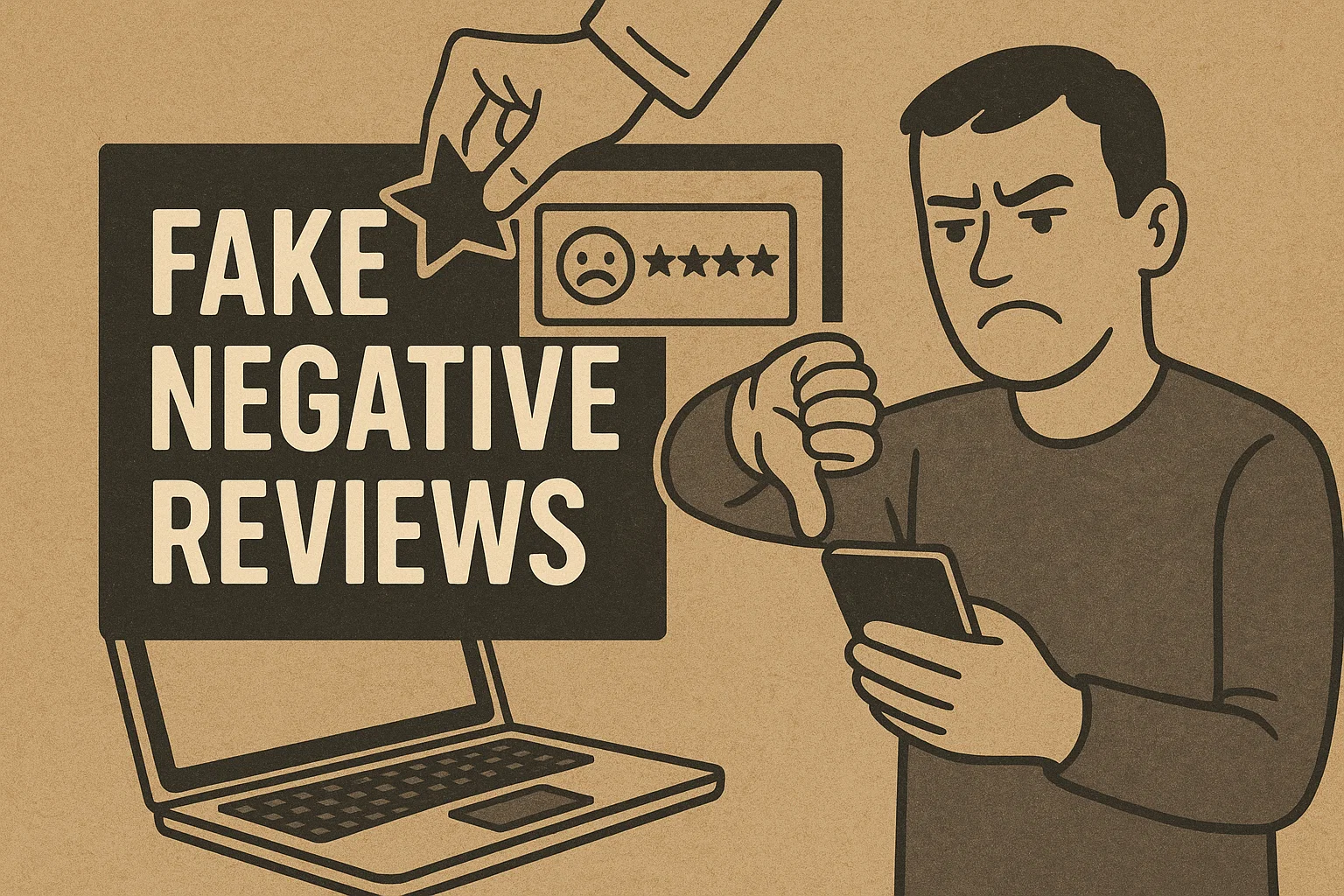
How Small Businesses Are Being Targeted by Fake Negative Reviews
Fake negative reviews are targeting UK small businesses. Learn how to identify patterns, report to Google and the CMA, and protect your reputation.
What Fake Reviews Look Like
Fake negative reviews usually follow a recognisable pattern. Some common red flags include:
- Vague or generic complaints – Reviews that lack specific details about the service, product, or experience.
- No record of interaction – Businesses often cannot find any record of the reviewer being a customer.
- Repetitive wording – Multiple reviews using nearly identical phrasing, suggesting coordinated posting.
- Anonymous or newly created accounts – Reviewers with no history or with suspiciously similar profiles.
- Exaggerated negativity – Reviews that use overly dramatic language without providing factual information.
- Unrelated complaints – Sometimes a review will describe services or products the company does not even provide, making it clear the feedback was copied and pasted without relevance.
- No proof of purchase or invoice details – Genuine reviews often reference an invoice number, order ID, or project details, while fake ones lack any verifiable transaction information.
- Lack of supporting evidence – Fake reviewers rarely attach photos of completed work, receipts, or documents that back up their claims.
- Hidden or non-existent reviewer history – Profiles posting fake reviews often have no visible activity, or their entire history is hidden from the public.
- Suspicious formatting – Many fake reviews begin or end with quotation marks, a telltale sign they may have been copied from AI text generators or template-driven scripts.
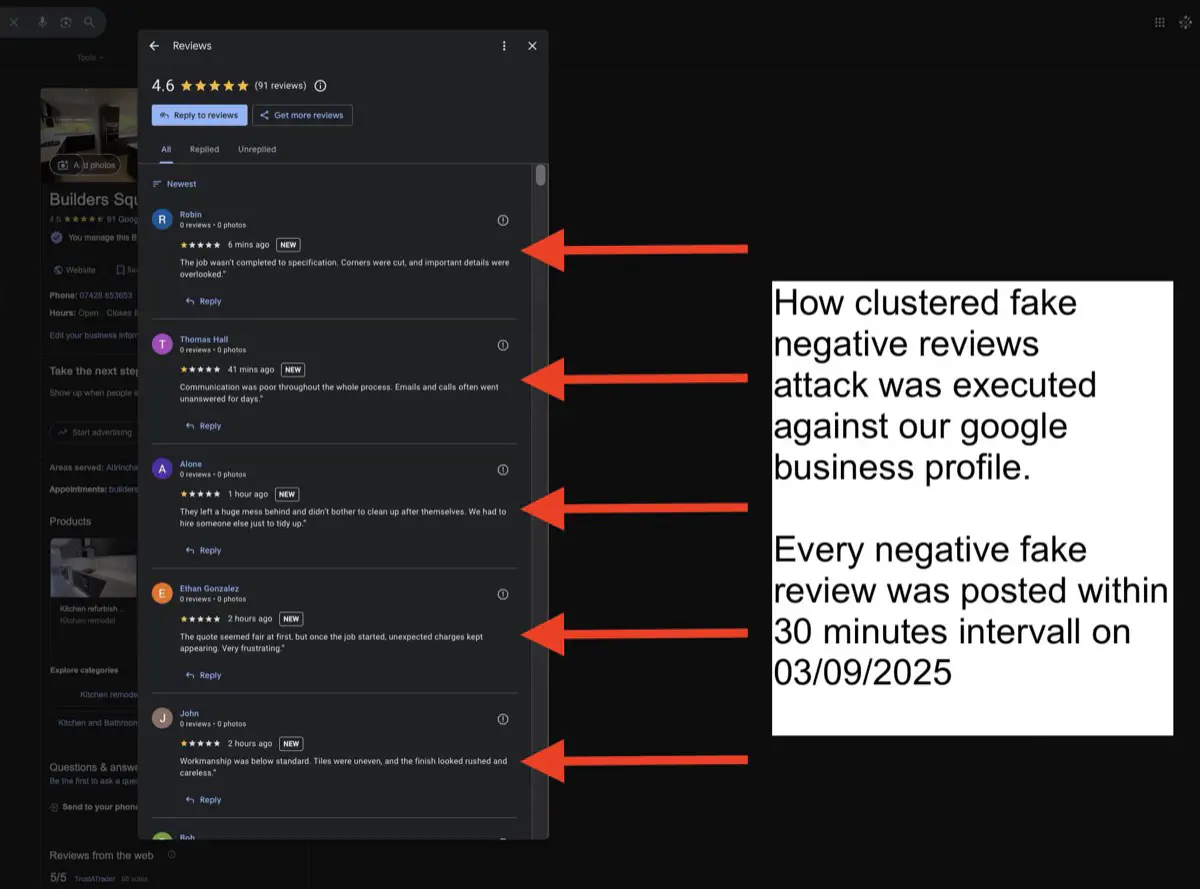
- Unnatural posting frequency – One of the clearest signs of automated activity is the timing. Fake reviews are often placed in rigid intervals — every 30 minutes, every hour, or at the same time each day — a pattern that strongly suggests the use of bots and algorithms for automatic posting.
For example, a long-standing client-focused company like Builders Squad Ltd may suddenly receive several one-star reviews from individuals who never used their services. These reviews often appear in clusters, pointing to organised campaigns rather than genuine customer dissatisfaction.
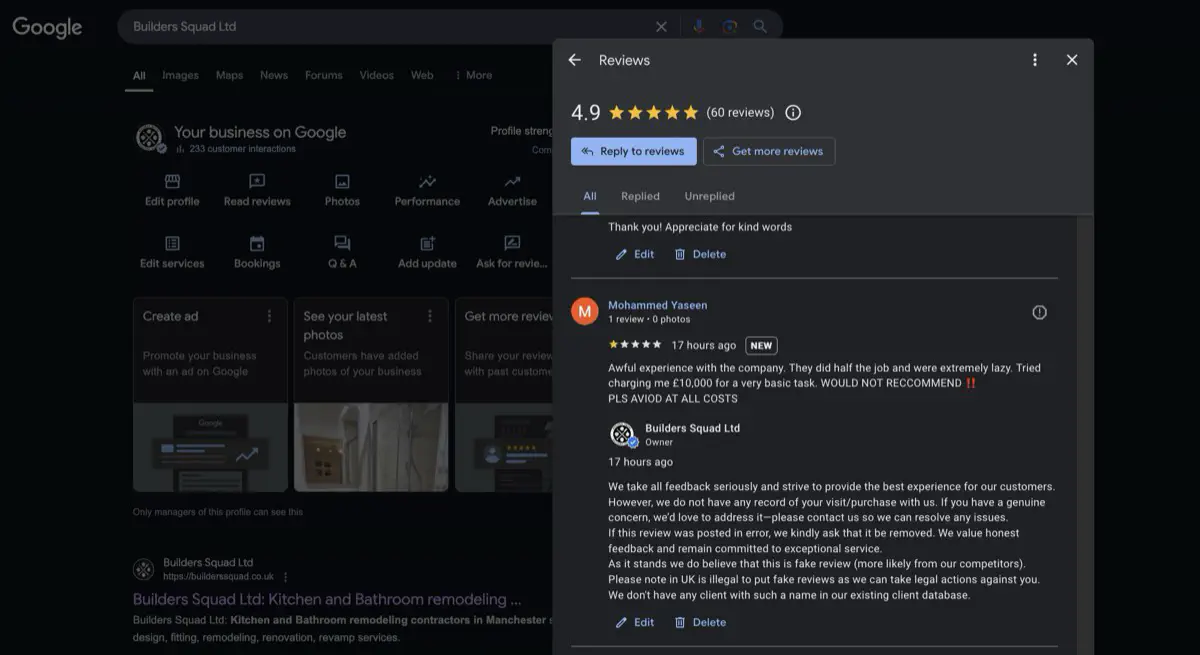
Few Real World Examples of Negative Fake Reviews Attacks on our Business Profiles:
An example of clustered fake negative reviews attack (Some reviews at the end still left with double quotes - fake reviewer couldn’t properly copy & paste content generated by ChatGPT or similar bot):
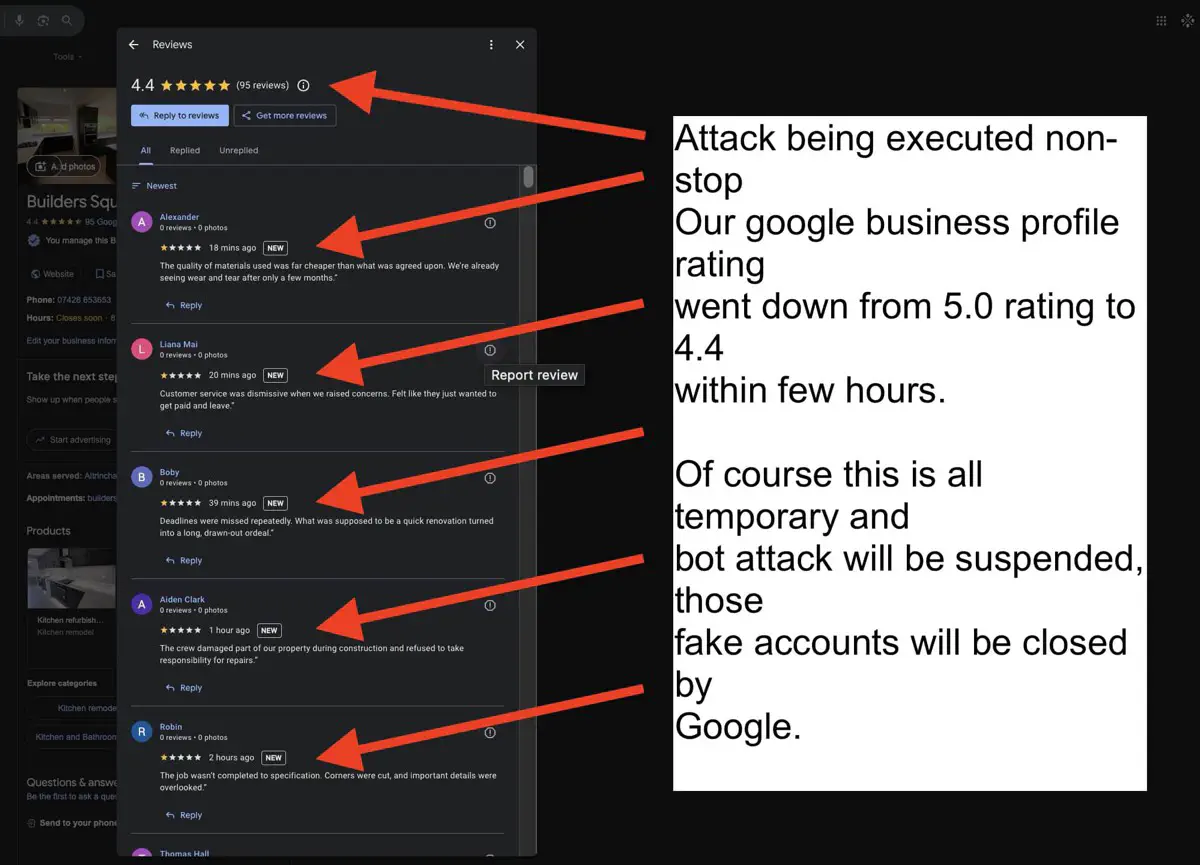
How same attack looks like after few hours:
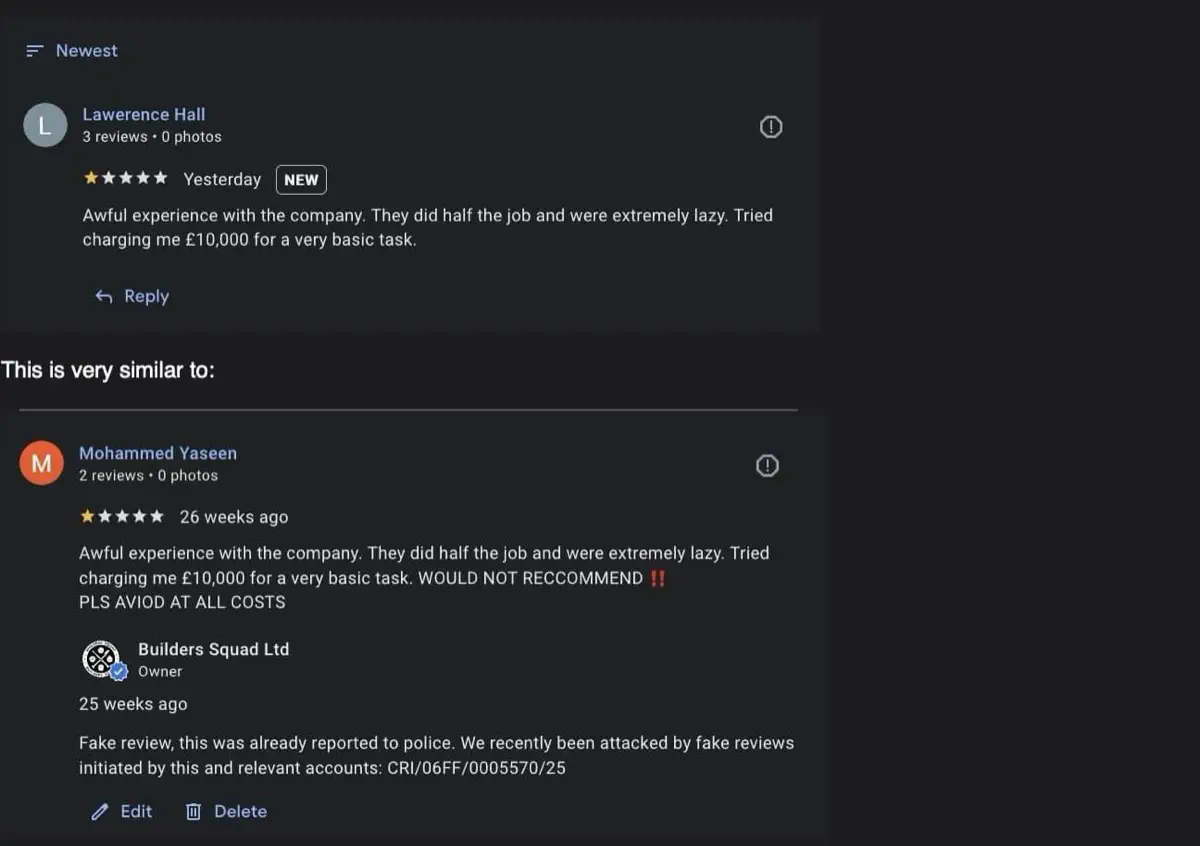
Another example of fake negative review with wording re-used in another fake review:
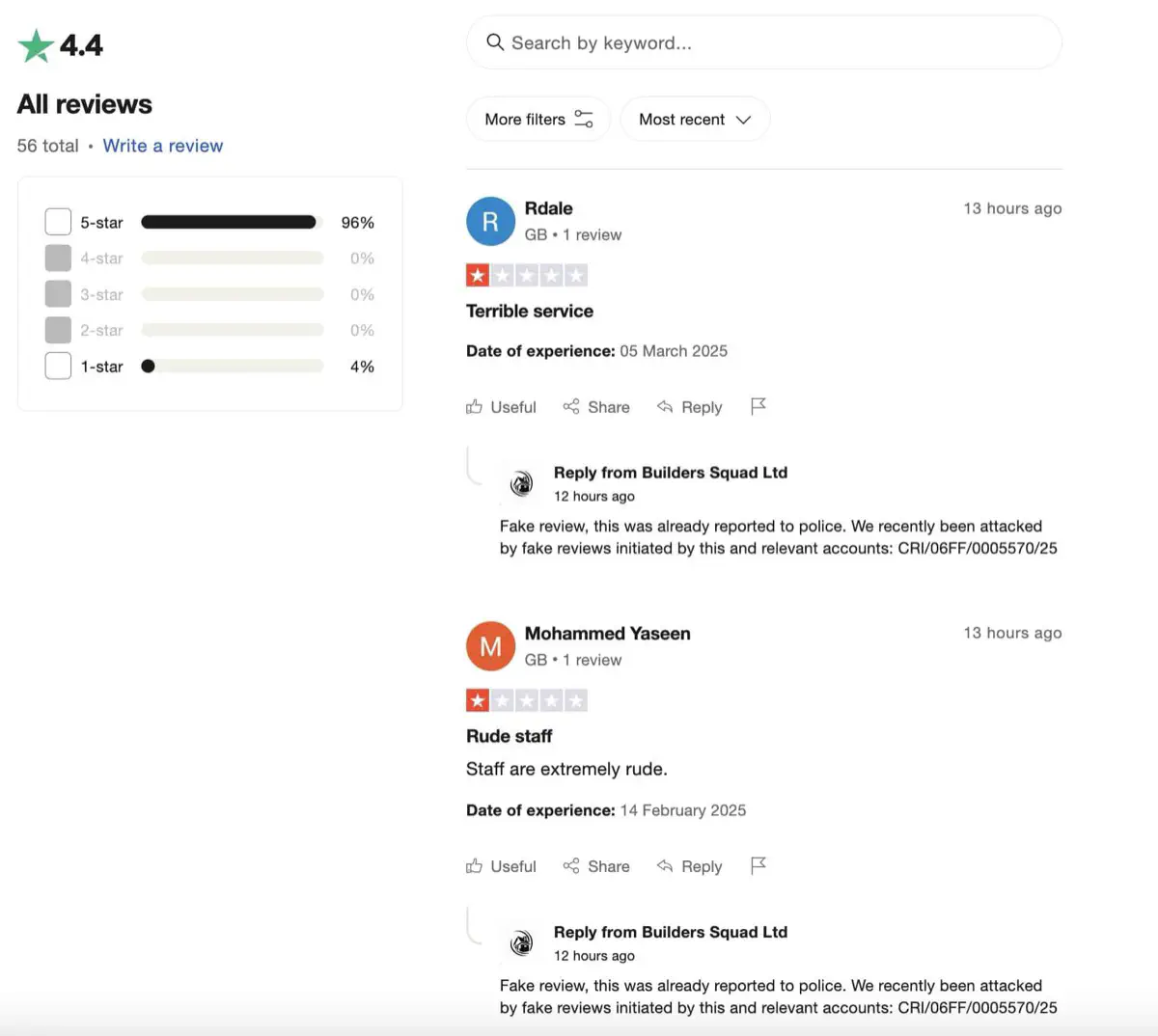
Example of same Google accounts being utilised on different review platforms, however with different wording this time:
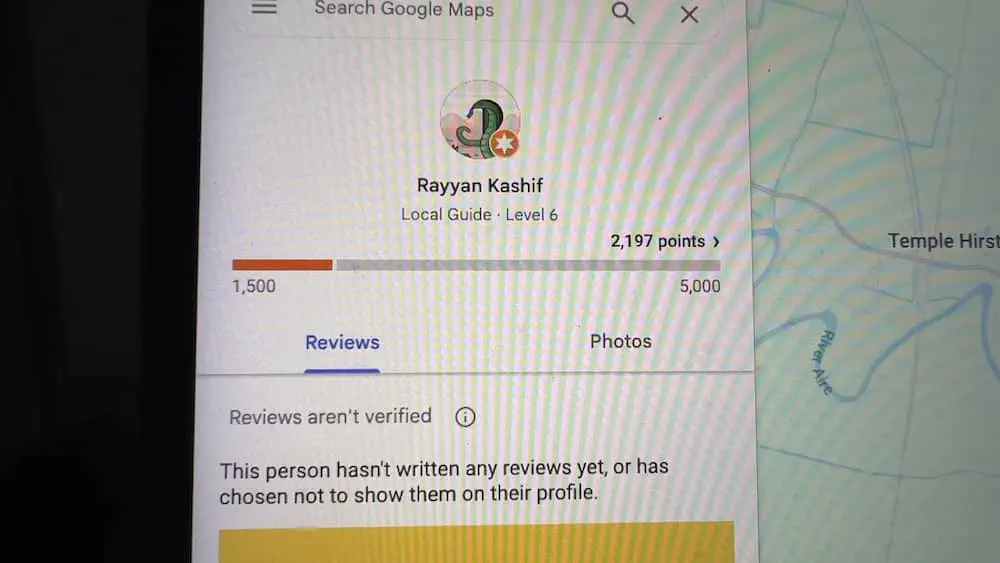
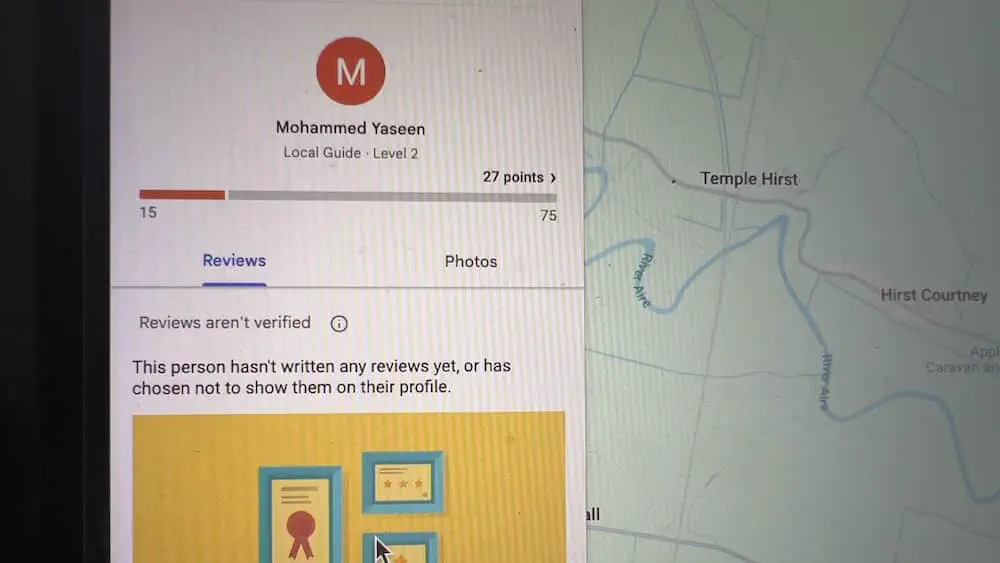
An example how fake reviewers profiles looks like who leaving fake negative reviews (they are disabling visibility of their reviews to eliminate any traces, however traces are still detectable with help of cyber sec tools):
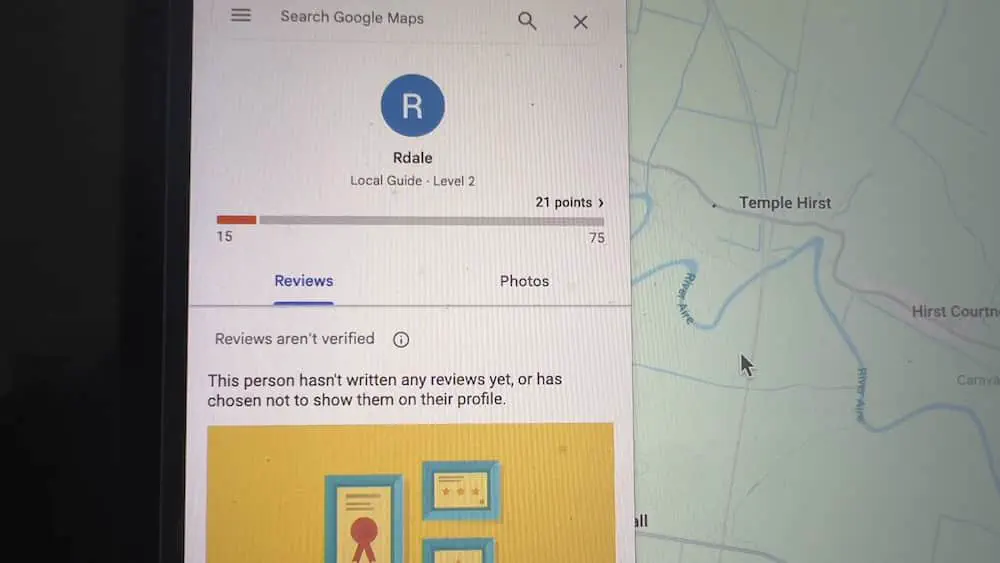
Tracing fake reviewers:
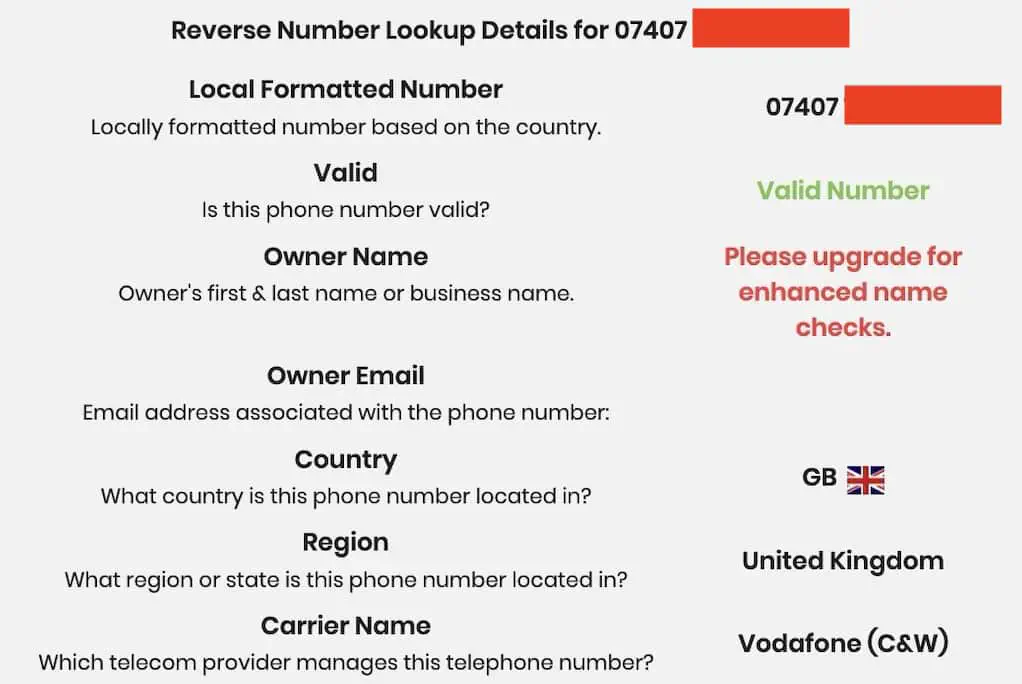
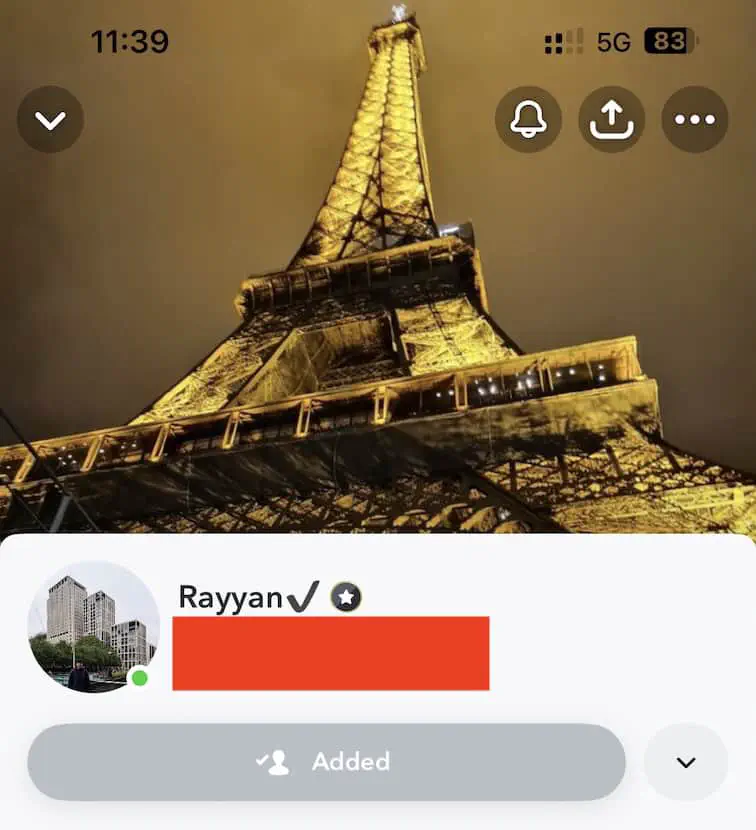
Exposing fake reviewers:
Coordinated Attacks and Extortion Attempts
In some cases, fake negative review campaigns are not random but part of a deliberate extortion strategy. After a wave of negative reviews appears, businesses often receive unsolicited messages through communication channels such as WhatsApp, text messages or email. These messages typically come from so-called “SEO agencies” openly admitting that they initiated the attack on behalf of a third party.
Their goal is straightforward: to pressure businesses into making a bounty payment in exchange for stopping the attacks. This practice not only damages reputations but also places small businesses under financial and emotional stress, forcing them to deal with criminals rather than focusing on serving their customers.
An example of typical fake “SEO Agency” communication via WhatApp message:
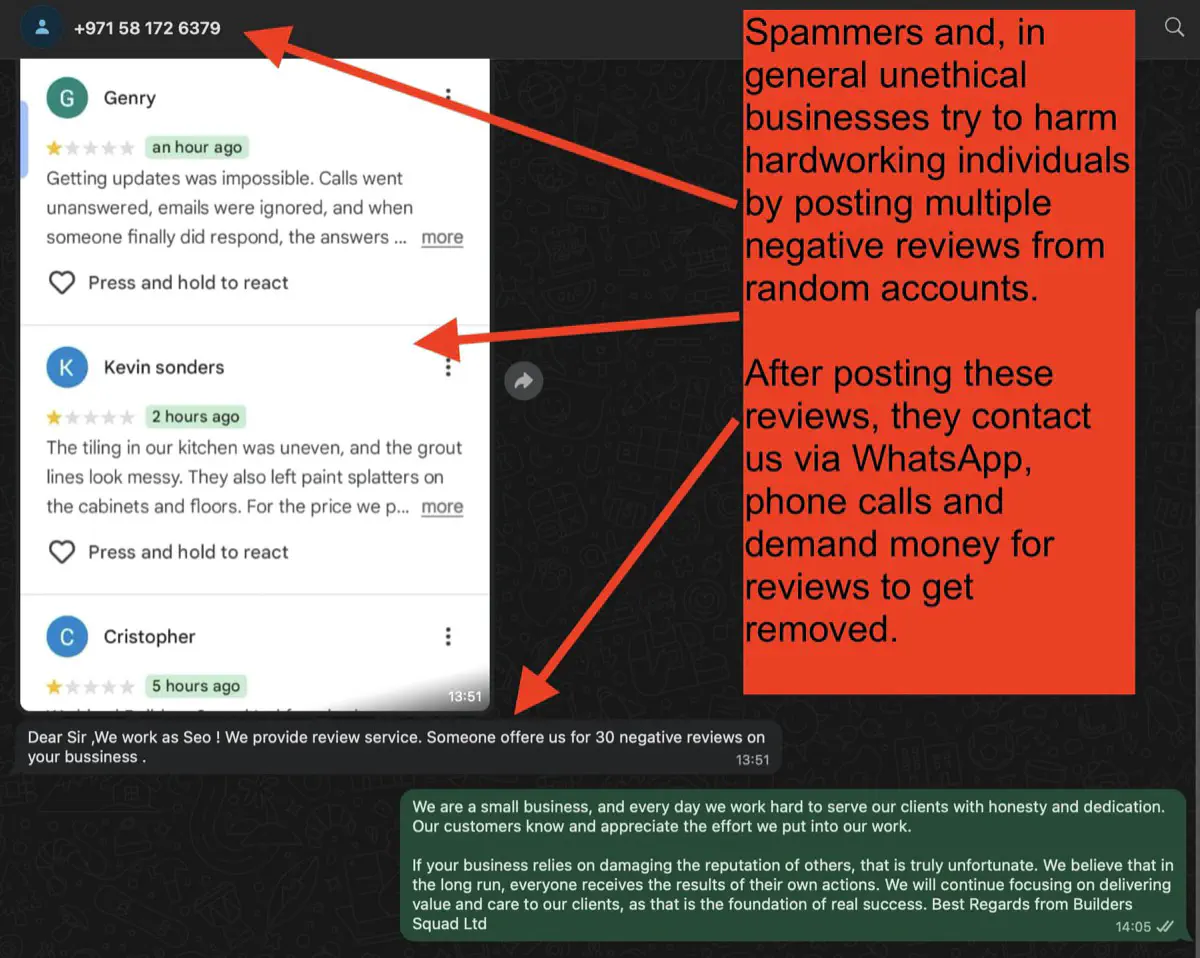
For companies like Builders Squad Ltd, such attempts are treated with zero tolerance and reported to the appropriate authorities, as extortion of this nature represents a serious cybercrime.
Why Small Businesses Are Targeted by Negative Fake Reviews
There are several reasons why businesses become victims of fake negative reviews:
- Unethical Competitors Some competitors resort to posting fake negative reviews to discredit rivals and capture market share. In highly competitive industries like construction, renovations, and home improvements, the pressure to outshine rivals can lead to these dishonest tactics.
- Paid Negative Review Campaigns There is a growing underground market for buying fake reviews. Individuals and companies can pay third-party agencies or freelancers to flood competitors with fabricated negative reviews, damaging their reputation almost overnight.
- SEO Manipulation Search engines take reviews into account when ranking local businesses. A sudden influx of negative reviews can lower a business’s ranking, making it harder for potential customers to find them. Competitors may use this strategy to push their own businesses higher in search results.
- Customer Trust Erosion A strong reputation is built on trust. Fake negative reviews are designed to sow doubt in the minds of potential customers. Even a handful of poor ratings can outweigh dozens of genuine positive ones, causing customers to second-guess their choices.
- Malicious Intent Sometimes fake reviews are posted not by competitors but by disgruntled individuals, spammers, or trolls seeking to harm a business without any direct benefit to themselves.
- Large Corporations Using Proxies In some industries, dominant corporations that control lead-generation or advertising markets may use third-party proxy companies to discredit smaller, successful businesses. By eliminating strong independent players, they can preserve their dominance and reduce competition.
- Unfortunate Job Seekers Individuals who apply for jobs but are not hired sometimes retaliate by leaving damaging reviews. These reviews are usually unrelated to customer experience, but they still appear publicly and can mislead potential clients.
- Rejected Marketing Agencies Small businesses are also targeted by marketing or SEO agencies whose proposals were declined. Out of spite or to pressure the business into a contract, these agencies may launch fake review attacks as a form of revenge.
The Impact on Reputable Businesses
For companies like Builders Squad Ltd, which rely heavily on client trust and word-of-mouth recommendations, fake negative reviews can have a disproportionate effect:
- Lost Business Opportunities – Prospective customers may avoid contacting a business with negative ratings.
- Time and Resources Wasted – Business owners must spend valuable time disputing fake reviews and appealing to review platforms for removal.
- Unfair Reputation Damage – Years of hard work can be undermined by just a few dishonest actors.
Protecting Against Fake Negative Reviews
While businesses cannot always prevent fake reviews, there are proactive steps they can take to minimise damage and protect their reputation:
- Regularly monitor review platforms – Assign a team member or use automated monitoring tools to keep track of new reviews on platforms such as Google, Trustpilot, and Yelp. Early detection of suspicious activity allows businesses to respond promptly before reputational harm spreads.
- Report and dispute fake reviews – Most platforms offer reporting mechanisms where businesses can flag reviews that violate guidelines. Although removal can take time, documenting evidence (such as absence of client records or invoice numbers) strengthens the case for deletion.
- Encourage genuine customers to leave reviews – The best defence against fake reviews is a steady flow of authentic feedback. Politely ask satisfied clients to share their experiences online. Verified photos, receipts, or detailed testimonials help drown out fraudulent postings and restore balance. Our portfolio gallery shows examples of genuine completed projects that speak for themselves.
- Communicate transparently with clients – When fake reviews appear, issue a calm and professional response. Clarify that the reviewer cannot be identified as a client and invite them to contact the business directly with supporting details. This reassures genuine customers that the company values accountability and transparency.
- Share and escalate evidence – Fake reviewers often hide behind anonymity, but some leave traces such as profile photos, identical email structures, or repeated posting patterns. Collecting and sharing this evidence with Meta, Google, Trustpilot, and other platforms helps to strengthen takedown requests. Publishing patterns of suspicious activity (without breaching privacy laws) also warns other businesses about active review scams.
- Seek legal or regulatory recourse – If there is evidence that competitors or agencies are behind coordinated fake review campaigns, businesses should consider involving legal professionals. In the UK, defamation and cybercrime laws may apply, and complaints can be filed with relevant authorities or trading standards bodies.
- Educate customers about fake reviews – Posting guidance on the company’s website or social channels about how to spot fake reviews builds awareness and reinforces credibility. Customers who understand the issue are less likely to be swayed by fabricated claims.
- Use reputation management services cautiously – Some legitimate agencies specialise in monitoring and protecting businesses from fake reviews. While these services can be helpful, companies must carefully vet providers to avoid working with unethical actors who might also be behind such attacks.
- Keep records of all interactions – Maintaining thorough documentation of projects, invoices, contracts, and customer communications ensures that businesses can prove or disprove claims when reviews are challenged. This evidence is critical in disputes.
- Strengthen cybersecurity practices – Many fake review attacks are accompanied by phishing attempts or extortion messages. Securing business communication channels, training staff to recognise scams, and reporting extortion attempts to authorities helps protect against broader digital threats.
By combining vigilance, customer engagement, reporting evidence to tech platforms, and legal awareness, businesses like Builders Squad Ltd can protect their hard-earned reputation and continue to grow despite dishonest online practices.
Final notes
In the UK, several high-profile cases highlight how seriously regulators treat fake reviews. One of the earliest enforcement actions came against Total SEO & Marketing Ltd, a search engine optimisation company that had posted more than 800 fake positive reviews on behalf of 86 small businesses across multiple platforms. The Competition and Markets Authority (CMA) required the company to remove the fraudulent reviews and formally commit to ceasing such practices. More recently, large platforms have also been held accountable. Following CMA investigations, both Google and Amazon agreed in 2025 to strengthen their systems for detecting and removing fake reviews, and to sanction sellers or users abusing their platforms. Similarly, Facebook was forced to remove thousands of groups and accounts that were facilitating the sale and exchange of fabricated reviews. Alongside these enforcement measures, the UK government has reinforced the legal framework through the Consumer Protection from Unfair Trading Regulations 2008 and, more recently, the Digital Markets, Competition and Consumers Act 2024, which explicitly bans fake or misleading reviews. The CMA has also issued warning letters to businesses found without adequate policies for review compliance, noting that more than half of firms checked were failing to meet legal standards. These examples show that both businesses and platforms can face serious consequences for engaging in or enabling fake reviews, with penalties ranging from fines and compliance orders to reputational damage.
Past Projects


Get a Free Quote
Book a free, no-obligation site survey. Call us on +44 7428 653 653 or request a callback.
Book Free SurveyOur Clients' Reviews

5/5

5/5
5/5

5/5
Based on 453+ verified reviews across all platforms
Related Articles

Bathroom Tap Finishes: Chrome, Brass, Matt Black and Beyond
The Finish You Choose Outlasts Every Other Bathroom Decision Tiles can be re-grouted. Paint can be refreshed in a weekend. But the finish on your taps, shower valves and accessories is permanent for the life of the fitting.
view this article Read more
Top 10 Shower Mixers You Can Buy in the UK
Why Your Shower Mixer Matters The shower mixer is the heart of your shower system. A good one delivers stable temperature, consistent flow and reliable performance for years.
view this article Read more
Bathroom Renovation Mistakes and How to Avoid Them
Why Bathroom Renovations Go Wrong Most bathroom renovations that end badly were doomed before the first tile came off the wall.
view this article Read more
Electric Shower Not Working? Expert Troubleshooting Guide
Why Electric Showers Fail and What You Can Do About It Electric showers heat water on demand using a powerful element, drawing between 7.
view this article Read more
Asbestos in Bathrooms and Kitchens: Risks, Safety and UK Law
What Is Asbestos? Asbestos refers to a group of six naturally occurring silicate minerals made up of fine, durable fibres. Because of its strength and fire resistance, it was commonly used in insulation materials, roofing and flooring products, cement compounds, automotive parts and fireproof textiles.
view this article Read more
Hiring Bathroom Fitters in Manchester: Costs, Process and Advice
What Manchester Homeowners Need to Know Before Hiring Renovating a bathroom is one of the most rewarding home improvements you can make, and one of the easiest to get wrong if you hire the wrong people.
view this article Read more
The Best Toilet Brands for Your Home: A UK Buyer's Guide
Choosing a Toilet Brand: What Actually Matters Selecting a toilet brand might seem less important than choosing a specific model, but the manufacturer behind your toilet determines the quality of the ceramic, the reliability of the flush mechanism, the availability of spare parts years down the line, and the level of after-sales support when something eventually needs attention.
view this article Read more
Bathroom Remodelling Ideas for Greater Manchester Homeowners
Remodelling Ideas That Work for Manchester Homes Greater Manchester homes come with character. Victorian terraces in Didsbury, semi-detached houses in Prestwich, post-war estates in Salford, new builds in Trafford.
view this article Read more
How to Replace a Shower with a Bath
Replacing a shower with a bath is an excellent way to enhance both the functionality and comfort of your bathroom, especially if you’re accommodating a growing family.
view this article Read more
How to Find the Best Bathroom Fitters Near You
Finding a Bathroom Fitter You Can Trust Searching for “bathroom fitters near me” returns dozens of results, but a Google listing tells you almost nothing about whether a contractor will deliver quality work on time, stay within budget, and stand behind their installation for years to come.
view this article Read more
Small Bathroom Ideas for British Homes
Making the Most of a Small British Bathroom The average bathroom in a British home measures roughly 2.2 metres by 1.
view this article Read more
Bathroom Tile Trends in 2026
What Is Shaping Bathroom Tile Design in 2026 The bathroom has long since outgrown its reputation as a purely functional room.
view this article Read more