
Quartz, Granite or Porcelain Worktops: Which Suits Your Kitchen?
Quartz vs granite vs porcelain kitchen worktops compared. UK prices, brand picks, heat tests, maintenance and which suits your kitchen.
The Three-Way Decision Most Kitchen Renovations Come Down To

Once you have decided that laminate is not enough and solid wood is not right for your cooking habits, the conversation narrows quickly. Quartz, granite, or porcelain. Three engineered and natural stone options that dominate the mid-to-premium UK kitchen market. The 2025 Houzz UK Kitchen Trends Study found that 42% of renovating homeowners chose quartz, making it the single most popular material. Granite held steady at around 18%, and porcelain slab (including sintered stone products like Dekton and Neolith) climbed to 12%, the fastest-growing category in the premium segment.
All three materials are hard, durable, and beautiful. All three cost significantly more than laminate. And the differences between them, while critical for long-term satisfaction, are not always obvious in a showroom. This guide breaks down exactly where each material excels, where each falls short, and how to match the right stone to the way you actually use your kitchen.
For a broader comparison that includes laminate, solid wood, Corian, stainless steel and recycled glass, our complete kitchen worktop guide covers all ten material categories. If your project involves a full kitchen overhaul, our kitchen renovation guide provides the wider planning framework.
Engineered Quartz
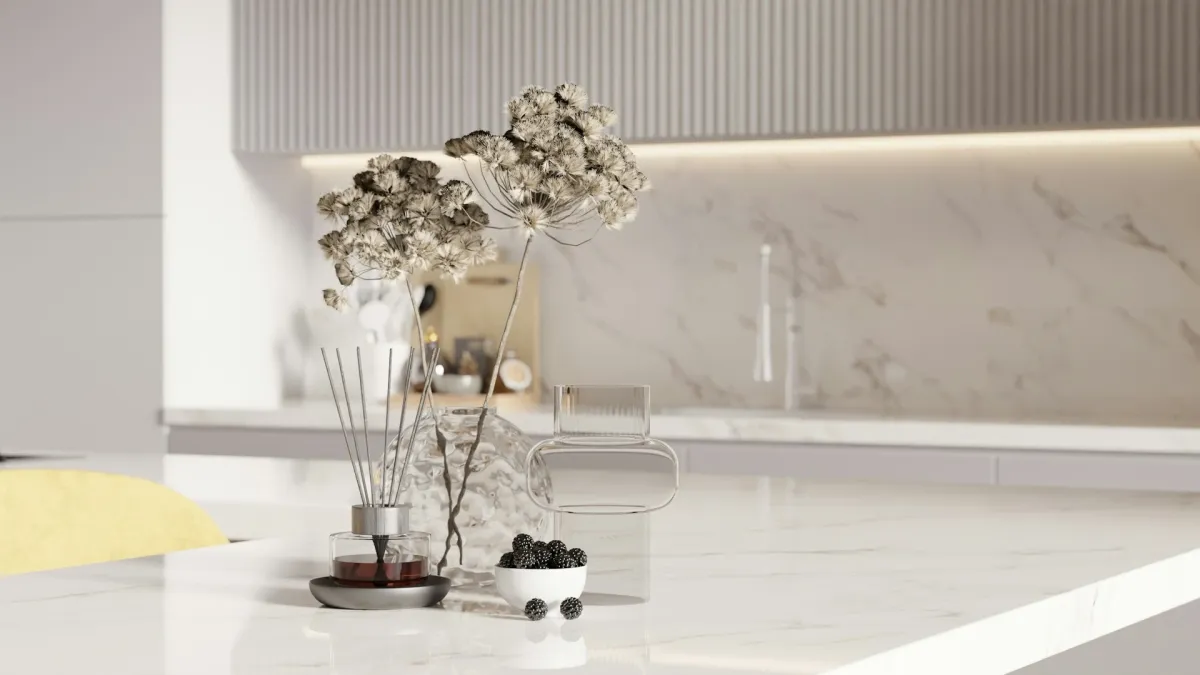
Engineered quartz is manufactured from 90-94% ground natural quartz crystals bound with polymer resin and pigments. The manufacturing process creates a material that is completely non-porous, never needs sealing, and can be produced in an almost unlimited range of colours and patterns. Calacatta-effect quartz (white with grey or gold veining mimicking Italian marble) is the single most requested finish in UK kitchen showrooms right now.
Performance
Quartz scores 7 on the Mohs hardness scale, the same as natural granite, making it virtually scratchproof under normal kitchen use. Its non-porous surface means bacteria, wine, coffee, turmeric and other household staining agents cannot penetrate the material. Cleaning requires nothing more than warm water and a mild detergent.
The critical weakness is heat. The polymer resin that binds the quartz crystals begins to discolour at sustained temperatures above 150°C. A hot pan placed directly on the surface can leave a permanent white mark or, in severe cases, crack the resin. Trivets and heat mats are essential with quartz. This single limitation is the main reason some homeowners choose granite or porcelain instead.
UK Brands and Pricing
The UK quartz market is competitive, with clear quality and price tiers.
| Brand | Origin | Price (per m² installed) | Warranty | Notes |
|---|---|---|---|---|
| Compac | Spain | From £250 | 25 years | Entry-level engineered quartz, good colour range |
| CRL Quartz | UK distribution | From £399 | 25 years | Includes template, fabrication, installation |
| Caesarstone | Israel | From £350 | 25 years (residential) | Premium finishes, excellent consistency |
| Silestone | Spain (Cosentino) | From £449 | 25 years | Market leader, HybriQ+ sustainable range, N-Boost technology |
| Cambria | USA | From £500 | Lifetime (limited) | Premium tier, natural quartz patterns |
For a typical 5 linear metres of worktop (standard U-shaped or L-shaped kitchen), supply and installation costs range from £1,260 to £4,200 depending on brand, thickness (20mm or 30mm), edge profile, and number of cutouts.
Best Suited For
Quartz is the right choice for households that want a maintenance-free surface with guaranteed colour consistency. It suits families with young children (no sealing chemicals, no bacteria harbourage) and anyone who prioritises a specific design aesthetic, because the manufactured colour range is far wider than anything available in natural stone. It is less suited to kitchens where hot pans regularly come off the hob and land directly on the worktop.
Natural Granite
Granite is an igneous rock formed from cooled magma over millions of years. Every slab is geologically unique, with variations in crystal pattern, colour depth and veining that no engineered material can fully replicate. That natural individuality is the primary reason homeowners choose granite over quartz, even though quartz outperforms it on maintenance and consistency.
Performance
Granite’s Mohs hardness ranges from 6 to 7 depending on the mineral composition of the specific slab. It is extremely scratch-resistant and handles heat far better than quartz. Hot pans from the hob can go directly onto granite without damage under normal domestic conditions. Thermal shock (cracking from extreme temperature change) is theoretically possible but extraordinarily rare in practice.
The trade-off is porosity. Granite is a natural stone with microscopic pores that absorb liquids if the surface is not sealed. A properly sealed granite worktop resists staining effectively, but the seal degrades over time and must be reapplied every 6 to 12 months. The water droplet test is the simplest check: place a few drops of water on the surface and wait five minutes. If the water absorbs into the stone rather than beading on top, the granite needs resealing. Neglected sealing is the single most common cause of granite worktop staining.
Weight is also a consideration. A 30mm granite slab weighs approximately 97.5kg per square metre. Base cabinets must be level, rigid, and properly connected to support the load. Most quality kitchen carcasses handle granite without issue, but budget flat-pack cabinets may need reinforcement.
UK Brands and Pricing
Granite is not branded in the same way as quartz. Instead, it is sold by stone type, origin and finish.
| Stone Type | Origin | Price (per linear metre) | Character |
|---|---|---|---|
| Bianco Sardo | Sardinia, Italy | From £199 | Light grey with black speckles, versatile |
| Absolute Black | India/Zimbabwe | From £249 | Deep black, polished or honed finish |
| Kashmir White | India | From £219 | White with grey and garnet flecks |
| Steel Grey | India | From £229 | Dark grey, consistent patterning |
| Blue Pearl | Norway | From £279 | Blue-grey with iridescent crystals, premium |
| Viscount White | India | From £209 | White with dramatic grey veining |
Supply and fit for 5 linear metres runs £1,610 to £2,850. The templating, fabrication and installation process is identical to quartz and adds the same 5 to 10 working days between template visit and fitting day.
Best Suited For
Granite suits homeowners who value natural authenticity and want every slab to be unique. It is the strongest choice for serious cooks who place hot pans directly on the worktop, and for traditional or transitional kitchen designs where natural stone character is part of the aesthetic. It is less suited to anyone who wants zero maintenance or guaranteed colour matching across multiple worktop runs.
Porcelain and Sintered Stone
Porcelain slab worktops and sintered stone (Dekton, Neolith, Lapitec) are the newest category and the fastest growing. Both are manufactured by firing natural minerals at temperatures above 1,200°C, but the processes differ. Porcelain slabs (Sapienstone, Laminam) are essentially large-format ceramic tiles scaled up to worktop dimensions. Sintered stone fuses minerals under both extreme heat and extreme pressure (400+ bar), creating a denser, stronger material.
In practice, most UK fabricators and showrooms group porcelain slab and sintered stone together because they share similar installation requirements and performance characteristics.
Performance
The performance data is remarkable compared to quartz and granite. Dekton withstands temperatures up to 300°C, and Sapienstone handles up to 650°C. Neither material scorches, discolours or cracks from hot pans. Both are completely non-porous without any sealing requirement. Scratch resistance is extremely high. UV resistance is total, making porcelain and sintered stone the only worktop materials suitable for outdoor kitchens.
Sintered stone offers five times the flexural strength of granite. Large slab sizes (up to 3,200 x 1,600mm for Dekton) allow seamless kitchen islands with no joins. Waterfall edges, where the material wraps from the horizontal worktop surface down the vertical sides of an island, are a defining design feature of sintered stone.
The main disadvantage is brittleness on impact. Despite their hardness, both porcelain slab and sintered stone can chip at exposed edges if struck with force. The chips are difficult to repair invisibly, unlike quartz where resin fills can be colour-matched, or solid wood where sanding restores the surface. Careful handling during fabrication and installation is critical, and edge protectors are worth considering in high-traffic kitchens.
UK Brands and Pricing
| Brand | Type | Price (per m² installed) | Warranty | Key Feature |
|---|---|---|---|---|
| Dekton (Cosentino) | Sintered stone | £450-£600 typical | 25 years | Largest slab size, broadest colour range |
| Neolith | Sintered stone | £400-£700 | 15 years | Excellent marble and natural stone reproductions |
| Lapitec | Sintered stone | £500-£800 | 20 years | Full-body colour (pattern continues through thickness) |
| Sapienstone | Porcelain slab | From £499 | 15 years | Highest heat resistance (650°C) |
| Laminam | Porcelain slab | From £350 | 10 years | Thinner profiles available (3mm for cladding) |
Supply and fit for 5 linear metres runs £2,150 to £3,900. Not all fabricators have specialist equipment for sintered stone, which can affect availability and pricing outside major cities. In Greater Manchester, several fabricators now work with Dekton and Neolith, but lead times are typically one to two weeks longer than for quartz.
Best Suited For
Porcelain and sintered stone suit households that cook intensively and refuse to use trivets. They are the right choice for anyone who wants the absolute best technical performance regardless of cost, and for contemporary or industrial kitchen designs where large seamless surfaces and waterfall edges are central to the aesthetic. The material is less suited to tight budgets or to homeowners who want a warm, organic appearance, because even the best marble reproductions in sintered stone lack the depth and luminosity of real natural stone.
Head-to-Head Comparison
| Property | Quartz | Granite | Porcelain/Sintered |
|---|---|---|---|
| Heat resistance | Moderate (150°C) | High (direct hot pans OK) | Very high (300-650°C) |
| Scratch resistance | Very high (Mohs 7) | Very high (Mohs 6-7) | Extremely high |
| Porosity | None (non-porous) | Porous (sealing required) | None (non-porous) |
| Sealing | Never | Every 6-12 months | Never |
| UV resistance | Low (can fade in sunlight) | High | Total (outdoor suitable) |
| Repairability | Resin fills possible | Grinding and repolishing | Difficult (chips hard to fix) |
| Weight (30mm slab) | ~75 kg/m² | ~97.5 kg/m² | ~55-75 kg/m² |
| Max slab size | 3,050 x 1,440mm typical | Varies by quarry block | Up to 3,200 x 1,600mm |
| Colour consistency | Guaranteed (manufactured) | Variable (natural stone) | Guaranteed (manufactured) |
| UK price (5 linear m, installed) | £1,260-£4,200 | £1,610-£2,850 | £2,150-£3,900 |
| Lifespan | 25+ years | 50-100+ years | 25+ years |
| Warranty (typical) | 25 years | Limited or none | 15-25 years |
How to Choose Between Them
The decision often comes down to three practical questions.
How do you cook? If hot pans go straight from hob to worktop regularly, quartz is the wrong material. Granite handles this comfortably. Porcelain and sintered stone handle it effortlessly. If you always use trivets and the heat question is irrelevant, quartz’s wider colour range and zero maintenance give it the edge.
How much maintenance will you actually do? Be honest with yourself. Granite requires resealing every 6 to 12 months. The process is straightforward (spray the sealer, wait 15 minutes, wipe off the excess) but it has to be done consistently. If you know you will forget, quartz or porcelain is the safer choice. A decade of neglected sealing on granite leads to permanent staining that no amount of remedial work can fully reverse.
What is your kitchen’s design direction? Natural granite carries warmth and geological character that suits traditional, transitional and farmhouse-style kitchens. Quartz’s design flexibility makes it the strongest choice for contemporary kitchens where a specific colour or marble-effect pattern is the centrepiece. Sintered stone’s large slabs and waterfall capability make it the definitive material for ultra-modern islands and handleless designs.
How to Test Samples Properly
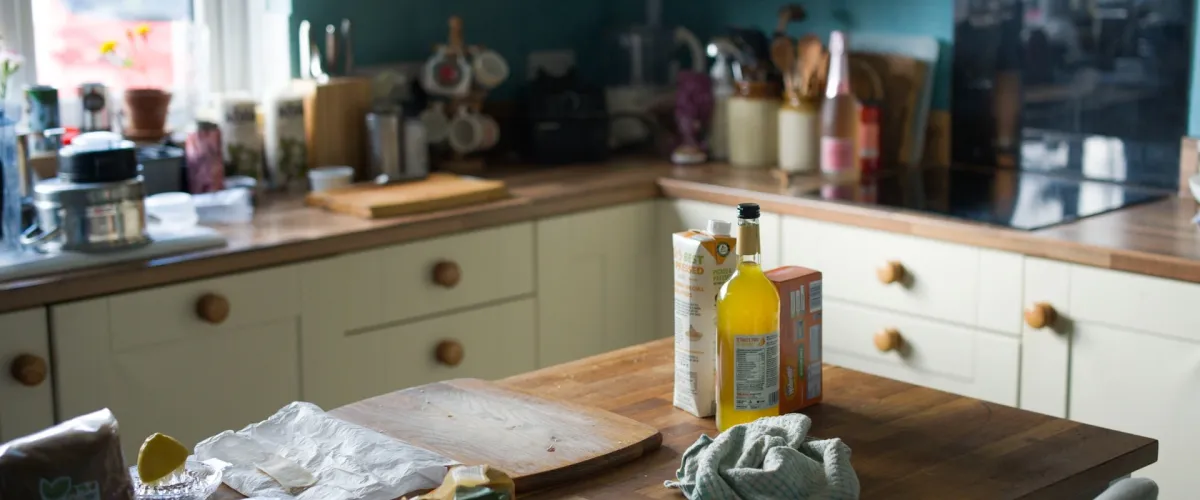
Showroom lighting is designed to make everything look good. Take samples home and test them in your actual kitchen. Place them on your base cabinets, view them under your kitchen’s lighting at different times of day, and test them against your chosen cabinet fronts and splashback. Leave the samples for several days. First impressions fade, and you want a material you still appreciate after the novelty wears off.
For granite specifically, request a sample from the actual slab that will be cut for your kitchen. Granite varies dramatically from slab to slab, and the display sample may look nothing like the stone that arrives. Reputable fabricators allow you to visit their yard and select your specific slab. For a guide on vetting fabricators and understanding the installation process, see our fitting kitchen worktops guide.
Questions to Ask Your Fabricator
Before committing to a fabricator, ask these questions:
- How many years of experience do you have with this specific material?
- Can I visit your workshop and see a worktop being cut?
- What is included in the quoted price? (Template, fabrication, delivery, installation, cutouts, edge profile, waste removal)
- What warranty do you provide on the fabrication and installation, separate from the manufacturer’s material warranty?
- Do you carry public liability insurance?
- Can I select my specific granite slab at your yard?
- What is the lead time from template to installation?
- How do you handle joins, and where will they fall in my kitchen?
A reputable fabricator will answer all of these without hesitation. If any question is deflected or dismissed, consider it a warning sign. The same vetting principles that apply to hiring bathroom fitters apply equally to kitchen worktop fabricators.
Edge Profiles for Each Material
The edge profile finishes the visual character of the worktop. Not every edge profile works with every material.
Quartz accepts all profiles. Pencil round (a gentle radius on the top edge) is the most popular in UK kitchens. Square or eased edges suit handleless designs. Ogee (a decorative S-curve) works in traditional settings. Mitred edges create a thicker visual appearance from a standard 20mm slab.
Granite also accepts all profiles, but more elaborate edges (ogee, double bullnose) suit the material’s natural character better than minimal square edges. The crystal structure of granite can cause micro-chipping on very sharp square edges over time, so a slight radius is advisable.
Porcelain and sintered stone are more limited. The thinness of the material (often 12mm or 20mm) makes elaborate profiles impractical. Mitred edges that create a 40mm or 60mm visual thickness are the standard approach. Waterfall edges, where the worktop flows vertically down the end of an island, are the signature detail.
Edge profiles typically add £10-£30 per linear metre for quartz and granite, while waterfall edges on sintered stone add £2,000-£5,000 per island depending on the material and height.
Contact us for a free, no-obligation quote on your kitchen worktop replacement or full kitchen renovation in Greater Manchester. We work with all three stone categories and can advise on the right material for your kitchen, cooking style and budget.
Frequently Asked Questions
Is quartz more expensive than granite in the UK?
Can I put hot pans directly on a quartz worktop?
How often does granite need sealing?
What is the difference between porcelain slab and sintered stone?
Which stone worktop is best for a family kitchen?
Can I select my specific granite slab?
Are sintered stone worktops worth the extra cost?
Past Projects


Get a Free Quote
Book a free, no-obligation site survey. Call us on +44 7428 653 653 or request a callback.
Book Free SurveyOur Clients' Reviews

5/5

5/5

5/5

5/5
Based on 453+ verified reviews across all platforms
Related Articles
How Much Does a New Bathroom Cost in 2026? UK Pricing Guide
What a New Bathroom Really Costs in 2026 The question every homeowner asks before a bathroom renovation is the same. How much?
view this article Read more
Bathroom Renovation Guide: Every Stage From Start to Finish
What a Bathroom Renovation Actually Involves A complete bathroom renovation is one of the most rewarding home improvement projects you can undertake, but it is also one of the most misunderstood.
view this article Read more
Bathroom Tiling Styles for Timeless Elegance
Why Layout Matters More Than the Tile Itself A bathroom tile is a raw ingredient. The layout pattern is the recipe.
view this article Read more
Ceramic Disc Technology in Bathroom Taps: How It Works
The Technology Inside Almost Every Modern Tap If your bathroom taps turn with a smooth quarter-turn rather than two and a half rotations, they contain ceramic disc cartridges.
view this article Read more
Fitting Kitchen Worktops: The Complete Installation Guide
From Order to Fitted The worktop is one of the last things fitted in a kitchen renovation and one of the first things to go wrong if the process is rushed.
view this article Read more
How to Choose an Electrical Bathroom Mirror
What an Electrical Bathroom Mirror Actually Does An electrical bathroom mirror is a permanently wired fixture that combines a mirror with integrated LED lighting, and often a demister pad, Bluetooth speakers, a shaver socket, or adjustable colour temperature.
view this article Read more
Best Bathroom and Toilet Brands in the UK
What Makes a Good Bathroom Brand The brand name on your toilet, basin or shower valve determines far more than the price tag.
view this article Read more
Bathroom Underfloor Heating: Types, Installation and What to Expect
Why Underfloor Heating Works So Well in Bathrooms Stepping onto a warm bathroom floor on a cold January morning is one of those small luxuries that, once experienced, becomes very difficult to give up.
view this article Read more
Tools Required for Bathroom Fitting: The Professional Trade Toolkit
The Professional Bathroom Fitter’s Complete Toolkit Every professional bathroom fitter knows that quality tools are an investment, not an expense. The difference between a flawless installation and a problematic one often comes down to having the right equipment for the job.
view this article Read more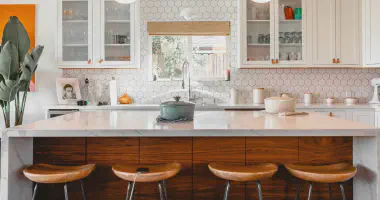
What You Need to Know Before Your Kitchen Renovation
The Gap Between Expectation and Reality A kitchen renovation is not a weekend project. The 2025 Houzz UK Kitchen Trends Study found that 71 percent of homeowners change their kitchen layout during a renovation, and the median spend rose 34 percent year on year to £17,500.
view this article Read more
Accessible Bathroom Design: UK Regulations, Grants and Guide
Why Accessible Bathroom Design Matters Around 16.8 million people in the United Kingdom have a disability. That is one in four of the population, according to the DWP Family Resources Survey 2023/24, and the figure has risen by 4.
view this article Read more
Bathroom Renovation Environmental Impact: Water, Energy and Waste
Why Your Bathroom Renovation Has a Bigger Environmental Footprint Than You Think The average person in England uses 136.5 litres of water every day, and more than two thirds of that disappears through the bathroom.
view this article Read more