
Cheap Bathroom Fitters: Understanding Hidden Costs
Why cheap bathroom fitters cost more in the long run. Red flags, hidden costs, consumer rights and how to protect your renovation investment.
The Real Price of a Cheap Bathroom Quote

An FMB survey of over 2,000 UK adults found that 37% had hired an unreliable or unqualified builder at some point. The financial damage across the country is staggering. Over a five-year period, cowboy builders cost British homeowners a collective £14.3 billion, with the average affected household losing £1,759 in wasted payments and remedial work. One in three homeowners said they had been put off renovation work entirely because of fear of hiring the wrong person.
Those numbers matter when you are searching for a bathroom fitter. The temptation to accept the cheapest quote is understandable, particularly when a mid-range bathroom renovation in Greater Manchester runs between £5,000 and £8,000. But a quote that seems too good to be true almost always is. This guide explains exactly what cheap quotes leave out, what failures look like in practice, and what legal protections exist when things go wrong.
For a complete breakdown of what bathroom renovations should cost, see our bathroom cost guide. For advice on finding and vetting reputable professionals, our bathroom fitters near me guide covers the full process.
What Cheap Quotes Actually Leave Out
A legitimate bathroom renovation quote from a professional fitter in the North West typically breaks down like this: labour accounts for 40-50% of the total, materials for 50-60%, and there are additional costs for skip hire (£150-£300), Building Regulations compliance, and VAT if the company is VAT-registered. A bathroom fitter in Manchester charges £200 to £350 per day depending on experience. Plumbers charge £200 to £300, electricians £180 to £250, and tilers £150 to £220.
When a quote comes in dramatically below these market rates, something has been omitted. The most common exclusions are the things you cannot see once the bathroom is finished.
No Tanking or Waterproofing
Tiles and grout are not waterproof. Water passes through grout joints and micro-cracks, especially in shower areas, corners, and joints. Without a proper tanking membrane applied before tiling, moisture reaches the substrate and begins destroying it from behind. Revised British Standards (BS 5385-1) recommend a tanking membrane in every wet area, and Building Regulations Approved Document C requires structures to be protected against moisture ingress.
Cheap fitters routinely skip this step because the materials cost £100 to £200 and application adds half a day to the schedule. The homeowner never knows it was missed until damp patches, mould, or lifting tiles appear twelve to eighteen months later.
Push-Fit Plumbing Instead of Soldered Copper
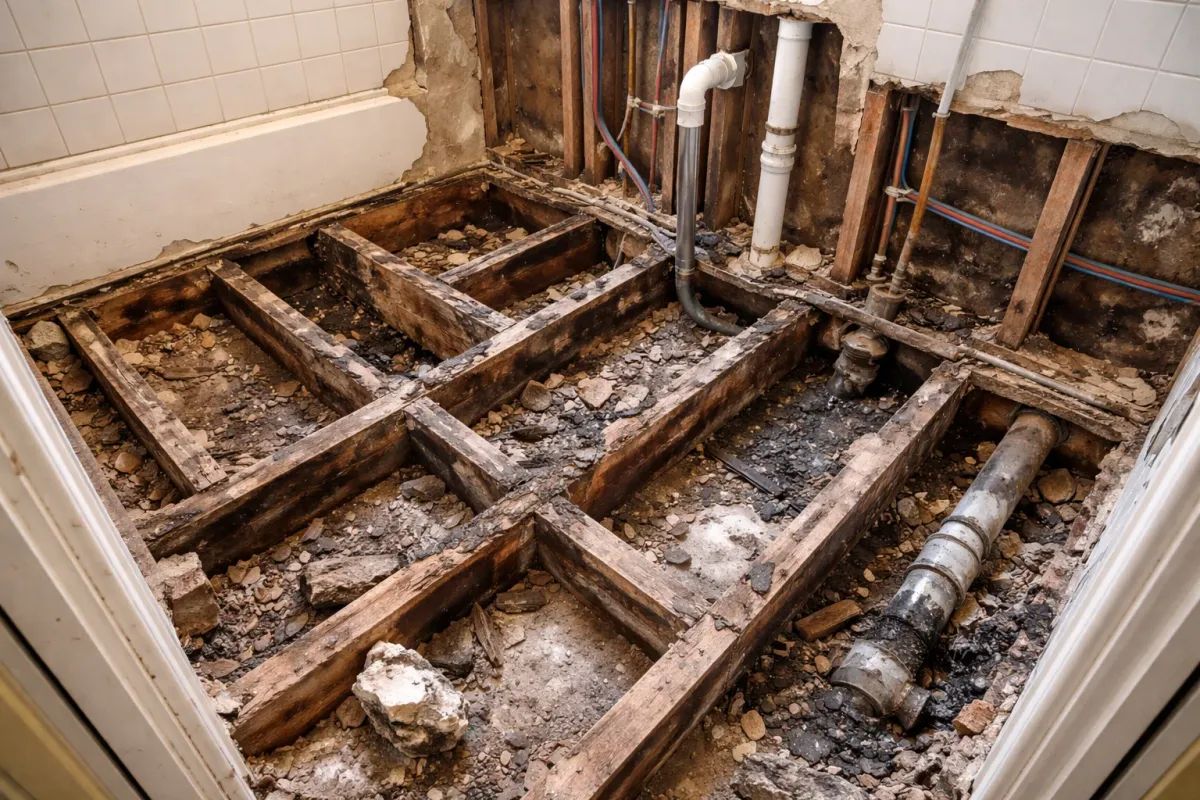
Composite push-fit fittings are faster to install than soldered copper joints. They click together in seconds rather than requiring a blowtorch, flux, and solder. That speed is exactly why budget contractors prefer them. Push-fit fittings are not inherently bad for accessible connections that can be inspected and maintained, but when buried behind tiles or under floors, they present a risk. They have a shorter lifespan than soldered joints, are more prone to working loose under water pressure fluctuations, and if they fail behind a finished wall, the repair means tearing out tiles, plasterboard, and potentially the ceiling below.
Professional fitters use soldered copper for all concealed connections and reserve push-fit for accessible service valves where future maintenance is straightforward.
No Part P Electrical Compliance
All electrical work in a bathroom must comply with Building Regulations Part P. Bathrooms are classified as “special locations” divided into zones, each with minimum IP (ingress protection) ratings for fittings. A Part P registered electrician must carry out the work and issue both an Electrical Installation Certificate and a Building Regulations Compliance Certificate on completion.
Cheap fitters sometimes handle the electrics themselves without registration, or bring in an unregistered mate. Non-compliant electrical work is illegal. It will cause problems when you sell the property, and more immediately, it is a genuine safety hazard in a room where water and electricity coexist.
Inadequate Preparation
A quality bathroom renovation begins with a full strip-out of the existing room, then moves through floor levelling, wall preparation, waterproofing, and first-fix plumbing before any visible finishing work starts. This preparation phase typically takes two to three days and represents a significant portion of the labour cost. Cheap fitters cut this short. They tile over existing surfaces, skip floor levelling, and start the “pretty work” immediately. The result looks acceptable on day one and deteriorates rapidly once moisture finds the gaps.
What Failure Actually Looks Like
The problems from a cheap bathroom installation rarely appear straight away. The first year tends to be fine. By year two, grout starts cracking. Silicone turns black with mould because it was applied to damp surfaces and cannot bond properly. Tiles lift at the edges. A faint damp smell develops. By year three, the damage behind the walls has progressed far enough that a full strip-out becomes necessary.
The cost of putting things right is almost always higher than doing the job properly in the first place.
| Remedial Work | Typical Cost |
|---|---|
| Silicone seal replacement | £60 - £120 |
| Mould removal (single wall) | £150 - £200 |
| Mould removal (full room) | £220 - £280 |
| Re-plastering bathroom walls | Up to £1,500 |
| Water damage repair (floor/ceiling below) | £2,000 - £5,000 |
| Structural damage from rot | £500 - £3,000+ |
| Complete strip-out and redo | £5,000 - £10,000+ |
In many cases of severely botched work, there is no viable shortcut. The only solution is to strip the room back to bare walls and start again. That means paying twice for the same bathroom.
Red Flags in a Bathroom Quote
Not every low quote is a scam. Some fitters are genuinely more efficient, or they work alone rather than running a large team with overheads. The trick is distinguishing a lean operation from a corner-cutting one. These warning signs help.
The quote is vague or unitemised. A professional quote breaks down labour by trade, lists materials individually, includes skip hire, specifies the timeline, and states the warranty terms. If you receive a single lump-sum figure with no detail, you have no way to know what is included and no basis for dispute if something is omitted.
Large upfront deposit demanded. A small deposit on signing (10-25%) is normal, with stage payments tied to milestones and a final retention (10-20%) held until snagging is complete. Any demand for 50% or more upfront, before work has started, is a significant red flag.
No insurance documentation. Ask to see a copy of public liability insurance. A reputable fitter carries at least £2 million of cover, which is the minimum required by BiKBBI. If the fitter is uninsured and causes damage to your property, your home insurance is unlikely to cover it. Accidental damage caused by renovation work is typically excluded from standard buildings and contents policies.
Cash-only payment. This often indicates the trader is not VAT-registered or is operating outside proper business practices. It also leaves you with no paper trail if disputes arise.
No mention of waste disposal. A 4-yard skip for a bathroom strip-out costs £150 to £300. Under the Environmental Protection Act 1990, anyone producing waste has a legal duty of care for its proper disposal. If an unlicensed carrier fly-tips your old bathroom suite, you could be held liable for fines up to £50,000.
No discussion of Building Regulations. If the fitter does not mention Part P electrical certification, waterproofing, or ventilation requirements, they either do not know about them or plan to ignore them.
No portfolio, no references, no reviews. A professional fitter with nothing to hide will happily show previous work, provide references, and point you to online reviews.
Certifications That Actually Mean Something
Anyone can legally set up as a bathroom fitter in the UK without demonstrating any proof of competence. Unlike electricians (Part P) or gas engineers (Gas Safe), there is no mandatory licensing for general building work. That makes third-party certification particularly important.
BiKBBI (British Institute of Kitchen, Bedroom & Bathroom Installation) is the only UK government-sanctioned institute dedicated to kitchen and bathroom installation. Members must carry minimum £2 million public liability insurance, hold a Basic Disclosure certificate, follow a Code of Conduct, and complete annual continuing professional development.
TrustMark is the only Government Endorsed Quality Scheme for domestic trades. Registered firms are vetted, inspected on-site, and must provide a minimum two-year guarantee on all work. TrustMark also offers deposit protection and insurance-backed guarantees for projects over £500 plus VAT.
Checkatrade runs a 12-point vetting process and blocked over 1,300 rogue applicants in 2024 alone, a 13% year-on-year increase. Rejection reasons included lack of proof of identity (31%), negative online reviews (8%), and poor trading history (5%).
Gas Safe Register is a legal requirement for any work on gas appliances. If your bathroom renovation involves moving a boiler or connecting gas-heated towel rails, the gas work must be done by a Gas Safe registered engineer.
For a detailed guide to finding and vetting bathroom professionals, see our definitive guide to hiring bathroom fitters in Manchester.
Your Legal Rights When Things Go Wrong
The Consumer Rights Act 2015 provides clear protection. Section 49 states that every contract to supply a service includes an implied term that the trader must perform it with “reasonable care and skill.” For bathroom fitting, that means following manufacturer installation instructions, complying with Building Regulations, applying proper waterproofing, achieving correct falls on shower trays, and delivering level, properly adhered tiling with complete grouting.
If the work falls below that standard, you have three remedies available by law:
- The trader must redo the inadequate element or perform the service again at no extra cost within a reasonable time.
- If repeat performance is impossible or would cause significant inconvenience, you can claim a price reduction.
- You can claim damages for losses caused by the breach, including the cost of hiring another contractor to put things right.
For claims up to £10,000, the Small Claims Court provides a straightforward route. Court fees range from £35 for claims under £300 to £455 for claims between £5,000 and £10,000. You will need photographs, the original contract or quote, all correspondence, and ideally an independent report on the defective work.
The practical difficulty is enforcement. If a cheap fitter has no registered business address, no insurance, and disappears after payment, recovering your money through legal channels becomes extremely difficult. This is precisely why vetting before hiring matters more than any remedy after the fact. Our avoiding costly renovation mistakes guide covers the most common pitfalls and how to prevent them.
What a Fair Quote Looks Like
A professional bathroom renovation in Manchester for a standard-sized room typically costs £5,000 to £8,000 for a mid-range specification. That includes a full strip-out, proper preparation, tanking, new suite, full tiling, Part P compliant electrics, and all finishing work. High-end projects with underfloor heating, natural stone, or bespoke joinery run from £10,000 to £20,000 or more. To get an idea of what your specific project might cost, use our bathroom renovation cost calculator.
The timeline for a standard bathroom renovation is four to six weeks from strip-out to completion. A fitter who promises to finish in one week is either cutting preparation steps or has not understood the scope of work.
A legitimate quote should include:
- Itemised labour costs by trade (fitter, plumber, electrician, tiler)
- Itemised material costs (suite, tiles, adhesive, waterproofing, plumbing, electrical)
- Skip hire and waste disposal
- VAT if applicable (threshold is £90,000 turnover)
- Start date and estimated completion date
- Payment schedule tied to milestones
- Warranty terms (a minimum of two years for TrustMark members)
- Public liability insurance confirmation
Get at least three quotes. If one is dramatically lower than the other two, that is not a bargain. It is a warning.
Affordable Does Not Mean Cheap
There is a genuine difference between affordable bathroom fitting and cheap bathroom fitting. An affordable renovation works within your budget by specifying sensible materials, avoiding unnecessary layout changes, and focusing the spend where it matters most. A cheap renovation cuts invisible corners to hit an artificially low price.
You can reduce bathroom renovation costs without compromising quality by keeping the existing layout (moving plumbing is expensive), choosing mid-range fixtures from reliable UK brands, and investing the savings into proper preparation and waterproofing. A well-fitted bathroom using sensible materials will last fifteen to twenty years. A cheaply fitted bathroom may need replacing in three to five. Over the lifetime of your home, quality is always cheaper.
Contact us for a free, no-obligation quote on your bathroom fitting project in Greater Manchester. We are fully insured, DBS checked, and we never ask for upfront payment.
Frequently Asked Questions
How much should a bathroom renovation cost in Manchester?
What are the biggest red flags when hiring a bathroom fitter?
What certifications should a bathroom fitter have?
What happens if a bathroom fitter does a poor job?
Should a bathroom fitter have public liability insurance?
Is it worth getting a cheap bathroom fitted to sell a house?
How long should a bathroom renovation take?
Past Projects


Get a Free Quote
Book a free, no-obligation site survey. Call us on 07428 653 653 or request a callback.
Book Free SurveyOur Clients' Reviews

5/5

5/5

5/5

5/5

5/5
Based on 453+ verified reviews across all platforms
Related Articles

Bathroom Fitter Qualifications and Accreditations: UK Guide
Why Qualifications Matter When Choosing a Bathroom Fitter
view this article Read more
Bathroom Tap Finishes: Chrome, Brass, Matt Black and Beyond
The Finish You Choose Outlasts Every Other Bathroom Decision Tiles can be re-grouted. Paint can be refreshed in a weekend. But the finish on your taps, shower valves and accessories is permanent for the life of the fitting. Choose a finish that scratches, tarnishes or shows every water spot, and you will notice it every time you wash your hands for the next decade.
view this article Read more
Top 10 Shower Mixers You Can Buy in the UK
Why Your Shower Mixer Matters The shower mixer is the heart of your shower system. A good one delivers stable temperature, consistent flow and reliable performance for years. A poor one fluctuates when someone runs a tap elsewhere in the house, dribbles at low pressure, or seizes up from limescale within a couple of years. The difference between a satisfying daily shower and a frustrating one often comes down to this single component.
view this article Read more
Bathroom Renovation Mistakes and How to Avoid Them
Why Bathroom Renovations Go Wrong Most bathroom renovations that end badly were doomed before the first tile came off the wall. The problems trace back to the planning stage, or more precisely, to planning that never happened. Budgets set without research. Drainage routes that nobody checked. Waterproofing skipped entirely. Materials picked because they looked good in a showroom, with no thought about how they handle a room full of steam.
view this article Read more
Electric Shower Not Working? Expert Troubleshooting Guide
Why Electric Showers Fail and What You Can Do About It
view this article Read more
How Small Businesses Are Being Targeted by Fake Negative Reviews
What Fake Reviews Look Like Fake negative reviews usually follow a recognisable pattern. Some common red flags include: Vague or generic complaints - Reviews that lack specific details about the service, product, or experience. No record of interaction - Businesses often cannot find any record of the reviewer being a customer. Repetitive wording - Multiple reviews using nearly identical phrasing, suggesting coordinated posting. Anonymous or newly created accounts - Reviewers with no history or with suspiciously similar profiles. Exaggerated negativity - Reviews that use overly dramatic language without providing factual information. Unrelated complaints - Sometimes a review will describe services or products the company does not even provide, making it clear the feedback was copied and pasted without relevance. No proof of purchase or invoice details - Genuine reviews often reference an invoice number, order ID, or project details, while fake ones lack any verifiable transaction information. Lack of supporting evidence - Fake reviewers rarely attach photos of completed work, receipts, or documents that back up their claims. Hidden or non-existent reviewer history - Profiles posting fake reviews often have no visible activity, or their entire history is hidden from the public. Suspicious formatting - Many fake reviews begin or end with quotation marks, a telltale sign they may have been copied from AI text generators or template-driven scripts. Unnatural posting frequency - One of the clearest signs of automated activity is the timing. Fake reviews are often placed in rigid intervals - every 30 minutes, every hour, or at the same time each day - a pattern that strongly suggests the use of bots and algorithms for automatic posting. For example, a long-standing client-focused company like Builders Squad Ltd may suddenly receive several one-star reviews from individuals who never used their services. These reviews often appear in clusters, pointing to organised campaigns rather than genuine customer dissatisfaction.
view this article Read more

Hiring Bathroom Fitters in Manchester: Costs, Process and Advice
What Manchester Homeowners Need to Know Before Hiring
view this article Read more
The Best Toilet Brands for Your Home: A UK Buyer's Guide
Choosing a Toilet Brand: What Actually Matters Selecting a toilet brand might seem less important than choosing a specific model, but the manufacturer behind your toilet determines the quality of the ceramic, the reliability of the flush mechanism, the availability of spare parts years down the line, and the level of after-sales support when something eventually needs attention. A cheap toilet from an unknown brand might look similar on day one, but the differences become apparent over months and years of daily use.
view this article Read more
Bathroom Remodelling Ideas for Greater Manchester Homeowners
Remodelling Ideas That Work for Manchester Homes Greater Manchester homes come with character. Victorian terraces in Didsbury, semi-detached houses in Prestwich, post-war estates in Salford, new builds in Trafford. Each type brings its own quirks to a bathroom renovation, from awkward plumbing routes in older properties to compact en-suites in modern developments. The ideas in this guide are drawn from projects we have completed across the region and reflect what actually works in the kinds of bathrooms Manchester homeowners live with every day.
view this article Read more
How to Replace a Shower with a Bath
Replacing a shower with a bath is an excellent way to enhance both the functionality and comfort of your bathroom, especially if you’re accommodating a growing family. This project walkthrough covers the entire process from strip-out to finished result, and applies equally to a full bathroom remodelling or a more targeted upgrade.
view this article Read more
How to Find the Best Bathroom Fitters Near You
Finding a Bathroom Fitter You Can Trust
view this article Read more