
Fitted Wardrobes and Bedroom Storage: A Complete UK Guide
Fitted wardrobes guide: compare materials, door types and UK costs. Expert advice on bespoke bedroom storage from Manchester joiners.
Why Fitted Wardrobes Are Worth the Investment

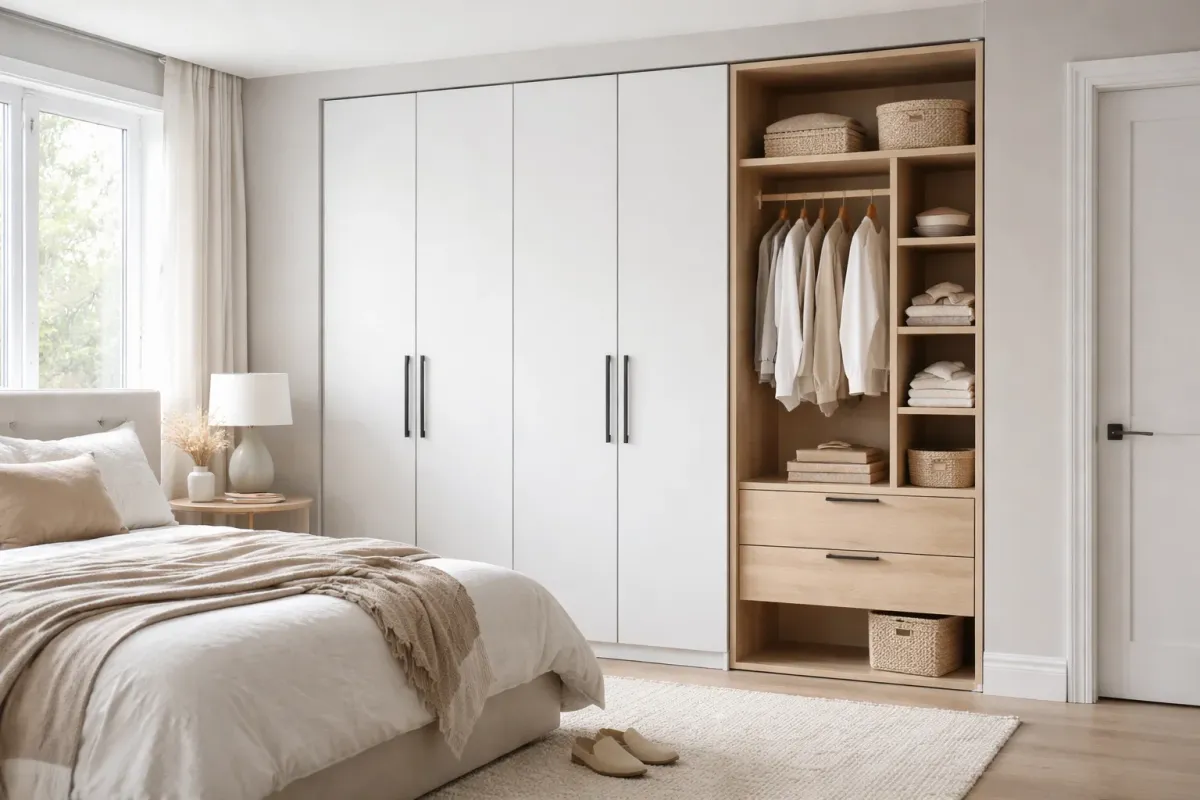
A bedroom should feel like a retreat, but clutter has a way of undermining even the most thoughtful interior scheme. Freestanding wardrobes dominate a room, leave awkward gaps against walls and waste floor space that a small bedroom simply cannot afford. Fitted wardrobes solve every one of those problems. Built to the exact dimensions of your room, they follow sloped ceilings, wrap around chimney breasts and create a seamless, built-in look that raises the perceived value of a property.
A Zoopla study of roughly 2,500 UK homes found that properties listed with built-in or walk-in wardrobes commanded significantly higher asking prices than comparable homes without them. The reasons are straightforward: buyers see fitted wardrobes as a sign of a well-maintained home, and they appreciate not having to purchase bedroom furniture after moving in. Estate agents consistently list storage as one of the features that sells a property fastest.
The practical advantages go further than resale appeal. Because a bespoke wardrobe is designed around your belongings rather than the other way round, you gain storage capacity that a standard flatpack unit cannot match. Shoes, folded knitwear, long dresses and bulky bedding each get a dedicated zone. The result is a calmer space and a faster morning routine.
For homeowners across Greater Manchester considering a broader refresh, fitted wardrobes pair naturally with a full house renovation or a professional painting and decorating project. Done together, the work is less disruptive and the finished result more cohesive.
Wardrobe Materials Compared
Material choice determines durability, appearance and budget. There is no single best option; the right pick depends on the look you want, the room conditions and how much you are prepared to spend.
Solid Hardwood
Oak, walnut and ash remain the gold standard for fitted wardrobes. Hardwood is exceptionally strong, develops character over time and can be sanded and refinished decades after installation. A well-built oak wardrobe will outlast the house itself. Supply costs for oak run from £600 to £800 per wardrobe before labour, with finished bespoke projects in solid timber starting around £1,200 per linear metre.
The trade-off is weight and cost. Hardwood demands robust fixings and a competent installer, particularly on lath-and-plaster walls where standard plugs may pull out. It is also susceptible to seasonal movement; wood expands in humid conditions and contracts when the heating is on. A skilled joiner accounts for this by incorporating expansion gaps into the design.
MDF and Veneered MDF
Medium-density fibreboard is the workhorse of the fitted furniture industry. It machines cleanly, takes paint beautifully and does not warp or split the way solid timber sometimes can. For wardrobes with a spray-painted finish in any RAL colour, MDF is hard to beat. Veneered MDF offers the visual warmth of real wood on the surface while keeping costs lower and the panel dimensionally stable. An 18mm moisture-resistant MDF sheet (2440 x 1220 mm) costs roughly £33 at trade pricing.
The main weakness is moisture. Standard MDF swells when exposed to water, so it is a poor choice for damp rooms. Moisture-resistant MDF (often dyed green at the core, classified as MDF.H Option 1 under EN 622) is available for higher-risk locations. MEDITE MR and Kronospan MR are the most widely used boards in the UK market. For most bedrooms the standard board performs perfectly well. The same principle applies to kitchen worktops and bathroom vanity units, where moisture-resistant panels are essential rather than optional.
Birch Plywood
Birch plywood sits between MDF and solid wood in both price and performance. It is lighter than hardwood yet stronger than MDF, and its layered construction resists warping. Exposed plywood edges have become a design feature in contemporary interiors, which makes it popular for open shelving and walk-in wardrobe systems. A sheet of 18 mm BB/BB birch plywood (the furniture-grade standard with smooth faces and minimal knots) costs £77 to £139, roughly double pre-2020 prices.
The downside is finish. Plywood surfaces can be inconsistent, and achieving a flawless painted result requires more preparation than MDF. It is best suited to projects where a natural or stained finish is the goal.
Melamine-Faced Chipboard
Budget-friendly and available in hundreds of colours and woodgrain patterns, melamine-faced chipboard (MFC) is the material most national fitted wardrobe companies use. Egger’s Eurodekor range alone offers over 250 finishes. MFC is pre-finished, scratch-resistant, easy to clean and 100 per cent recyclable. Each 18 mm Eurodekor panel sequesters roughly 103 kg of CO2 equivalent, making it a surprisingly strong choice from a sustainability perspective.
Chipboard is, however, the weakest structural option. Shelves spanning more than 800 mm can sag over time under heavy loads, and the board does not hold screw fixings as securely as plywood or hardwood. For wardrobes that will see heavy daily use, reinforcing shelves with solid timber lipping or choosing a thicker board (25 mm rather than 18 mm) helps mitigate these issues.
Material Cost Comparison
| Material | Cost per Linear Metre (installed) | Best For |
|---|---|---|
| Melamine-faced chipboard | £530–£770 | Budget projects, rental properties |
| Painted MDF | £650–£900 | Spray-painted finishes, modern interiors |
| Veneered MDF/plywood | £800–£1,400 | Natural wood look without solid timber cost |
| Solid hardwood (oak) | £1,200+ | Premium quality, period properties |
When specifying any engineered board, ask about formaldehyde emissions. E1 is the legal minimum in the UK and EU. E0 boards emit less than half the formaldehyde and are worth requesting for bedrooms where you spend eight hours a night breathing the air. FSC or PEFC chain-of-custody certification confirms that the timber was sourced from responsibly managed forests.
Door Types: Hinged, Sliding and Bi-Fold
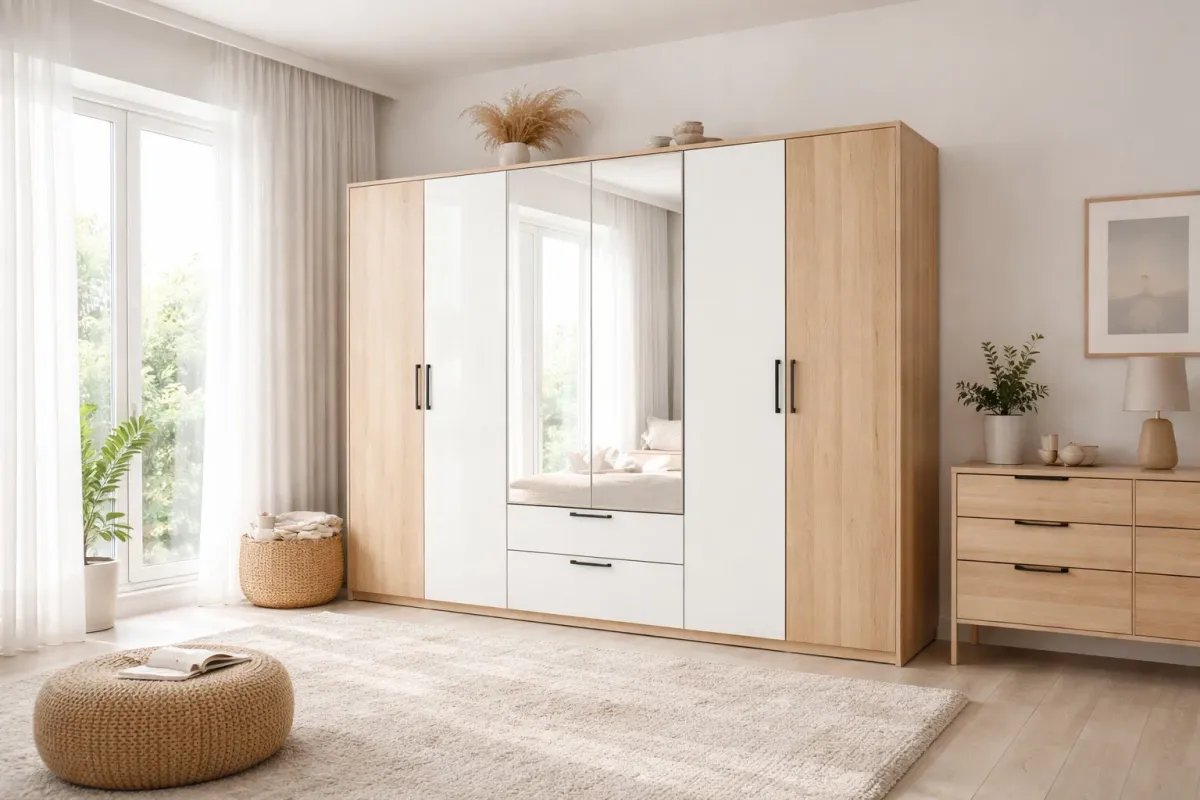
The choice between door types affects clearance, cost and the overall feel of the room.
Hinged Doors
Hinged doors are the traditional option and still the most common in UK fitted wardrobes. They open fully, giving unobstructed access to the entire interior at once, which makes organising and reaching items straightforward. Modern installations use soft-close hinges as standard. Blum’s CLIP top BLUMOTION range, widely used by UK joiners, integrates the soft-close mechanism directly into the hinge cup and offers three-dimensional cam adjustment for precise door alignment.
The requirement is clearance. Each door needs roughly 900 mm to 1,200 mm of clear floor space in front to swing open without hitting the bed, a radiator or another piece of furniture. In a generously sized bedroom this is rarely a problem; in a compact room it can be a dealbreaker.
Sliding Doors
Sliding doors save space because they run on tracks parallel to the wardrobe face. They suit tight bedrooms, loft conversions and children’s rooms where a swinging door might be in the way. Full-height mirror panels are a popular option that makes a small room feel larger, and modern track systems with soft-close runners operate almost silently.
The compromise is access. At any given moment you can only reach roughly half the wardrobe interior, which can be frustrating if you need to compare outfits side by side. Sliding door mechanisms add roughly £450 to the cost of a three-door wardrobe compared with hinged hardware. Track systems come in two main types: top-hung (where the door weight is carried from an overhead rail, leaving the floor clear) and bottom-rolling (where a floor-mounted channel carries the weight, better suited to very heavy doors).
Bi-Fold Doors
Bi-fold doors fold back on themselves, offering wider openings than sliders while needing less clearance than a standard hinge. Hettich’s WingLine L system is a well-regarded option in the UK market, available in both handleless push-to-open and traditional pull-to-open configurations. Bi-fold doors work particularly well on wider wardrobes where four or more panels would otherwise be needed, and they give a near-panoramic view of the interior when fully open.
Planning Your Wardrobe Interior
The exterior gets the attention, but the interior is where a fitted wardrobe earns its keep. A well-planned layout accommodates everything you own and adapts to seasonal changes.
Hanging rails should be split between full-length and double-height sections. Full-length hanging suits dresses, coats and long garments. Double-height rails, stacked one above the other, effectively double the hanging capacity for shirts, blazers and folded trousers on hangers. Most people need roughly 60 per cent short hanging and 40 per cent long, but a joiner can adjust the ratio to match your actual wardrobe.
Shelving works best at the top of the unit for items used less frequently, such as suitcases and spare bedding. Adjustable shelves on shelf pins allow you to reconfigure spacing as your storage needs change. Fixed shelves are stronger but less flexible.
Drawers built into a fitted wardrobe remove the need for a separate chest of drawers, freeing floor space. Internal drawers with soft-close runners are ideal for underwear, socks and accessories. Blum’s Tandembox system, with a dynamic carrying capacity of up to 65 kg, is the benchmark for fitted furniture drawers in the UK. Pull-out trouser racks, tie holders and vertical shoe racks are useful additions in a dressing area.
Shoe storage is often overlooked. Angled shoe racks at the base of the wardrobe, or pull-out shoe drawers, keep pairs visible and off the floor. Allow roughly 250 mm of depth per row.
Lighting transforms the experience of using a wardrobe. LED strip lights triggered by a door-activated sensor illuminate the interior without adding heat, and they consume very little energy. Warm white (around 3000K) is flattering to clothes and avoids the clinical feel of cool white. Budget £100 to £300 for a well-designed LED lighting package.
What Fitted Wardrobes Cost in the UK
Fitted wardrobe pricing varies enormously depending on material, size and internal configuration. Checkatrade data for 2026 places the average custom-built two-section wardrobe at around £3,400, with the full market ranging from £1,500 to £7,000 and above for premium installations.
| Configuration | Materials | Labour | Typical Total |
|---|---|---|---|
| 2-door hinged, basic | £800 | £300 | £1,100 |
| 2-door with shelves and rails | £1,000 | £400 | £1,400 |
| 3-door hinged, basic | £1,200 | £600 | £1,800 |
| 3-door with sliding doors | £1,400 | £600 | £2,000 |
| 4-door with full internals | £1,800 | £1,000 | £2,800 |
| Walk-in wardrobe/dressing room | £3,500–£10,000 | £1,500–£5,000 | £5,500–£15,000 |
Carpenter day rates for wardrobe installation average £270 nationally according to Checkatrade, though rates in the North West typically sit below the national average. LED lighting adds £100 to £300, soft-close hinges £20 to £50 per door, and mirrored or glass door panels £250 to £800 per door. Removal of an existing wardrobe runs £100 to £300 depending on size and whether skip hire is needed.
For context on how wardrobe costs fit into a larger project budget, our guide to what a new bathroom costs uses the same Checkatrade methodology for an adjacent room.
Victorian and Period Property Considerations
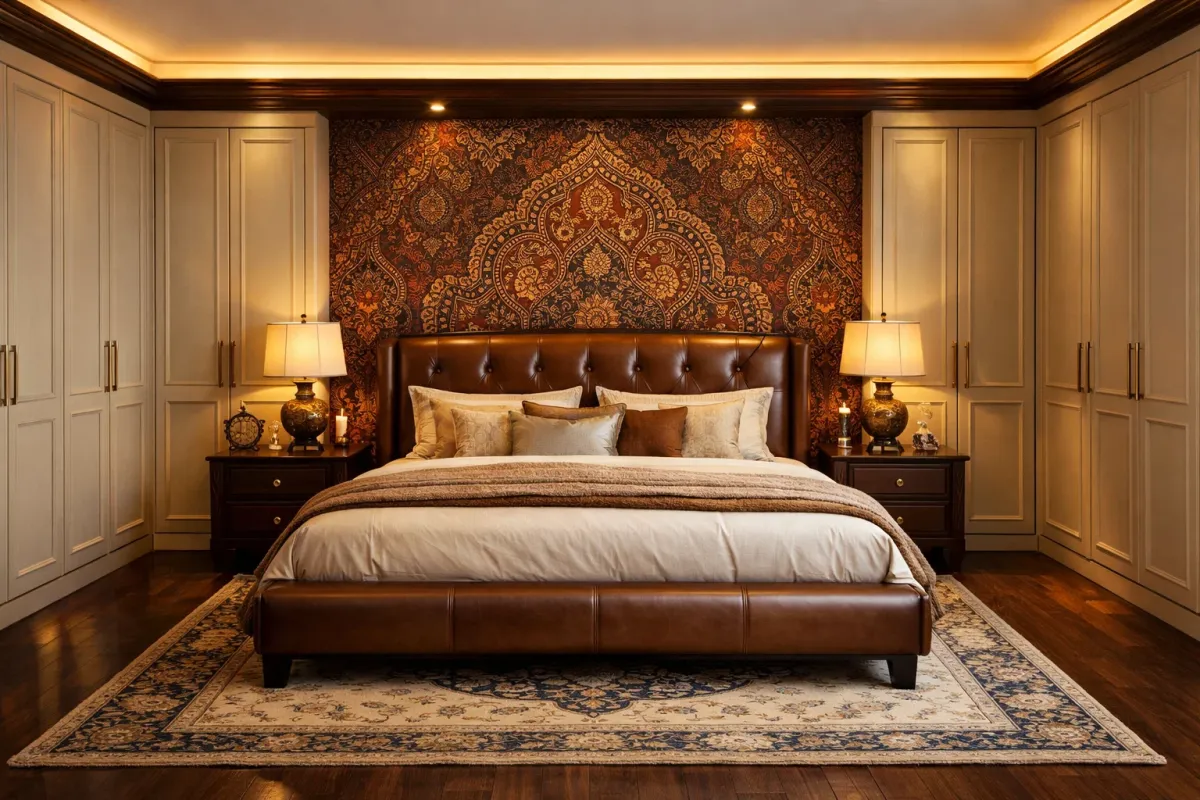
The age and construction of your home often dictates how a fitted wardrobe project should be approached. Greater Manchester’s housing stock is dominated by Victorian terraces and 1930s semis, both of which present specific challenges.
Uneven walls and floors. Period properties frequently have walls that are not plumb and floors that are not level. A modular flatpack system will quickly go out of true in these conditions, with doors dropping and drawers refusing to close properly. Bespoke joinery, with scribing strips and filler pieces cut to accommodate the irregularities, is the only reliable approach. A good joiner measures each wall independently rather than assuming symmetry.
Lath and plaster. Standard plug-and-screw fixings can pull out of lath-and-plaster walls. The joiner needs to find the underlying timber framework (studs or noggings) for load-bearing fixings, or use toggle bolts where studs are not available. This is one reason a proper site survey matters far more in a Victorian property than in a modern plasterboard home.
Chimney breast alcoves. One of the most popular locations for fitted wardrobes in Victorian properties. Alcoves flanking a chimney breast are typically around 570 mm deep, which is sufficient for hanging space. The section across the chimney breast face is shallower (around 450 mm) and better suited to shelves and drawers. Three main design approaches work here: wardrobes in the alcoves only with the chimney breast left visible, full-width sliding doors across the entire wall that conceal the chimney, or a combination of the two.
Ventilation behind wardrobes. This is the issue most often overlooked and the one most likely to cause problems. A wardrobe pressed tightly against a cold external wall traps stale air. That air cools, moisture condenses, and mould grows on the concealed wall surface. The solution is a ventilation gap of at least 50 mm between the wardrobe back panel and the wall, with openings at the top and bottom to allow free convection of air. Some joiners omit the back panel entirely on external walls, using wire baskets rather than solid shelving where the wardrobe meets the wall. In period properties where bedroom damp proofing has not been addressed, fitting a wardrobe against an external wall without ventilation is asking for trouble.
The Fitting Process
A professional fitted wardrobe project follows a clear sequence, from initial conversation to the final handle being screwed into place.
The process begins with a site survey. A joiner visits the property, takes precise measurements and discusses your storage requirements, preferred materials and budget. Walls in older Manchester properties are rarely perfectly plumb, so accurate templating at this stage prevents costly errors later. The survey typically takes 30 to 60 minutes and is free of charge.
Next comes the design phase. Using the measurements, the joiner produces detailed drawings or 3D renders showing the external appearance and internal configuration. This is your chance to adjust shelf heights, request additional drawers or change the door style before manufacture begins. Revisions at this stage cost nothing; revisions after panels are cut cost a great deal.
Manufacture takes place off-site. Panels are cut, edged, drilled and, where applicable, painted or lacquered. Lead times depend on the company: national brands like Sharps typically deliver in four to six weeks, while Hammonds and John Lewis fitted bedrooms quote six to eight weeks. An independent joiner may be quicker or slower depending on their workload, with two to eight weeks being the typical range.
Installation is the quickest part. A straightforward two-door wardrobe can be fitted in one to two days. A standard three-door takes two to four days. Larger configurations with full internals, sliding doors or walk-in layouts may need a week or more. Where walls need making good before the wardrobe goes in, plastering is completed first and allowed to dry fully before any panels are fixed against the surface. Our joinery and carpentry team handles every stage in-house, which means one point of contact from survey through to snagging.
The 2025 Which? survey of nearly 2,800 fitted furniture buyers found that 86 per cent waited less than two months from order to installation, and only 20 per cent experienced any issues during fitting. The most common complaint, reported by 9 per cent of respondents, was the installation taking longer than originally planned.
Built-In Storage Beyond the Bedroom
The same construction techniques that produce a fitted wardrobe can solve storage challenges elsewhere in the house. Alcove cabinets flanking a chimney breast in a living room combine display shelving above with concealed cupboards below. They make use of space that would otherwise sit empty and give the room a finished, architectural quality.
Under-stairs storage is another area ripe for bespoke joinery. Pull-out drawers, coat hooks and shoe racks can turn a neglected cupboard into a highly functional boot room, and the doors can be designed to sit flush with the surrounding wall. The same principle applies to home renovations where a coherent storage plan, designed at the outset, avoids the need to retrofit piecemeal solutions later.
Media units, window seats with lift-up lids, and home office desks built into spare bedrooms all fall under the same umbrella. A garage conversion is another project where fitted storage makes a real difference, turning an empty shell into a functional bedroom, office or utility room with built-in wardrobes and shelving designed to the space. The same professional tradespeople who sequence a kitchen installation can manage a bedroom joinery project with the same discipline.
Frequently Asked Questions
How much do fitted wardrobes cost in the UK?
How long does it take to fit a wardrobe?
Can fitted wardrobes be installed under a sloped ceiling?
What is the best material for fitted wardrobes?
Do fitted wardrobes add value to a house?
Should I choose sliding or hinged wardrobe doors?
Can I keep my fitted wardrobes if I move house?
Should I get fitted wardrobes before or after decorating?
Do I need planning permission for fitted wardrobes?
How do I prevent damp behind fitted wardrobes?
Past Projects


Get a Free Quote
Book a free, no-obligation site survey. Call us on +44 7428 653 653 or request a callback.
Book Free SurveyOur Clients' Reviews

5/5

5/5

5/5

5/5
Based on 453+ verified reviews across all platforms
Related Articles
How Much Does a New Bathroom Cost in 2026? UK Pricing Guide
What a New Bathroom Really Costs in 2026 The question every homeowner asks before a bathroom renovation is the same. How much?
view this article Read more
Bathroom Renovation Guide: Every Stage From Start to Finish
What a Bathroom Renovation Actually Involves A complete bathroom renovation is one of the most rewarding home improvement projects you can undertake, but it is also one of the most misunderstood.
view this article Read more
Bathroom Tiling Styles for Timeless Elegance
Why Layout Matters More Than the Tile Itself A bathroom tile is a raw ingredient. The layout pattern is the recipe.
view this article Read more
Quartz, Granite or Porcelain Worktops: Which Suits Your Kitchen?
The Three-Way Decision Most Kitchen Renovations Come Down To Once you have decided that laminate is not enough and solid wood is not right for your cooking habits, the conversation narrows quickly.
view this article Read more
Ceramic Disc Technology in Bathroom Taps: How It Works
The Technology Inside Almost Every Modern Tap If your bathroom taps turn with a smooth quarter-turn rather than two and a half rotations, they contain ceramic disc cartridges.
view this article Read more
Fitting Kitchen Worktops: The Complete Installation Guide
From Order to Fitted The worktop is one of the last things fitted in a kitchen renovation and one of the first things to go wrong if the process is rushed.
view this article Read more
How to Choose an Electrical Bathroom Mirror
What an Electrical Bathroom Mirror Actually Does An electrical bathroom mirror is a permanently wired fixture that combines a mirror with integrated LED lighting, and often a demister pad, Bluetooth speakers, a shaver socket, or adjustable colour temperature.
view this article Read more
Best Bathroom and Toilet Brands in the UK
What Makes a Good Bathroom Brand The brand name on your toilet, basin or shower valve determines far more than the price tag.
view this article Read more
Bathroom Underfloor Heating: Types, Installation and What to Expect
Why Underfloor Heating Works So Well in Bathrooms Stepping onto a warm bathroom floor on a cold January morning is one of those small luxuries that, once experienced, becomes very difficult to give up.
view this article Read more
Tools Required for Bathroom Fitting: The Professional Trade Toolkit
The Professional Bathroom Fitter’s Complete Toolkit Every professional bathroom fitter knows that quality tools are an investment, not an expense. The difference between a flawless installation and a problematic one often comes down to having the right equipment for the job.
view this article Read more
What You Need to Know Before Your Kitchen Renovation
The Gap Between Expectation and Reality A kitchen renovation is not a weekend project. The 2025 Houzz UK Kitchen Trends Study found that 71 percent of homeowners change their kitchen layout during a renovation, and the median spend rose 34 percent year on year to £17,500.
view this article Read more
Accessible Bathroom Design: UK Regulations, Grants and Guide
Why Accessible Bathroom Design Matters Around 16.8 million people in the United Kingdom have a disability. That is one in four of the population, according to the DWP Family Resources Survey 2023/24, and the figure has risen by 4.
view this article Read more